



“It’s the contest everyone wants to lose,” Dan Rather can be heard saying on the CBS Evening News circa 1982 in “To Use a Mountain,” referring to the 77,000 tons of waste produced by the U.S. that becomes a not-so-grand prize following the passage of the Nuclear Waste Act, setting off a search for a state that will accept it. The process would ultimately take two decades, leading to a planned repository in Yucca Mountain, Nevada not far from where tests were conducted for the atomic bomb amongst a community well aware that no matter how deep the radioactive material was buried, its effects were bound to rise to the surface, and skeptical for other reasons when the designated area sat on the ancestral home of the Western Shoshone and Paiute tribes.
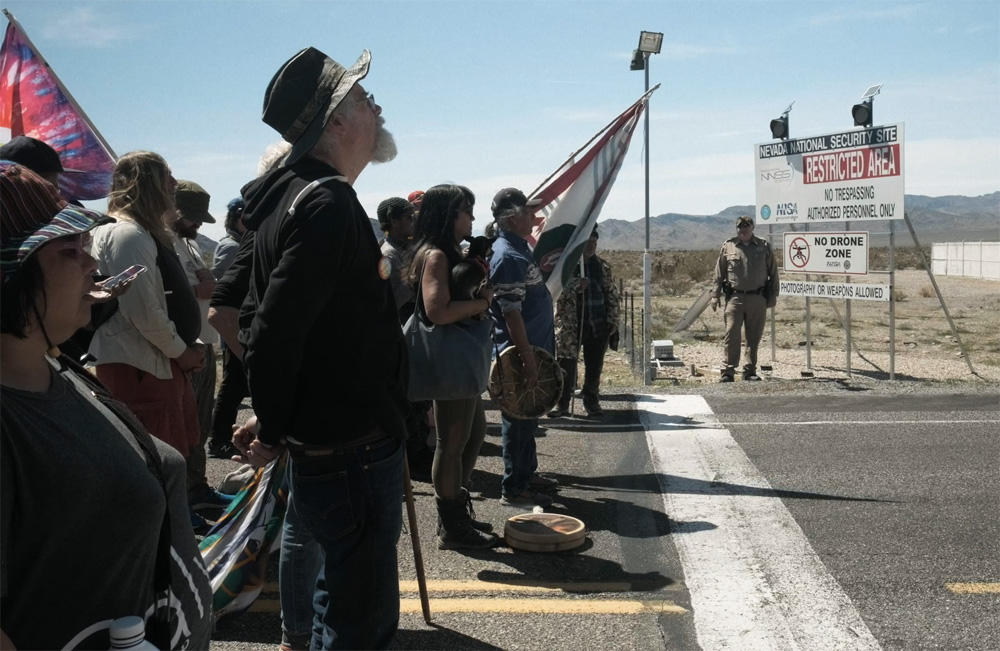
Protests continue to greet federal workers on the site where there is a renewed push from the Trump Administration to get the nuclear dump up and running after construction had been abandoned during the Obama Administration, but Casey Carter finds a contemporary story in other ways while largely digging into the documentation surrounding the search for a proper disposal site. Inventively turning a paper trail into flesh and blood, the first-time director visits the six locations across the U.S. that were tabbed as initial possibilities, revealing unsettling truths about the country beyond what environmental impact a decision is bound to have on the land as certain communities are clearly designated to be left behind. In Heflin, Louisiana, Carter finds residents already abandoned once as the mill that once supplied jobs to locals and made it a sustainable town had shut down, leaving nothing but hunting and church to pass the time, while in Richton, Mississippi, a predominantly Black enclave that faces a further erosion of the promise they were made after the Civil War when land that was given to their ancestors to start anew after slavery now threatens to be poisoned by nuclear waste if their area was selected.
Carter not only removes the indifference that can come from statistics and projected outcomes by putting a face to those who might’ve been forced to reside by a toxic waste dump, but to also show the toll resistance takes as the time since some of the most heated battles over the proposed site has clearly drained the energy of some who were willing to put up a fight and simply disheartened others who have to contend with being looked upon as second-class citizens, even when making a enormous contribution to society as farmers or stewards of the land in other ways. Although the process of elimination ultimately narrowed down to the remote Yucca Mountain, Carter shows that the effects touch everyone and remain to this day and after traveling the festival circuit since premiering at Visions du Reel last year, “To Use a Mountain” is now headed to theaters in general release and the director generously took the time to talk about why it was worth revisiting what may seem like an arcane piece of legislation, what it was like to come into contact himself with the people who already had been so deeply affected by it and making the archival materials he had at his disposal really come alive.
 How did you get interested in this?
It goes back to my childhood in East Tennessee, although I wasn’t so much aware of it at that point in time. I grew up not too far from one of the country’s first national nuclear laboratories in Oak Ridge and also in the town where I live nearby, Kingsport, the economic backbone of the town has always been Eastman Chemical Company, which was also involved in the earliest nuclear industrial activities like the Manhattan Project, co-managing things at Oak Ridge. But the real seed for the film came much later when I was doing some research on Yucca Mountain, which was the site that was ultimately selected for this geologic nuclear waste repository. I was looking into all of these government documents and I came across all of these reports that the Department of Energy had produced on the other candidate sites that I had never heard of.
Of course, if I had lived through it in the 1980s, I might have been aware, but in this day and age, if anybody knows anything about this issue of nuclear waste and nuclear waste storage, they probably have heard about Yucca Mountain because it’s been a very controversial project for the last number of decades and the idea for the film came from this discovery of these other places that were also under consideration and the recognition of this national project of searching across the country for the one place that would become this sacrificial lamb.
In these documents, there were hundreds of pages of statistics and maps of each of these places and text characterizing them in every way you can imagine, except through some sort of human dimension, and the idea for the film was really the question of what is that human dimension. What do we learn when we put these two ways of seeing a place side by side — this way of representing a place for its hypothetical utilitarian value from this point of view of this national project of what to do with nuclear waste and then the point of view of actually engaging with a community and [their] history and identity. Then of course learning about this issue of nuclear waste is core to the to the film as well.
Originally, I understand you might’ve been considering developing this as a photo project. What made it a film in your mind?
When I first was doing this research and learned about all these other candidate sites, it was a number of years before I ever began making the film. In fact, it was a few years before I ever tried to make any film and I had been a photographer for many years at that point in time. I thought this could be a really interesting photographic survey of some sort with landscape portraiture in comparison with archival materials from these documents. I think you get that same sensibility in the film, but of course, you can really tell much more of a story in a documentary film and you can get inside of people’s emotional worlds in a way that you can’t really access through photography So fast forward a few years after I had a few short films under my belt and I was like, “Okay, I think this is a film. Let’s let’s see what’s out there.”
As you were visiting the communities, was it a common story you were hearing or something you realized in the edit you could weave together pretty seamlessly?
Both because it definitely has that way of moving you forward through time, especially in relation to the consequences of the nuclear program and nuclear weapons development because as we move through these candidate sites beginning with the the sites that were eliminated from consideration first until the selection of Yucca Mountain, we’re also moving through this procession of sites that have a deeper and ongoing engagement with the U. S. nuclear program, including the Hanford Nuclear Reservation in Washington and what is now known as the Nevada National Security Site in southern Nevada where Yucca Mountain is located. So there was this opportunity to take this very systematic structure that mirrors the idea of just looking at each one of these places and to have that structure lead us deeper and deeper through time, beginning with this initial moment with the passage of the Nuclear Waste Policy Act in 1982 with the the images of Ronald Reagan near the beginning of the film. and then to move across the country and move into the present day and wind up in this place where we realize that this issue is not something that has been resolved. It is something that people are still dealing with in these frontline communities in very concrete and enduring ways.
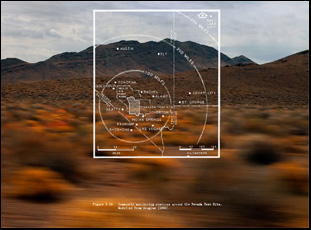 The documents become a very lively part of the film — as mention about Reagan, I loved the idea that the applause for him signing the bill into law becomes this barrage of documents. How did the style for the film come about?
Yeah, I love that detail. The idea of creating some novel and cinematic experience with these static maps and text from these environmental assessment reports produced by the Department of Energy was part of the initial seed of the film and I was working with a colleague and friend, Magdalena Orellana, who did the majority of the animation in the film. The process of making this involved a lot of iteration, a lot of grant writing, a lot of editing samples here and there and pushing things forward piece by piece. What exists in the final form of the film is much more articulated and specific, but even in the very first sample that I used for the earliest grant applications back in 2019, it had traces of these visual experiments — animations, textural things with the documents to try and create this atmosphere and understand the visual language and juxtaposition between the landscape and portraits of these communities and then the encounter and immersion into this world of the documents.
Was there anything that changed your ideas of what this was as you were working through it?
Part of what’s so interesting to me about documentary in general is it’s always a process of discovery through the act of creating the film because you don’t write it in advance. You’re learning every step of the way and you’re recalibrating what your approach is. With this film, the overarching approach stayed remarkably consistent because it was a structural approach and it left space to within each part of the film to discover how this piece of the film would would manifest itself and what it would be filled with and how it would relate to other parts of the film.
For example, the scene that opens the film in Louisiana with boar hunting, on the first trip that I took for the film, we spent just two days in Louisiana and talked to a few men there and they talked about how the the forests where the Department of Energy was planning to locate this facility is basically the place where they they hunt deer on boar and how boar had really increased the population there in recent decades. It’s an invasive species in the area and they hunt for food, they hunt for sport, and they also hunt to control the population. And I [thought], “We have to got to figure out a way to film with these guys hunting in these woods.” Finally six years later, I was able to do that and not only film the hunting but for it to be this father and son experience in the landscape, and to establish that theme that runs throughout the whole film of these intergenerational relationships.
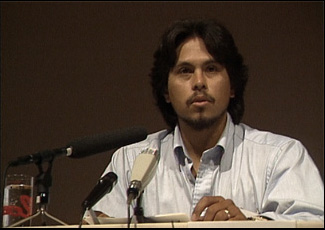 What’s it been like so far engaging with audiences?
It’s been so rewarding and an interesting extension of the process of making the film itself. Making the film was such a journey and existed in so many different places across the country and was made up of many different relationships and encounters. Traveling with the film and engaging with audiences has a remarkably similar feeling, especially across the United States to these communities where they have a deep relationship with these issues. For example, the the film is screening tonight in Boulder, Colorado, very near the old Rocky Flats Plutonium Pit production facility that was shut down some years ago, but the community here has an enduring and very conflicted relationship with the history of the U.S. nuclear program as a result. The film obviously resonates with with those folks and with many other people for for other reasons as well. Over the years of making the film, visiting one community and another, coming back multiple times, I began relaying the stories from one place to another place in conversations with people as I was shooting and that began to create this feeling of some sort of narrative solidarity, coming together across all of these places.
“To Use a Mountain” opens on August 21st in New York at the DCTV Firehouse.