



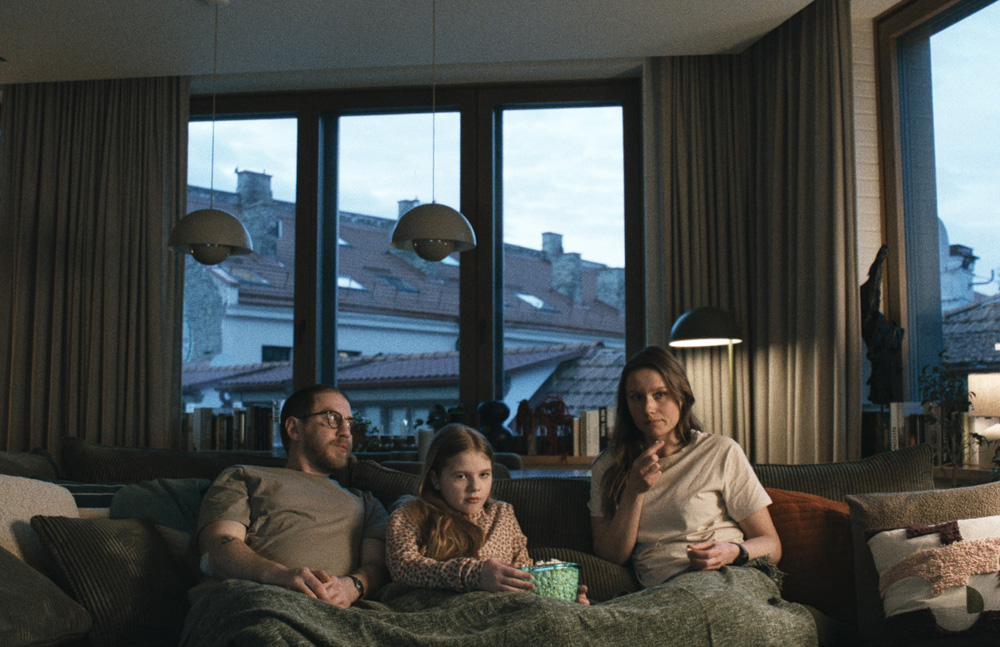

Only a day after she brings up the prospect of separating from Vytas (Marius Repšys), her husband of 11 years, Marija (Žygimantė Elena Jakštaitė) starts to regret it in “How to Divorce During the War.” Not because she is any less frustrated with the state of her union, having success at work because of her strong motivation unlike the aimless writer she married who she thought would give her an adventurous life, and she is only slightly more concerned about the impact a separation will have on their young daughter Dovile when she already senses her constant anger at Vytas has prevented her from being the mother she could be, but rather that the timing is inopportune for the Lithuanian family that lives just close enough to Ukraine that the Russian invasion that just began puts a chill in the air even if the aggression doesn’t spill over the border.
The backdrop of an international conflict becomes both a clever setting and a strong metaphor for what goes on in the foreground of Andrius Blaževičius’ darkly comic drama, which unfolds over the first year of the war in Ukraine and as civilians carry on under the constant threat of violence, unable to fathom an alternative, Marija and Vytas remain in touch for the sake of their child yet have trouble standing in the same room with one another. Often filmed at a chilly remove during generally downcast weather in carefully crafted still frames, the sparks nonetheless fly inside of them as the couple attempts to reimagine their lives separate from one another with limited success when Marija’s meteoric rise at the viral content company she works for is stunted by the sudden complications posed by having other offices in Russia and Ukraine to be mindful of and Vytas, who long found purpose in handling domestic duties while his wife was away at work, is thrust back into creative work he tried to avoid by cleaning the house, eventually landing on well-intentioned but questionably executed performance art to protest the war.
The couple clearly would be better served by weathering the tough times together even if the ultimate goal remained to part given the volatility going on around them, yet any compromise seems off the table with their stubborn pride and the engagement they do have in conflict becomes oddly comfortable as they become accustomed to it as part of their routine, making a healthy resolution even more difficult. It’s a tonal tightrope walk that Blaževičius and his cast pulls off brilliantly, seemingly working towards the film since bursting onto the director’s debut feature “The Saint” when not only has there been a refinement of the filmmaker’s distinctive seriocomic sensibilities, but Jakštaitė and Repšys have been along for the ride, retaining the same name in each of the films even if the roles they’re playing are vastly different. (One is left to wonder whether the heavy tattoos that adorned Jakštaitė in “Runner,” a high-energy romp through the streets of Vilinus, are hiding underneath the business attire she wears when both are named Marija, just as the scholar Repšys played in “The Saint” might or might not be the frustrated artist that appears in his latest.)
Still, “How to Divorce During the War” is bound to be an introduction for many to this exciting new auteur after the film picked up the Grand Jury Prize for World Cinema this year at Sundance and was subsequently selected as Lithuania’s official entry to this year’s Oscars, and with its U.S. theatrical release starting this week at the IFC Center in New York, Blaževičius took the time to talk about how he saw a parallel in conflicts with no easy resolution, how the lines between reality and fiction blurred when Vytas’ performance pieces really took place in the public eye and working on the film’s eerie, eclectic score.
 How did this come about?
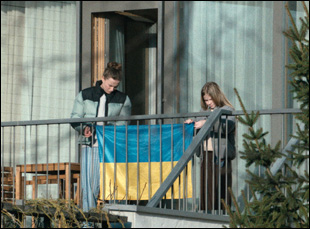
I was really thinking a lot about the theme of divorce because I got separated and there are people in my circles who are divorcing or separating and when I would read the internet or listen to podcasts, very often I found that people were speaking like there weren’t enough films about divorce. It should be more when half of people, like every second couple is divorcing. Then the war started in Ukraine and what I noticed were the many divisions in a society because there was some in Lithuania who were supporting the war and the majority was supporting Ukraine and there was also COVID, which again triggered many different opinions in society and when the war started, COVID just disappeared from the news and this separation in the family and in society somehow blended [in my mind] seamlessly. I was noticing things during the war really impacting lives of Lithuanians and we are not at war, but we’re just so close. How I was feeling, I remember for the first weeks of the war, was so strong that I just felt that I needed to do something with it. And then I did.
It was interesting formally to see this film next to “Runner,” which true to its title was constantly on the move with a lot of shifting camerawork, and this is almost the complete opposite with intricate blocking and stillness.
Actually when I was writing it, I wasn’t thinking too much about the style, but little by little, towards the end of the whole writing process, I started to think about how it should be shot and we had this test scene that we had to do to find financial support. So we did it in this classical way — it was this divorce scene in a car — and I had this master [shot] then I go to close ups. And somehow I had this feeling that something wasn’t working because when I read the scene, it’s interesting, but the way we did it in the test scene, it wasn’t. And then I was trying to figure out this observational style in a way, which was very good for this story because I think this distance from characters gives the audience the space to think about what’s happening and you are the one who creates meaning. From the screenings I had at the festivals already, I found that some people really relate to Maria. Some people hate Maria. Some people hate Vytas. Some people love Vytas. And it was very interesting how this space between the camera and the characters gives the audience the space to think about. We have the saying that if you want to understand yourself, you need to observe it from the distance, so I approached this film in this way.
 From your previous films, did you know these actors could pull off the long takes with all the dialogue required?
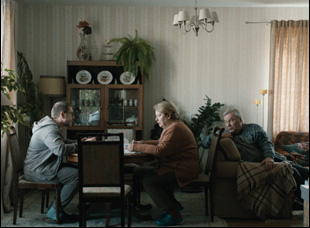
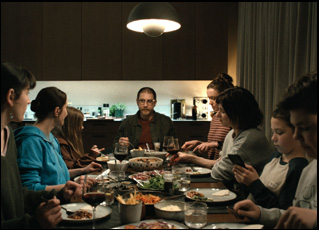
Everything was quite clear regarding casting because I worked with Zygimante [Elena Jakstaite] in “Runner,” so when I was writing script, I was imagining her and Marius Repsys, who plays Vytas, for the role and then the supporting actors also appeared in my other films. And because of those long takes, we rehearsed [quite a bit] and a fun fact is that that divorce scene when we rehearsed it, there was never a perfect take during the rehearsals, but during the shooting, we had two really good takes and some magic happened, probably because of [the pressure]. The actors delivered it really, really well. And again with the dinner scene, the Ukrainian actors they came from Ireland because most of them lived in Ireland and they flew to Lithuania to rehearse and it was very useful because the dinner scene seems like people are sitting next to the table, eating and talking, but it was very hard because you need to keep the pace of the scene [while shooting in a long, unfolding take].
The production design was extraordinary in this and said so much about the characters. What was it like creating these spaces?
Yeah, I would totally agree with you that the production designer did a great job creating that space and the color palette. First of all, it was very important to find that apartment because probably 50% of of the action happens there and I really wanted that apartment to represent conformity in a way, which is very abstract idea when you say this to a production designer. The [immediate] ideas are a cliché — sterile spaces like Scandinavian-style [where] everything is empty, so we tried to not to do that and that apartment was actually was really hard to find because it was the real apartment in the old town. Of course, these kind of apartments belong to rich people in Lithuania too and rich people usually aren’t interested to let filmmakers in because they don’t need the money, but thank God the owners were art lovers, so they really helped us and we tried to make it rich in a way, but at the same time it should represent characters and the theme of the film.
The story seems to unfold with a really specific timeline. Were you attaching elements of the story to certain real events?
I wrote the first treatment maybe in the first month of the war — I started maybe after two weeks, so the date when the war started, it was like every Lithuanian probably can say what they were doing and how they reacted. It was like a huge thing for us. It started in the end of February and somehow I knew that the first half of the year will be crucial for people. Summer will come and then people will go out and relax because we have this very clear seasons in Lithuania — a real autumn, a real cold winter, spring, and when it’s summer everybody is going out and celebrating life. So I thought summer should be the end point in a film and the first half of a year, every news [program] started with the war and it’s just war everywhere and after one year it was just completely normal.
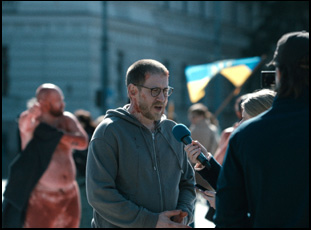 The place where I could see reality and fiction really blurring is when Vytas has a public performance piece – what was it like setting that up and actually shooting it in the middle of the city?
There were many protest performances in Lithuania happening, especially in the first half of the year and I actually took inspiration from real life because we have this huge Russian embassy in this very prestigious neighborhood in Vilnius, the capital of Lithuania, and next to this embassy there are small ponds. Our Olympic gold medalist swimmer swam through those ponds, and they were colored with red, so it seemed that she was swimming in blood. Of course, I couldn’t repeat this, but I realized that we can do something with blood and lots of male bodies. So I came up with this performance, which is of course is not that smart or creative [reflecting the character], but to shoot that scene was really hard because we shot it in in May and sometimes the beginning of March can be cold or very warm. Unfortunately it was a cold day.
It was really hard for all the actors and I’m very thankful to all of them for doing that because there were many professional dancers in that scene and there was this movement which seems it’s easy, but it’s not. And then in this blood, which is basically sugar [or corn syrup] I think, because it was very sweet, it was sticky, so it was really hard and [the scene] was shot in the center of the city where many tourists were walking around. It was a Sunday and that morning we started very early when the city just woke up and some people were going to church. They were walking around and they see 20 to 50 guys covered in blood and it was interesting to observe their reactions to what was happening in this square.
 It’s a great moment in the film. The score is quite interesting as well with a bunch of unusual instrumentation. What was it like to put music on this?
Jakub Rataj, the composer, I worked with on “Runner,” and when we met for the first time [on this film], he read a script, but he saw I worked in a way [where] I edit first and then the music comes on top of the film. And both of us [said] almost simultaneously, and I’m not joking, that we should try something with prepared piano because I wanted this music to somehow [be of] a different world, not to just impact the emotion of the audience but more to represent what’s happening inside of the characters — this chaos, this broken world — so this was our approach. And what is interesting in the film is that [the music] starts maybe in 25th minute of the film because it starts when the war starts. And I remember the first time we did it, because I’m used to this editing, we put the score on in 25 minutes and I was so scared. I remember the first time maybe it felt like a mistake and maybe we don’t need the score because I’m used to the silence, but in the end, I really loved it. I think it gives something special for a film.
It does. What’s it been like to engage with audiences and see the film start to go out into the world?
It’s great because we had the premiere in Sundance and I didn’t know what to expect. I come from Europe and I had never had such a wide U.S. audience. I screened “Runner” in the States, but there were still more local Lithuanians coming to the screenings. And the reactions were just so just perfect. People understood the film and what I found really strange for me is audiences who are further from the war zone understand the film somehow better. When it’s closer to the war zone, people pay attention to different things. Maybe it’s because the war is still happening, so somehow they react differently. But in Hong Kong or America or South Korea or Ireland, which is the furthest from the war zone, people get this film really well. And I’m looking forward to the premiere in Lithuania, which will happen in September and awaiting those reactions.
“How to Divorce During the War” opens on August 21st in New York at the IFC Center and August 28th in Los Angeles at the Laemmle Royal, the Encino Town Center and the Laemmle Glendale, Santa Barbara at the Riviera, and Hudson, New York at Time & Space before expanding across the country. A full list of theaters and dates is here.