

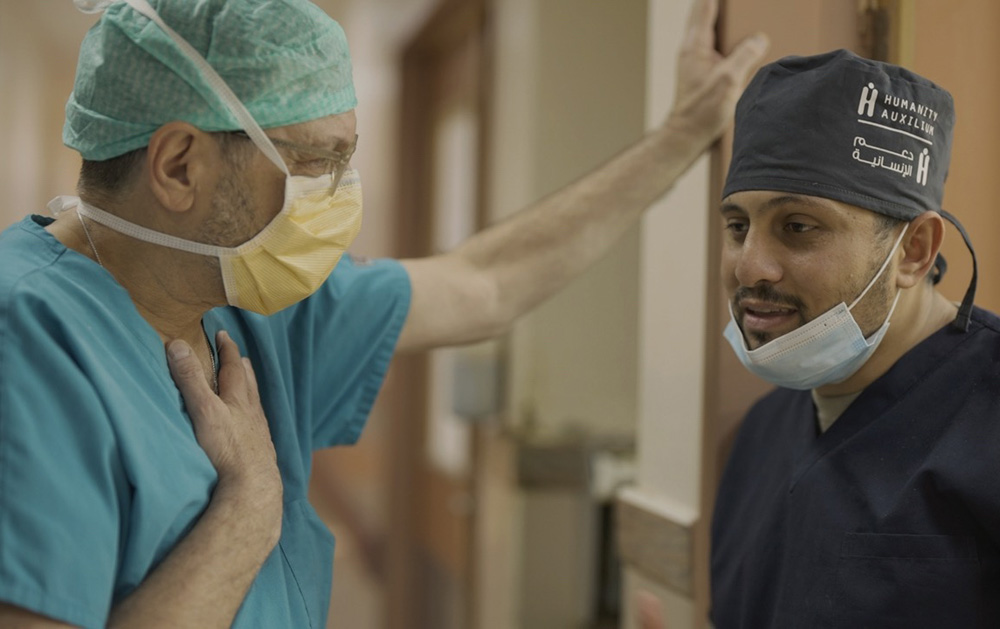

An unusual thing happened as the credits began to roll on “American Doctor” when it played at the Sundance Film Festival. Audiences surely needed a moment to breathe after watching the harrowing chronicle of three U.S. physicians – Dr. Thaer Ahmad, Dr. Mark Perlmutter and Dr. Feroze Sidhwa – who against all odds sought to provide care to Palestinians at one of the last remaining clinics in the Gaza Strip as Israel continued to wage war against them, with only two of the three being cleared to practice, and a song gently began to play to offer some comfort. Yet it clearly wasn’t jut a soundtrack for the film that was coming over the loud speakers, but a real live voice that made the tenderness of the track seem even a little more intimate.
“When you see one name appear multiple times — director, producer, executive producer, cinematographer, and then song, that’s when you know the filmmaker has no money,” laughs Poh Si Teng, who being there to do a post-screening Q & A for the film anyway, thought it might be nice to sing after taking on that responsibility for the film. When the song itself was a last-minute addition, it had become a moment of relief for her as well.
“We had wanted a song to dedicate to our Gazan team and Suad [Bushnaq], an incredible composer wrote the end montage song just a few days before we had to lock for Sundance and we needed an end credits song. We were initially going to license a song, but it didn’t work out, so 10 days before we lock in the DCP, I called [Suad] and said, ‘I know you’re doing the end montage song. I also know you just had a baby. But can you write one more song?’ He’s like, “I got you,” and he said, “We could get an artist [to sing it],” but I said, “There’s no money. Okay, I will sing it.’ We sent it to our Gaza team once we recorded it. We wrote it for them just to just to honor them and their craft and their work and their sacrifice.”
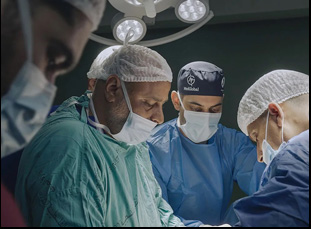
Having a great voice turned out to be part of a rare overall skillset that made Teng perhaps the only filmmaker who could’ve pulled off “American Doctor.” Having come to directing her debut documentary after years of commissioning longform nonfiction for Al Jazeera America and ABC and being a cameraperson herself, she understood the logistics at play in filming inside a war zone that she knew would be too dangerous to attempt entry into for an international crew. One only needs to see the footage she films of Dr. Perlmutter packing his bags with ordinary items that can be later be repurposed as medical equipment, as supplies at the clinic in Khan Younis are scarce, to see how tight a grip Israeli authorities have on what’s allowed in the region and working with a Palestinian camera crew, the film captures the horrors of working at a hospital with the bare minimum of resources through the inspiring work of Dr. Perlmutter and Dr. Ahmad as an endless array of new patients arrive on an hourly basis while Dr. Sidhwa, who is turned away at the border for specious documentation-related reasons, returns home to raise awareness of how dire the situation really is and advocate for the necessary international aid.
While “American Doctor” offers an unflinching look at a humanitarian crisis unfolding, one that Teng can be seen upfront admitting she’d rather not show in full out of good taste until Dr. Perlmutter insists his work would be in vain otherwise, it also becomes a compelling portrait of how much is asked of these caretakers who not only bear witness to so much tragedy around them but are thrust into the uncomfortable position of being a public figure in addition to their medical practice when they are the only ones that can testify abroad to the ongoing atrocities. Truly one of this year’s must-see movies, the film is now coming to theaters across the country after a celebrated festival run that started at Sundance and continued on through True/False, Seattle and San Francisco and Teng, generously took the time to talk about the deeply personal reasons she undertook such an improbably production, finding such a trio of physicians whose stories were complimentary and honoring the urgency of the situation by racing to finish the film so it could speak to the moment.
 How do you even start to think about making a film where you could never actually step foot in the country it largely takes place in?
It was one of those things where Mark [Perlmutter] is ever the eternal optimist. So when we were filming in the early days, he’s like, “I’m going to take you to Gaza. I will train you as my scrub nurse, which anybody doing any search of my name [would find] New York Times, Al Jazeera, ABC, Disney and [I’d be outed as] “This is not a legit scrub nurse. Israel controls the borders, so I realized from the get-go, it was never going to happen. So how do you film it? Fortunately, I had worked with this incredible producer, Reem Haddad, [when we were] documentary commissioners for Al Jazeera English and she had worked with this incredible cinematographer, Ibrahim Al-Otla, and our co-producer Mohammed Sawwaf on a brilliant short documentary at the end of 2023. I saw it and I [thought], “Can they film in Gaza? And they said yes, so we communicated every day and they would send the footage over every day.
They were also very naughty, and I’ll tell you this because I am thinking as a director, but I’m also a producer, and I’m thinking of the logistics of getting this footage out. And I told them, please do not shoot in 4K. I don’t know how you’re going to transmit this out. We can’t bring out drives, and they’re like, “Yeah, yeah, yeah…” They still shot in 4K and they still got me the footage every single day. So it’s a credit to how much they wanted to do this and how creative and entrepreneurial they were on the ground and how to make things work. We owe everything to them.
It seems like you deserve some credit as well when you bring an interesting background as both someone that started in news and has a large body of work as a producer. Was being a director much of an adjustment?
If I can be honest, I was scared because I had spent years as a journalist and then years as a producer and the job of the producer is working to make sure the director’s vision is fulfilled. And the director comes with an artistic vision of what the film should be. Now, I think I’m a pretty decent producer, but [I wondered] am I a good director? So I was extremely nervous, but I thought, “Hey, I’m going to give it a shot” and then with the easiest topic, right? On Palestine. And the moment I got to hold a camera again, I was nervous, but I was also a camera person for the Associated Press. That was my first job. So [I thought] it’s been a long time. Technology has changed. But once I got to hold the camera again and then be in the director’s seat as well, it was like I get now actually get to sketch whatever I want on the canvas. That was very, very thrilling.
You decide to include a scene at the start of the film that I imagine some filmmakers might leave out and others might actually decide not to continue filming when Mark insists on showing the carnage from Gaza as it applies to children and in the moment, you demure, but do decide that has a point. The scene is quite an introduction and really gives the audience an idea of what they can expect as well as see the position that you’re in. What was it like realizing that was how you should open this?
That scene with Mark happened on the second day of production. And that was quite a moment for me. I felt really guilty because Mark was so upset with me. He was like, “Why are you here? You’re going to be like the rest of them.” And I’ve said this before, but it’s such a delicate balance [in regards to the violence]. You show too much, it’s gratuitous. If it’s a theater, they’re going to run out. If they on a streaming platform, they’re going to turn to something else. And if you show too little, that’s a huge disservice and disrespect to the lives lost and the people who have survived those who have been lost. Initially, I didn’t know I’d keep it. I cut it for myself but I didn’t know what it would be but I knew it set the tone for the film. Then in the early days of documentary filmmaking, you have to raise funds, so I would always show clipped scene selects to potential funders. And I’ll show a clip, we watch it, we have a conversation and I remember showing [this scene] to one potential funder early on and I showed it to him. After that, we talked and the first thing he said was “After seeing that, I guess I’m going to have to watch the whole film.”
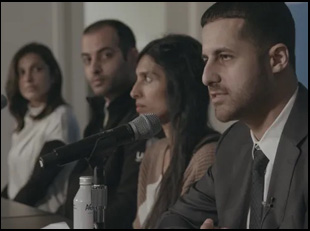 Was there anything that happened that changed your ideas of what this was?
I think so much of the film and the thought behind it was really what I was grappling with as a filmmaker, as a journalist, and as somebody who was paying taxes to go into these 2000-lb. bombs to like drop on children. There was all that despair, and anguish and having worked for Al Jazeera, my former colleagues were getting targeted and executed. So it’s all this emotion. And when I met Mark, Feroze and Thaer, they gave me a certain kind of language to speak and to move.
There are moments in the making of the film and even in my life at the time [where I’d think[, I should be more like Mark. I should speak my mind. Why am I so scared all the time? But then I also realized, “Look, I’m a woman, I’m a person of color, I’m barely five feet, I don’t always get to say what I want to say. There’s no redemption for me if I say something real, and then I look at Thaer and I remember the first time I saw him speak publicly, I thought to myself, “Wow, he’s a leader in his community — and a leader of our time in many ways — and a leader who is reluctant, who is able to balance both humility and confidence. And I wanted to be that. And then with Feroze, I don’t think I can ever be Feroze because Feroze is built differently. He has an encyclopedic memory. But I learned from him in the course of these two-plus years, that sometimes I get so angry and my hands have clenched, and with Feroze, he taught me, open your palm a little bit.
As a filmmaker, it’s really remarkable to find a trio of people who have such different attitudes and complimentary storylines when they were grouped together by happenstance. Was it organic to simply follow these three guys from the start?
It was purely organic, and I chanced upon them because I had worn all these different hats in the documentary ecosystem and my last job was as a studio executive, but [again] I’m seeing my former colleagues at Al-Jazeera getting targeted and [I thought] I’m going to quit my job, but I didn’t what film to make until I saw Mark being interviewed by a reporter. The reporter asked him, “Why do you think there’s no ceasefire? You just came back from Gaza.” And he said, “There’s no ceasefire because politicians are *expletive* to lobby groups.” And [I thought] “Mmm, this is interesting.” So I meet Mark and soon after Mark introduces me to Thaer and Feroze and if you’ve produced films, you know when somebody is charismatic and you can’t stop watching them, you know you have something because there’s something you can learn and you really want to lean forward. One is so privileged to encounter that, so when you have three… [laughs] I met Mark November 1st and by mid-November, I was introduced to the other two doctors and [I thought] “This is it. Let’s be focused and live in their world.”
Watching it again, it only sunk in now when the film starts in March 2025, you had less than a year to make this, which is a crazy timeline when a lot of films spend a year in editing at least. What was that sprint like?
We started Christmas 2024 and we wrapped Christmas 2025 and it helped that I had an experience as a journalist and as a cameraperson that always had to turn things over fast for news packages. Working at the New York Times and Al-Jazeera English, one had to learn how to see what was coming in terms of the news cycle and as a producer and a grants director, when you look at a lot of projects, you also have to be able to see what is going to stand the test of time in a year, in two years, five years, and 25 years to come. Sadly on the topic of Palestine and the U.S. involvement in it, it’s going to be relevant for a while, so all those different experiences combined I think helped finish it in one year. But like all filmmakers, we’re also a little delusional. We think we can, and I didn’t think it would be a walk in the park for me, but six months in, I [thought], “Oh, this is harder than I thought. But there’s no halfway. Once you’re in, you have to you have to do it. No matter what. And I did not do it by myself. I had an incredible team that spanned eight countries and I asked the everyone, the best at their craft, whether it’s the editor or producer, “Can you do this with me? I’m not going to have much funds for this, but we will do something together on this topic.” And I was surprised everybody said yes. The only people we didn’t bargain with, they get whatever they want is the Gaza team.
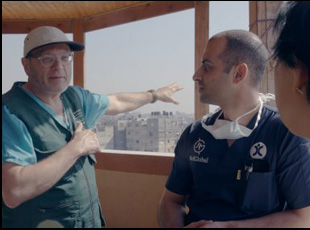 You’ve honored them at every stop, but what’s it been like traveling the world yourself and making sure they’re aware of the reception this has received so far?
We talk to them often. They are watching our social feeds, and we share as much as possible. But that’s what keeps us going. They’re still there. We’re still here. On the one hand, it’s exciting to have this kind of theatrical debut and premiere. But on the other, what is the point of it if we cannot advance their message? So we’re going fully forward and I just found out we are now going to play across more than 77 theaters in the U.S. and Canada. I never thought that would happen, but but this is just the beginning and we’re excited that more people will be able to hear and see their message.
“American Doctor” is now open in New York at the Angelika Film Center and Toronto at the TIFF Lightbox and opens in Los Angeles on August 21st at the Laemmle Royal and August 24th in San Francisco at the Roxie Theater. A full list of theaters and dates is here.