


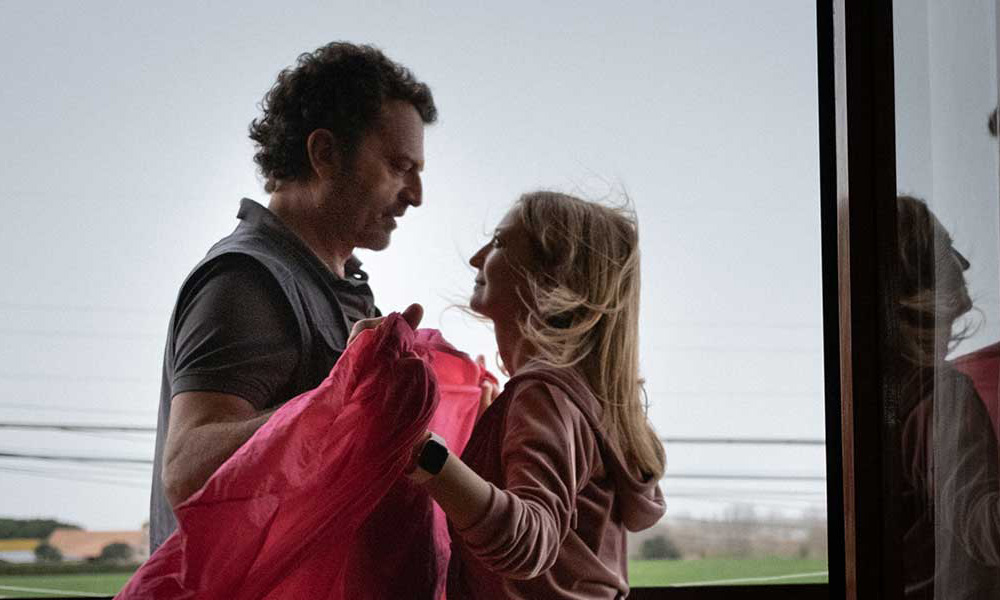

“Una Storia” opens with a shot that would seem to convey the excitement felt by Irene when she starts her first year in college, accompanied by her mother Erika (Alba Rohrwacher) and father Mauro (Guido Caprino) to her dorm, with the camera swirling around as if the inevitably tiny dorm was pulsating with possibility. Yet it can be read a different way once it follows her parents home where all that spinning seems to have led to disorientation, a spiraling out that as the translation of Anna Foglietta’s feature directorial debut alludes is “a common story” as the two contend with an empty nest. A strong two-hander enhanced by Fogliatta and cinematographer Andrea Benjamin Manenti’s adventurous decisions behind the camera, the film spends a year with the couple as they try to find an identity other than being a mom and dad in middle age.
Foglietta, a longtime actress herself, surely appreciates the power of a closeup, which is foundational to the most distinctive element of “Una Storia” as the camera begins to reflect how confining Erika and Mauro’s newfound freedom is after building their routine strictly around caring for their daughter and become unmoored by imagining life without her. Erika is quite obviously the more distraught of the two, not even being able to leave the college campus before washing a few dishes in the communal kitchen, but taken into the arms of Mauro for comfort, it seems like they’re prepared to let go until they actually reach home where the house seems a little emptier. Mauro fills his time as a soccer coach to younger kids when he’s not helping out his father Marcello as an electrician, but when Erika tries to busy herself by helping out her mother, she finds there’s not much to occupy her time as she has her mother would rather play cards with her own friends.
Although it feels like a slightly unrealistic concession to the drama that neither Erika and Mauro have anyone to confide in that’s their own age besides each other – and conversations are strained when they’ve known one another so long they feel they know how any talk is going to go, preventing it from happening in the first place – Foglietta, Matteo Ferri and Tania Pedroni wisely set up Erika and Mauro’s parents as parallels for who they don’t want to become in old age. To Erika, her mother may be content, but leads a dull life with little connection to her, leaving her to wonder if Irene will grow just as distant, and Mauro truly has grown to hate Marcello, who sells his business without caring where that would leave his son financially and will make lecherous comments towards women, continuing the disrespect his son felt her showed his late mother. While Erika and Mauro largely keep their emotions in check without sharing them, they are expressed in occasionally wild flourishes within the camerawork, dashing about at times when they feel anxiety or drawing closer to the actors when the walls appear to be closing in on them. (It reminds of the inventive approach to capturing the wild mood swings of a new college student in Giovanni Tortorici’s “Diciannove.”)
The cinematography picks up on already sensitive performances from Rohrwacher and Caprino, who are counted on to deliver the tension when the film insists they largely suffer in silence, and through all of the film’s elements, Foglietta nicely observes the couple working through a tough moment in their marriage, neither likely to end their relationship but knowing it can’t go back to what it was initially either as they have to reassess who they are at this different point in their lives. Although the simplicity of the story is one of its virtues, it can feel at times that the premise is stretched slightly thin when a reckoning between Erika and Mauro is inevitable and the indignities leading up to it can feel redundant, yet in a domestic drama that could feel routine, “Una Storia” comes across as a welcome disruption, just as the couple at its center may need in their own lives.
“A Common Story” will screen again at the Venice Film Festival in the Orrizonti section on September 9th at the PalaBiennale at 2:30 pm.