

There’s a particular feeling that one could have waking up around 2 a.m., bleary-eyed and turning on the television while attempting to get back to sleep years ago, only to be strangely entranced by some B-movie from decades earlier that was on to fill time at the local TV station when it would cost next to nothing to license. Chris Zuhdi could take inspiration in the truly surreal storylines that such films had for his latest film “Nine Black Cats,” but he also was drawn toward recreating the whole experience, splicing in clips from black-and-white movies into his noirish mystery to make it feel as if one was channel surfing.
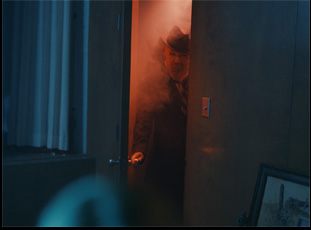
“Structuring the story around those clips was very much intentional from the start, and I wanted to make a physical connection to the films that came before and build that bridge for contemporary audiences back to some of those classic films in the public domain,” says Zudhi, whose fever dream of a film fits snugly into the realm of insomniac cinema, with the writer/director also starring as a beat cop named Joe Pacifico, whose latest murder investigation leads to the discovery of something even more dangerous and volatile.
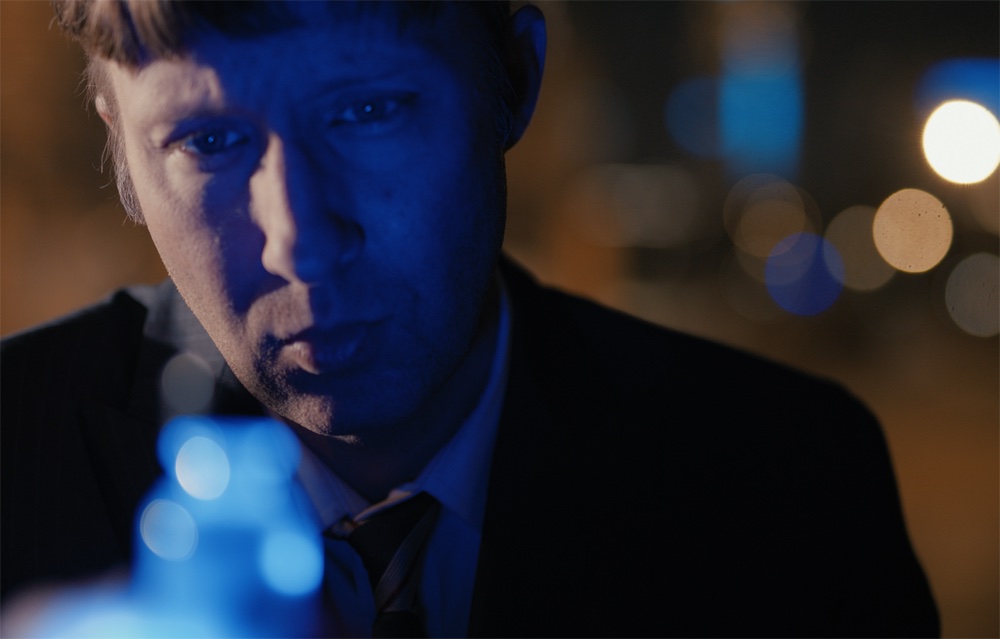
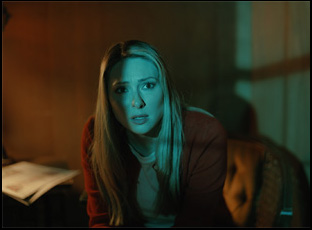
With a serial killer on the loose that dons a latex mask not entirely unlike Art the Clown, “Nine Black Cats” would appear at first to be a grizzly horror film as Joe surveys a club where a deadly massacre took place, but as he is threatened with being pulled off the case for his role in another investigation being probed by internal affairs, Zuhdi takes things in a wildly different direction than one might expect as well when the possibility of plutonium being right under the town’s feet not only may offer a profit motive for some to commit crimes, but also has unusual effects on the locals with the effects of radiation in an already neon-soaked milieu when not much has changed since the 1950s. Along with a waitress (Hannah Brantley) who worries she could be next as far as the masked murderer is concerned, only to find she also should stay away from a blue powder that has traces left about town, Joe ventures into some truly weird territory as he attempts to get to the bottom of all of it and his disorientation is reflected in the phantasmagoric aesthetic that Zuhdi conjures with intense red and green light and wielding a wide focus lens.
The film is slipping into New York’s Cinema Village this week as readily as it sneaks into the subconscious and Zuhdi graciously took the time to talk putting together the scrappy surrealist thriller in his native Oklahoma, being inspired by the French New Wave and achieving the film’s arresting look.
 How did this come about?
Basically, I was trying to do a conventional detective story and my script hit a dead end. I was reading the famous book with Truffaut and Hitchcock where they go through Hitchcock’s entire catalog of films and discuss them. I came across that famous section about the MacGuffin and I realized what my [initial] version of “Nine Black Cats” was missing was it didn’t really have a MacGuffin device, so I thought it’d be fun to do that glowing blue mystery powder. Once I put that plot point in the script I was already working on, it all came together and then I was able to structure the whole story around that visual motif and plot device.
The blue powder really does give a foundation for an entire color palette. What was it like to create a look for this movie?
Once I had that glowing blue powder, I knew I wanted the color palette to be radioactive and electric and neon [in general], so with the blue powder in there, I was able to just go over the top with the color design from there. And then once I realized we were going to be shooting full format, I thought it’d be really cool to limit my cinematographer. We used other focal lengths, but stick with that wider angle. I think it was about a 32 mm on a full frame sensor, but I like that edge distortion, the lens compression, and the three-dimensional texture you get with a wide-angle lens on a full format sensor, so that came pretty early on in the production process.
What is your relationship with your cinematographer like when you put yourself in the center of the action as an actor?
A very fruitful one. Justan Floyd was the cinematographer and then the gaffer was Tim Katz and those two guys have worked together for many years, and in fact they started lighting for film negative and I think a lot of their film background comes through in this film, so I knew they were really really competent and I could give them some basic notes and then I could trust them to help me do the world building and focus on acting and directing.
You’ve got a lot of strong locations in this that help set a tone. Were they in mind from the start?
They were. I actually filmed in a very, very obscure place, Shawnee, Oklahoma, right in mid-America, and there’s a portion of Shawnee downtown hat has been basically lost because the town has moved north and west to the all the new strip malls, so there’s this time capsule that’s just frozen in the mid-20th century. You have bank buildings and storefronts and hotels that I absolutely love and those practical locations were very informative in terms of how I covered the film.
One of our locations was built in the late ’70s, it was a a electric company at one time, and I didn’t expect that one location to basically be our studio for about 80 percent of our film because it had a second story, a vintage staircase, a reception desk, and all these cool little wood paneled vintage office spaces that my production designer was able to to turn into a hotel room. Originally, I was expecting to find locations piecemeal, scattered across that downtown area but by scoring this one building was a cool surprise. Caitlin Dodge was my production designer and she was able to go in and just almost universally use that one location for the vast majority of the film.
It not only sounded like you were looking for a specific kind of location to fit the time, but also a certain kind of actor. What was casting like?
It was very specific. I was going for a European arthouse feel because that’s what I was watching and inspired by when I dreamed this particular movie up, so the look of each [actor] has had to have that art house feel. I was excited about all of them. My lead actress Hannah Brantley, I was hoping to cast in the lead originally and [was told by her manager] that Hannah would be great, but she’s out of state now and it turned out about two months into the casting process that she was actually available and we didn’t realize it, so I was able to circle back and Hannah did a terrific job.
But it is difficult these days because a lot of casting is done via Zoom or remotely and back in the day you would get actors in person and they would read with one another, they’d read through the scene and you can see if the dynamic is working or not. And there is kind of a scary surprise element a lot of times in casting these days because you may not see how two actors interact with one another until you’re actually filming a real scene, but fortunately everyone’s chemistry was great.
 What’s it like directing yourself?
It’s definitely difficult to be objective about ourselves, so that’s a challenge and then trying to to act and direct and then give notes to other actors, but it’s satisfying. I’m a big fan of French New Wave Cinema and I like that idea that the director is the author of of a film, so if they can put themselves in the film, either in small ways like Hitchcock would do his little cameos or Truffaut was famous for actually starring in his movies, it’s cool to put that extra fingerprint in.
I’ve kept hearing exciting things about the filmmaking scene these days in Oklahoma. Is it an interesting time to be a part of?
Yeah, there are definitely exciting things happen. Of course, we have had major films that have come through fairly recently, like “Killers of the Flower Moon” or “Twisters,” but I think the infrastructure is is developing at a very good pace. Audio Planet in Tulsa did all my post-production audio and they’re top-notch and we have some really state-of-the-art technicians, facilities and crew here in Oklahoma that can really do a terrific job. Also, people are still excited about the movie industry here. If you go to L.A. or New York, a lot of people are burned out because they they’ve been doing the movie thing 24/7 for a hundred years, so it’s no big deal. But here in t the mid part of the country, you talk to people about making a movie, people genuinely get excited and that excitement is encouraging.
What’s it like to get to this point with the film and start sharing the film with audiences?
It’s a blessing. The movie got finished and then this whole avenue opened up at the last minute to [screen] in New York at Cinema Village, so things have just really blossomed in a wonderful and unexpected way for this particular film. It’s a bit scary, but in an awesome way, so we’re very very blessed to have this opportunity for the film to reach a wider audience.
“Nine Black Cats” opens on August 21st in New York at the Cinema Village.