


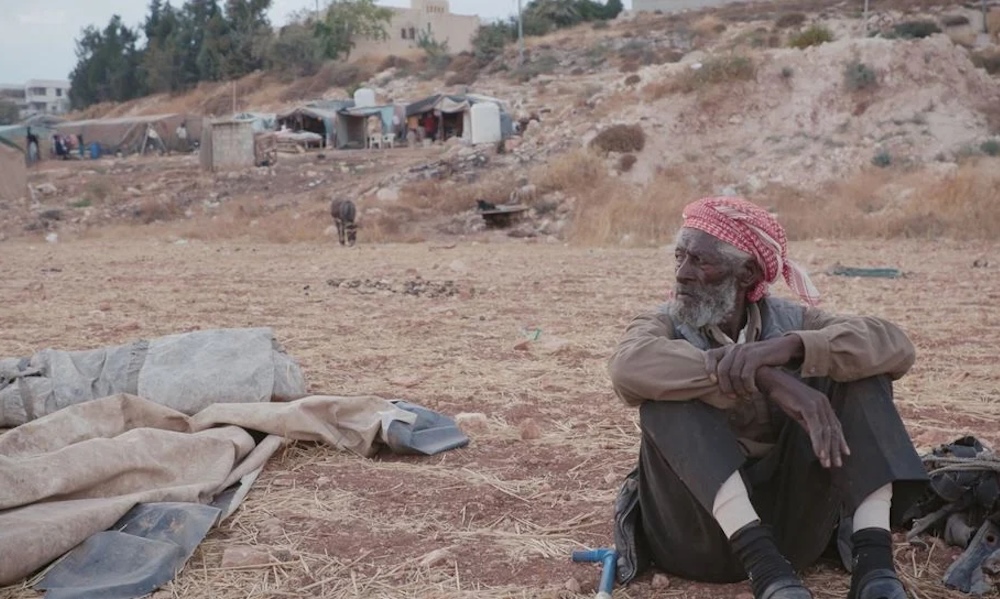

“It will be over soon,” Abu Awad, the patriarch in “Concrete Land” says as he’s watching news perched in Jordan where Itamar Ben Gvir, the Israeli minister of national security was recently empowered to clear the land of what’s left of the sovereign Bedouin communities in the area as it has been designated for commercial development as part of the Negev Desert. “This will be a terrible year.”
How terrible may be a matter of some debate within the tent where Abu Awad resides with two other generations of his family who are showing signs that the way of life that’s long been a point of pride may not only been untenable for reasons beyond the bulldozers that come in to knock down trees around them to build condos. Asmahan Bkerat’s sensitive chronicle of the family’s resistance to change is inevitably bound to be seen as a reflection of the Israel/Palestine conflict as settlers from the former continue to push out the former in the contested territory, but filmed over eight years, the director is also able to capture something less political and more personal when the family’s respected patriarch can be seen clinging onto traditions that may no longer be prudent or reasonable to uphold.
The fact that Abu Awad can watch television in the first place is a sign that times have changed from the nomadic past of his ancestors, but still the family tends to land that they have no desire to claim ownership of, separated from larger society and self-sufficient with their flock of sheep, hardly disturbing anyone on land that would seem inhospitable to most with a lack of civic infrastructure. However, besides the sudden incursion of state-sanctioned wrecking crews, strain has also developed between Abu Awad and his son Awad, who has to deal with the brunt of responsibility to keep the lifestyle his father wants by driving a truck and being away from his own children for unforgivably long stretches of time, leaving around all the women to handle the domestic duties for the family and don’t see the material world to be as evil as it’s suggested that the patriarch does, enjoying jewelry and makeup that they’re forbidden from wearing.
The beauty of the Bedouin tradition can be seen in the film’s very first few frames and beyond – besides Bkerat’s patience, she clearly also has a sharp compositional eye as a cinematographer – as Abu Awad sits unbothered on a grassy hill with his sheep and begins to sing, but as much as it feels as if he can stop time in that moment, it is clear that the world is in constant churn around him yet when he is clearly in his golden years, he is largely unburdened by what’s going on. That obligation falls on Awad, who in his rare moments off the road, has to spend at least some of his time dealing with wealthy Israelis that have purchased real estate and file complaints with the government about the family, while his wife has to tend to their daughter Eman who is approaching her teenage years and attends school, both broadening her understanding of the world and how cruel it can be as she’s teased for her skin color.
There’s nothing to denote time passing, but clearly Eman grows up and as she eventually comes into possession of a cell phone, the temptation of a different life than the one her family has had looks inevitable. Yet Bkerat carefully observes how the gradual erosion of a culture occurs over generations as both Awad and his father both have modern comforts that make their way into their daily routines and whereas it once looked like a duty to remain outsiders, it now appears it’s a choice with all the tension that brings with the reputation that’s developed externally and how much that’s felt internally to live up to it. By most measures, the family may be considered as being in exile, but “Concrete Land” raises issues that will hit home for most when it comes to what’s owed to the past versus deciding what’s right for the future.
“Concrete Land” does not yet have U.S. distribution.