

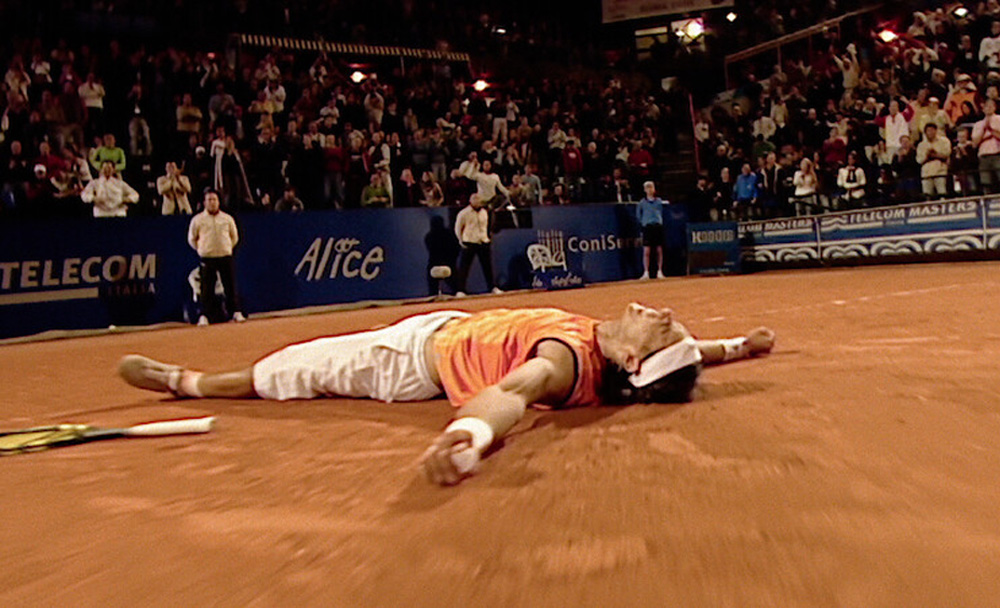

“An added extra pressure has always been good for me,” Rafael Nadal can be heard saying in “Rafa,” describing the time he took the court as an 18-year-old, playing Andy Roddick, then ranked number two in the world in tennis at the time, in the 2004 Davis Cup, where the crowd at 27,000-plus was the most he had ever played in front of. His coach Toni, also his uncle, recalls pleading with him not to use up all his energy celebrating as it began to look like he’d have the upper hand, still needing it for the set to follow, but that zest was what kept everyone’s eyes on him during the match and all those he’d play in the 20 years that followed, winning 22 major titles and one of just three ever in the sport to complete a career grand slam including a gold medal.
Although he never let anyone see him sweat on the court, particularly on clay where he was nearly unbeatable, “Rafa” reveals that Nadal’s career was filled with more pressure than anyone could know in Zach Heinzerling’s captivating series in which the “Cutie and the Boxer” filmmaker follows what ended up being the tennis star’s final year of competition. Resting up to return to the court after a hip injury following the Australian Open in 2023, Nadal has plenty of time to reflect on one of the greatest careers the sport has ever seen, but also relentlessly pursues a comeback when he still feels at 38, he’s got game left in him. Heinzerling finds that his attitude towards bouncing back had been there from the very start of his career, when he was diagnosed with a unique and potentially career-ending chronic condition known as Mueller-Weiss Syndrome causing severe pain in his foot, and after successfully testing the waters with an experimental treatment to change the position of his foot, he was never averse to risk-taking if it led to greater achievements, including putting himself in the public eye when he was really a homebody. (As his wife Mery Perelló recalls, they only moved out of his parents house when he was 30.)
Over the course of four episodes, Heinzerling charts ups and downs in Nadal’s career as he rose to become an equal of the great Roger Federer and subsequently dueled with Novak Djokovic, who would eventually take the crown of the world’s best, but “Rafa” does it in an inspired and inventive juxtaposition of the past and present when while following Nadal’s recovery, honoring the player’s unusual talent for putting spin on the ball as it spends each hour moving back and forth in time to reflect how the mental side of the sport was always as demanding as the physical, not only having to come back from injury at various points and manage pain with medications he had to be cautious not to overuse, but becoming a celebrity in his native Spain and making tough choices at times to change his game to keep up with the sport, ultimately parting with Toni and instead turning to a former opponent Carlos Moyá to coach him after a decade together professionally and years before that in his youth. All of it leads up to the most difficult decision of all ultimately hang up his racket, even though he has enough evidence to suggest he can still compete with anyone, but “Rafa” presents a man at peace, which may be more impressive than all the titles he won after the series so vividly illustrates all it took to get there.
With its debut on Netflix today, Heinzerling, who was said to have won Nadal over when he often will operate his own camera and keep an on-set crew to the minimum, graciously took the time to talk about getting the call to make a definitive portrait of the tennis star, being able to find connections throughout a career that could speak Nadal’s revered ability to come back after being counted out and how he could identify with that himself.
How’d you get interested in this?
It was a dream opportunity. Coincidentally, I happened to love and and play tennis, I also speak some Spanish and I got lucky with the timing. I was talking to Skydance about a different project, and this project came in. Rafa had said “no” to a documentary forever and being his last season, his team finally convinced him to do it. It really didn’t come together until two weeks before the start of the season and they called and asked if I could go to Australia as a trial period – shoot some [footage], get to know him. If he likes you, maybe we’ll continue the project.” And it went from there.
Did you know what you were walking into? It seems like such an interesting time when he’s got all this downtime because of the injury, but at the same time, that’s got to be a really frustrating moment for him.
I did not know what I was walking into. I think everyone’s idea of the story was the final comeback, or “The Last Dance,” Rafa Nadal’s version. He’s known for these miraculous feats of coming back from injury or winning from two sets down and never quitting, so there was no reason to believe that he wasn’t able to do it again. In 2022, he won two majors and finished number two in the world, and this was basically a year-and-a-half later. We were all hopeful that the the comeback would arrive, but then what happened was in the first tournament back he re-injured the same hip and there was a moment of, “Well, what’s going to happen? Is the season over? Is this documentary potentially at risk? What are we following now? And I had to figure out and pivot from there.
Did you know what shape this would take as far as a feature or a series?
I actually wanted it to be a feature originally. I thought it could be about his last season. I really love verite filmmaking and the documentary films that I love come from that observational embedding yourself with somebody and showing the audience what it’s like. I thought this could be contained. The stakes were there, this was going to be his last year, what was going to happen? But once it became clear the season was not necessarily this heroic comeback with a walk-off homer moment, the question of why is he continuing started to arise. Then that became even more persistent once he started to drop out of tournaments but not fully retire. He’d play a tournament and some other injury would arise and his team was obviously supportive, but there was a bit of a question among my crew and some some people surrounding him of like, “Well, when is this going to end? This is becoming painful to watch” because we know that his body is telling him that the end is here, but his mind is such that he’s going to continue until every last drop is left on the court.
The answer to that question of why does he keep going came in the the revelations from his past. One of the reasons is this foot injury where he was told at age 19 that you may never play again and then somehow he managed through like an experimental method of having these insoles to play again. His foot was a kind of ticking time bomb [where it was always] maybe “This is the last match, maybe this is the last year, so I’m going to play as if it is and never take anything for granted.” Then beyond that, his childhood with his uncle [who was his coach] and and just forging that mentality of never giving up [gave us this other question of] how does the guy who based his identity on never giving up finally decide to quit? That was the tension of the whole series and what allowed it to be a more career-spanning hybrid of of past revelations with present drama that brought you closer and still gives you — [from] watching what it’s like, who he is, how he reacts, how he is with his family, and how emotionally vulnerable he is — things that you can’t get from interviews. So it ended up being more contextually fulfilling and representative of his essence in a longer series format.
Once you settled on four chapters, was there a backbone for you? And did you immediately realize you could move through time the way you do, where the last chapter dips back as much to the past as the first?
Yeah, we had great editors, Drew Blatman, and our story producers, Germain Gulick, Tim Moran and Andrew Helms, who really were finding that weave because they’re two completely different stories and it was our job to essentially write this marriage of the two stories where you’re learning about his present through the past and you’re learning about who he was in the past through what he looks like in the present and [recognizing] the same thing that is making him continue and causing the pain of seeing him suffer in his last year of tennis is what made him such an incredible tennis player early on in his in his career. There’s a power in connecting these two seemingly different [strands] but it’s the same person through time. Even some of the tournaments that we were at, it would be in Rome or in Madrid where these epic battles had happened and he was playing his last time there. The fact that Davis Cup, where in 2004 he really made a name for himself, was the last tournament that he decided to play, and the foot [being] the same foot that was responsible for a lot of pain — and potentially creating a mentality of fight and grit and and determination that led to his wins — was the same foot that at the end of of the series you see has this giant alien-shaped knot on it and basically he had to numb for the ending of his career just to be able to play, I find a lot of poetry in the symmetries.
Whether intentional or not, I’m not sure, but I think they are somehow revealing of the epicness of his story. I don’t think there are many athletes quite like Rafa. He has a spirit and mantra that can be applied to anything in life. If you were just to compare him to say [Roger] Federer or Novak [Djokovic], I think of Federer as this impossible to emulate [figure], the idea of beauty and perfection in tennis. Novak obviously has all the the Jordan-esque stats and is the greatest of all time, but something about Rafa’s humility, and Rafa as the eternal underdog, fighting against the odds and to win with determination, that’s just something I always have rooted for. I’m not sure why, but I always find that’s part of who I am is the desire to be the one who’s going to try the hardest or improve myself and use myself as the benchmark rather than competing with others or motivating myself because of victories or accolades. There’s a real integrity to his life that I felt a big responsibility to get right.
You really did such a marvelous job and this may be silly to ask, but when you’re working with as much archival footage as is in this, does the research support the interview process or do you find things in the footage after the interviews that correspond to the stories that are being told?
I think you always start project assuming one thing and then it turns into something completely different. There was a lot of discovery in the archival. Rafa was talented from a young age and was winning tournaments quite young, so one of the interviews I found most revealing was when I think he wins some tournament when he was eight or nine, and the interviewer is like, “How do you feel after winning the championship?” And he says “Winning this tournament doesn’t mean you’re going be very good. You have to keep working.” And you can just see the voice of Toni [his coach] in this little kid’s head. No other kid would have that response immediately after that, like “Well, this doesn’t mean anything.” To an eight-year-old, I’m sure it meant a lot, but he was trained with this mentality at such a young age that it left this imprint that in every environment he remained the humble, never letting it get to your head [competitor].
There was a lot the archival reveals. Some of the other things, like the painkillers was something that came as a result of pushing him and and his team because when when you’ve been with the same team for 20 years, there are a lot of secrets that exist of how things are done and and no one really talks. Most tennis players they have a new coach every three years and you could probably find a coach a few coaches back who had some beef with or just would open up about what it was like, but [with this] you’re in the Rafa vault. So pushing Rafa and [his physiotherapist Rafael] Maymo to reveal that there were tensions and arguments and a discussion that he was doing too much [as far as painkillers after an injury in 2015] and this might be bordering on addiction, taking them when he didn’t necessarily need them to prevent the pain from coming and knowing that it was a threat to his health…a lot of athletes probably take painkillers and that’s probably common knowledge. But I think what was more interesting about it was that there were disagreements because of how much his loved ones cared about his well-being. You see that his sister and his wife say that no success can be more important than your health. And I think Rafa really pushed his health to the limit and sometimes maybe beyond it.
The other thing that was a a revelation was just how it went down with his uncle and having his dad have to tell the uncle that they were bringing in somebody new who was ultimately sidelining him [as coach]. They’re brothers, and it’s his uncle and it was something that is not talked about in the world because it’s very sensitive. [Rafa] has dinner with his uncle every week, and they love to sweep that under the rug. But how did you explain having the same approach for 20 years and then that change [of coaches] happening? It couldn’t have been easy. But I think that it’s told in a way that they appreciated and everyone’s perspective was was represented fairly. I think you can see enough in the interviews, you get what happened and you understand it from Rafa’s point of view, which was the most important one for me to get right.