



“Do you think I’m inheriting anything from her?” Ayaan (Sathya Sridharan) asks his sister Zainab (Sara Haider) after she’s relinquished the role of their grandmother Nayyer’s caregiver in “The Curfew,” and he’s not asking about the things in her New York apartment, but rather concerned about any personality traits when it’s difficult to speak to her. There’s a variety of reasons for this when the two don’t share a language – she left Pakistan in the 1970s at the height of political turmoil in the country when the streets were silenced by military patrol at night and continued to speak Urdu upon resettling in the States, which Ayaan never picked up himself being born in a predominantly English-speaking country – but she also refrains from speaking, humbled by recovering from a stroke and requiring care, but not necessarily company as her grandson has become responsible for her well-being.
Ayaan finds that tending to Nayyer (Balinder Johal) is a far more complicated task than his sister laid out for him in writer/director Shehrezad Maher’s compelling dramatic short when not only Ayaan has trouble engaging with his grandmother who has a habit of sleepwalking, prone to nightmares from her time of living in fear in her homeland, but he also doesn’t seem welcome in her building when the doorman who rarely sees her downstairs has to wonder if Ayaan is just an Uber Eats courier based on a bit of racial profiling. The job soon requires him to look up the history of Pakistan as he learns how the count out Nayyer’s prescription medication, realizing that having a better understanding of where he comes from could help him find his footing in every aspect of his life.
After making the 2018 doc “This Shaking Keeps Me Steady” and a variety of video art pieces that offer people the opportunity to reflect on a culture that’s made an imprint on them in often unconscious ways, Maher opens a similar space in her first narrative work as Ayaan works towards a relationship with his grandmother that acts as establishing a connection to a country with a tortured past, compelled to engage when it’s his bloodline, but at a loss as to what he can offer when no one could possibly know where to start. A bit discomfiting formally to match Ayaan’s uncertainty about what he’s stepping into, “The Curfew” shows off Maher’s ability to keep audiences on their toes as well as she realizes Nayyar’s surreal dreams as well as the alienation that Ayaan starts to feel in the city he thought he knew well when he starts to see it through his grandmother’s eyes. On the eerie of the film’s premiere at the Venice Film Festival (though it is being made available anywhere in the world through September 30th with a Festival Scope account, as most of the festival’s shorts are), Maher spoke about making the transition from video art to narrative filmmaking, how “The Curfew” took shape and finding innovative ways to reflect a larger world.
How did this come about?
I’m formally trained in visual arts, and initially, I had a very image-based practice and sometimes when trying to write, a film starts from an image. Strangely enough, the first image for this was the fruit cart vendor scene [that happens midway through the film]. But some years ago, I was living in the Upper East Side and had this experience of walking into stores and being mistaken for help, and one moment that really stuck out to me was having dinner with one of my partner’s friends — an established orthopedic surgeon, and he walked into this nice restaurant, and this guy told him to go to the back where the Uber Eats drivers pick up their deliveries. I was also diagnosed with pre-diabetes and understanding that the links of the diabetes epidemic that goes all the way back to British colonialism, [the film became] a mixture of all these things coming together.
When you talk about a visual practice, it shows up in the film with how the spaces reflect emotions. Did the idea of these long hallways in the building that Nayyer lives in come to mind immediately? I realized afterwards that you start out in a bodega aisle where Ayaan is picking up some ice cream that echoes these narrow pathways that come later.
There were certain things that were very important to me, like the hallway just be really long and this feeling that when you exit the apartment and you’re in the hallway where Nayyer, the grandmother sleepwalks, it should be an overwhelming space and from a very dramatic perspective. It’s this liminal portal because she’s reliving a memory. When we were location scouting, we were looking for a slightly bigger place, and it worked out that the apartment building that we got were very claustrophobic spaces, so it was challenging filming there, but it really worked for the film in the end.
The grocery store was interesting because we got one of our choices, but it turned out to be one of the smaller ones, but again it worked out really well because he’s just very overwhelmed in that first scene where his sister is rushing him to get the things he needs to get because he’s suddenly having to take care of his grandmother at the last minute and I wanted the sense that this character is not in these spaces often, so when you have these towering things above him and an excess of choice, he’s just having trouble just doing this basic errand and it pointed to this character that I was developing that was immature around the edges and a little bit out of his depth as a caregiver, not used to shopping for somebody else.
The editing throws you a little off-balance in a good way too when you’ll occasionally inject some surveillance footage of the building into the mix. What was it like to portray this space in that way?
Yeah, one of the balances with the editing was trying to capture Ayaan’s confusion and feeling of being lost and things kind of jolting him sometimes just out of his sleep without losing the audience and confusing them too much. Sometimes I was interested with playing with the contrast of the intimacy of this very easy conversation between a brother and a sister — [with the sister] out of the country, they have this shorthand and a way of joking — and layering that on top of CCTV of the building as a way of showing the building without necessarily getting out the Alexa camera and filming it beautifully, but to show something of the atmosphere, what kind of residents might live there and the ways in which it’s surveilled, so it’s a kind of uncomfortable shift from the previous scene, but I think that sense of being watched really sets us up nicely for when he meets the doorman and is mistaken for a food delivery guy because I was trying to slowly build up to this idea that he’s being treated like an outsider in this building even though he really wants to just walk in like everybody else.
Satya has been a favorite of mine since seeing him in “Ben and Suzanne: A Reunion in Four Parts” on the festival circuit last year. What sold you on him to play this character of Ayaan?
I watched a lot of reels on a lot of films, and it was an interesting experience because this is my first narrative film, and I hadn’t really cast before, so I was expecting it to feel really challenging and thought it would feel like a very convoluted and difficult process finding the right actor. But what was wonderful about coming across Satya’s work was instantly in the first few minutes, it was a very clear choice. I had watched “Minor Premise” and especially for “The Curfew,” I needed somebody who was good with not having scene partners all the time and I was really fascinated by how he could sit absolutely still and still be very riveting. He has this ability to act with his eyes and convey a lot without moving too much and that kind of stillness was really interesting to me for the character of Ayaan. In this film, there’s Ayaan and his grandmother living in these close quarters, but not quite interacting. They’re stealing glances at each other and being curious, but they don’t know each other very well. There’s a language barrier between them, so Satya just seemed like such a great choice for this role.
And working with such an experienced and confident actor for my first narrative film — I edited the film [as well], so from take to take, he’s doing these very different subtle things that give you all these options and take you in unexpected directions from the writing that are welcome, so it was wonderful working with him.
Were there things in the edit that you found you could pare back to make them more effective?
The scene in the lobby [with the doorman], the way it was written, there was actually a lot of filming done for that scene and then it was very pared down because of the quickness which sometimes a microaggression can occur. It’s kind of instantaneous and you’re caught up in the confusion of it and you realize too late what’s happening. But for a long time, there was the neighbor who is this white male resident in the building and [his introduction] was one of the hardest scenes to edit in the film because it kept tipping the scales and centering him, even though I didn’t mean to. The breakthrough was just realizing that it was so much more effective to take him out [of the scene with the doorman] and just have it be between these two South Asian American men, one confusing the other for a food delivery guy. The focus could just be on them and the texture of what’s happening is a little bit more nuanced than when you have the more familiar dynamic of a white man walking in and being let into the building and then having Ayaan not be let into the building. The focus on just these two men proved to be the most effective way of expressing that.
Did anything change your ideas of what this was or take it in a direction you didn’t expect once you were in the think of it?
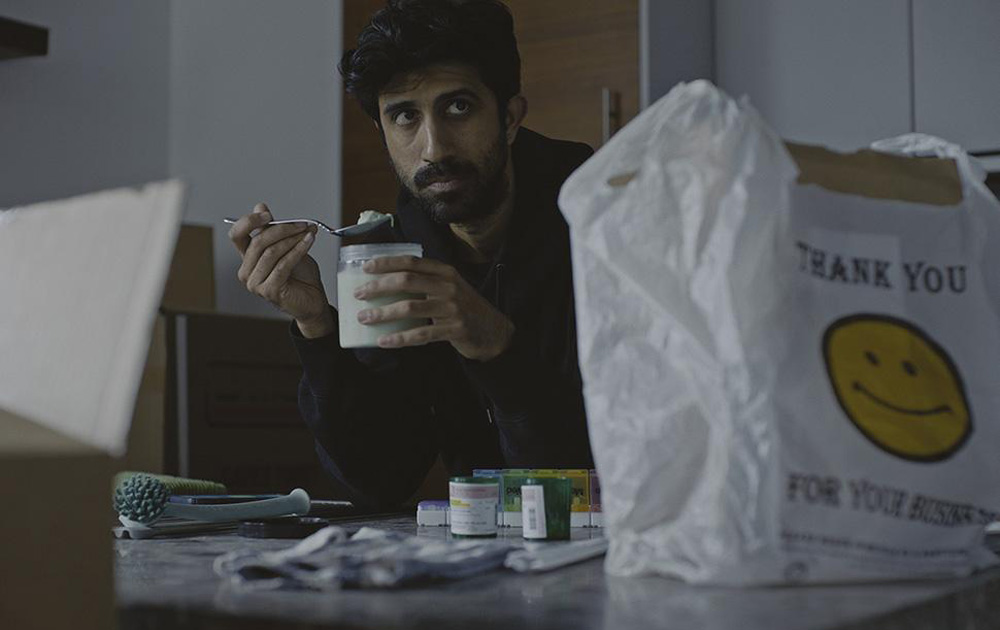
Yeah, with the character of Zainab, I wanted this older sister who’s often teasing her younger brother, and [with Sara Haider in the role] I was just so amazed by how you can’t actually see her, but so much is conveyed just through her voice, so there was a lot of playfulness and even some improvisation between [Sara] and Satya. One interesting thing was also Balinder Johal, who plays Nayyer, wasn’t on set until later and the last scene in the film, which is really important, [she and Satya] were not that familiar with each other at that point. There was still a lot to film with her, so [filming the last scene towards the beginning of her time on set] helped because sometimes there are these notes of revulsion in Satya’s acting [watching her eat]. I accidentally talked to them separately, so there were just these little surprises because of these two actors’ lack of exposure to each other socially that resulted in the last scene that I was really happy with.
What’s it like getting the film to Venice?
We’re all really excited. It’s not been shared with that many people yet, so the world premiere at Venice is the first big way that it’s going to be shared and I’m very interested in sitting with an audience and watching it with them. It’s our baby step out into the world, so I don’t know what to expect and I’m very excited at the same time.
As you mentioned, it’s your first narrative work. Was there something that motivated you to explore that realm from your previous work?
I started off with video art and then moved into experimental nonfiction film, and I was starting to feel a little bit frustrated with how often it felt like nonfiction was a mirror, but I was tired of mirroring, at least in my practice. I really love my community as an immigrant woman and Muslim from Pakistan, but we’ve done a lot of mirroring and what we’re reflecting isn’t that like interesting sometimes to me. I think fiction has this ability to create prototypes and to imagine new ways of seeing the world and being in the world that sometimes nonfiction can limit you with, so I was just very excited by the idea with my feature and with my short, just to mirror less and to imagine and invent more. Fiction allows that and you don’t have to feel as accountable to the way things are in the world. You can be more inventive.
“The Curfew” will screen at the Venice Film Festival on September 4th at 5 pm at the Sala Giardino and September 5th at 8:30 am at the Astra 1.