




If Chie Hayakawa made a striking first impression with her debut “Plan 75,” gently outlining a dystopian future in sensitively exploring how it hard it gets for adults as they age when society seeks to usher them out once they hit their seventies, her follow-up “Renoir” is equally arresting when it shows how it isn’t any easier when you’re younger, recalling her own youth in 1980s Japan where community was beginning to fray as televisions and phones could give an artificial sense of connection. It is particularly disorienting to the 11-year-old Fuki (Yui Suzuki), who is seeing her own immediate family fall apart, having her bedbound father Keiji (Lily Franky) at the hospital while her mother Utako (Hikari Ishida) works to pay off their mounting medical debt, leaving her to be a latchkey kid where independence comes at the expense of not having any idea of what to do with it nor examples to follow.
What results is a strange and occasionally surreal drama in which Fuki dabbles in telepathy, both making friends at school and discouraging others with rituals she’s learned from a psychic she watches on TV and participating in a dating hotline with a far less instantaneous response than Tinder, leaving a single cryptic message and letting calls come in from strangers. She’s an eccentric child to be sure, but no more than most it seems and her unusual proclivities aren’t discouraged by her parents who are too consumed with their own issues to pay much attention. It is noticed early on at a funeral she doesn’t cry as so many other parishioners do, but Hayakawa studies how Fuji gradually develops a conscience in strange times where it appears that society as a whole is becoming more and more desensitized as cultural priorities shift and there’s greater social stratification. While Fuki goes through the motions of a traditional childhood attending birthday parties and summer camp, an increasing sense of isolation sets in as she’s drifting into uncharted waters not only for herself, but her entire generation, perhaps becoming an orphan quite literally if her father’s terminal diagnosis comes to pass and the film bravely doesn’t romanticize such a precarious moment but sees the danger in it, making it all the more incredible should Fuki overcome the fear of the unknown.
Following its premiere at Cannes around this time last year, “Renoir” is now making its way to U.S. shores and with the assistance of a translator, Hayakawa graciously took the time to talk about the film which shares a real curiosity along with its protagonist about the world around her, as well as knowing how she got the right family of actors together for the story and allowing herself the freedom to understand the story she was really telling only when she reached the edit.
 From what I understand, you wanted to let emotions lead you in terms of the story rather than having a more traditional narrative drive. I wondered how did you find the structure for this?
Yes, when I began writing the script, I had various moments and episodes from my childhood that as a child I knew I wanted to translate into a film one day. I had collected all of those in a notebook and I had this stockpile of experiences and memories, so at the very start of writing the script, I wrote all of those out. I knew that it wouldn’t lead to a narrative that had a very traditional narrative arc, but that was my starting point for creating this story.
Then with Yui [Suzuki], after I met her at the audition, instead of trying to make her become the character that I had written, I wanted to incorporate characteristics that she already had into the character of Fuki, so I would say half of the character of Fuki comes from Yui Chan herself.
Once you brought Yui into the mix and saw her interact with Lily Franky and Hikari Ishida as her parents, did anything change your ideas?
I don’t think that there were big changes in the dynamic between Fuki and the parents. But when I got the three actors together to meet one another for the first time, we played a telepathy game. Yui would play the game with the person playing her father, and then Yui would play the game with the person playing her mother, and with the father, they played the game three times and his guesses matched hers one time, whereas with the mother, all three times they didn’t they didn’t, so it was interesting. Immediately, there was this dynamic of the father understands her and the mother does not, which was exactly what was written into the script, so it very organically fit into the roles of the parents and the child.
The film also has a perspective of the world with a certain innocence embedded into the camerawork. What was it like to find the right visual approach to reflect how Fuki sees the world?
I wanted for the darkness and death that Fuki witnesses, I wanted that to be represented with shadows and for the beauty that she’s able to observe and witness, I wanted that to be depicted through light, whether it’s from the sun or the light reflecting off the water and the river or even the campfire. I knew that I wanted there to be this contrast between the shadow and the light as a reflection of of what she what kind of things she’s observing.
 It’s not autobiographical, but when it is this era of the 1980s and it’s your memories, were there any production details that were important to include as part of the family home?
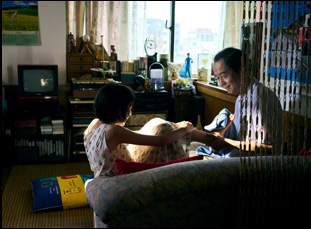
The production design is thanks to the art department that worked tirelessly to collect many different props from the ‘80s, but two key things were the TVs and phones. In the ‘80s, people had CRT TVs and they were always on in the households. Everyone watched the same programs and today we all watch different programs and many of us don’t watch television at all, but I knew that the presence of the television and how important it was in the household was something that was really important to depict. The phone was also important for me to depict accurately, a way that we could directly hear other people’s voices and connect with one another. That media was a very important part of living in the ’80s.
Was the dating hotline, which becomes a major storyline in the film, something that actually existed?
Yes, that actually existed and actually as a child I would sometimes call and listen. I never left any messages and certainly never met anyone. But it was like taking a peek into the world of grown-ups where men and women were were trying to to find lovers. I also think that I was interested in the kind of warmth that you can uh sense from a person’s voice.
How did the decision come about to set this during the summer?
Part of it was that I wanted to capture that feeling of summer, but also it was very practical decision in that the [actor] being a child, we needed to be able to have her on set for as long as possible, so naturally it had to be in the summer, [which] is also a very important moment for kids, for building their memories. It’s also that the protagonist is nearing the end of her childhood, so that overlaps metaphorically with this idea of summer and that period of freedom and fun coming to an end.
 What was the day like of shooting the summer camp scene with the big bonfire? It looked daunting.
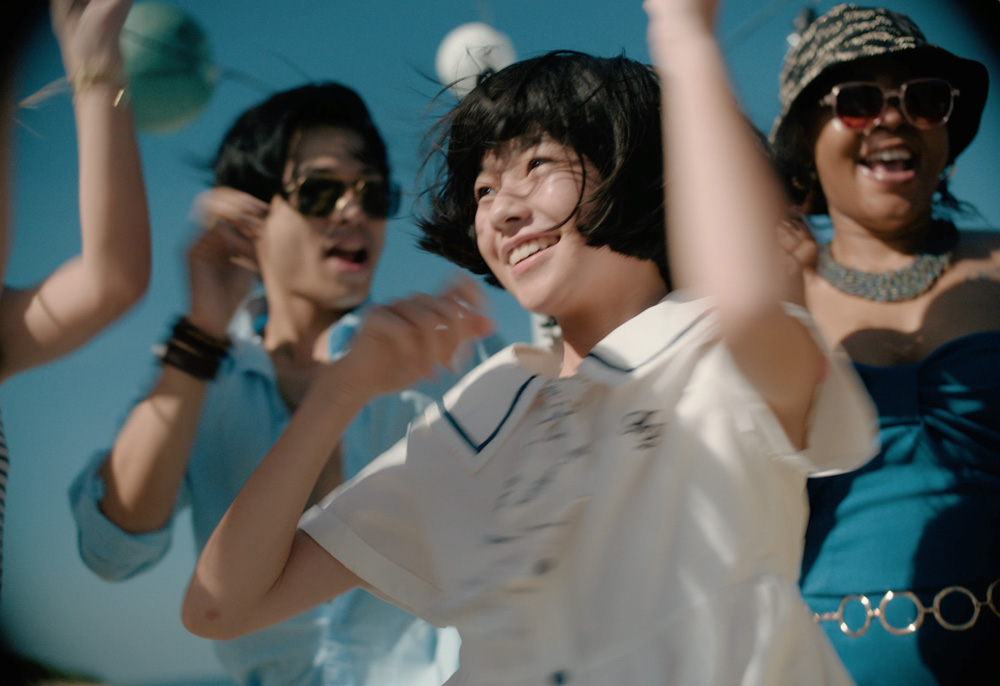
We had to make sure that the kids were on their way home by 8 pm and in the summertime, the days are very long, so there’s only a very brief moment that we were able to shoot at night and not only was it a short period [to film], but also the fact that they had to all dance, so I just remember it being a very challenging scene.
You’ve said before that through the process of actually putting together the film in post-production, the story really started to take shape. Was there a point for you that things seemed to click into place?
As I was writing the script and even while we were filming, I wasn’t sure what it was that I wanted to say, and it was during the edit when I realized that Fuki doesn’t understand yet why the grown-ups around her cry or the pain that they experience. But then through her experiences in that one summer, she finally encounters a kind of pain that makes her cry for the first time. That was the moment I understood what the film was about.
It’s quite moving. What’s it been like to see audiences engage with the film around the world?
I think that regardless of culture or environment, I think that this the feelings that children have and how they react towards their families is shared across all cultures. In that sense, I hope that the film is received and loved for a very long time.
“Renoir” opens on May 29th in New York at the IFC Center, June 4th at the TIFF Bell Lightbox in Toronto, a special screening in Los Angeles on June 5th at the Nuart Theatre, and June 12th at the SBIFF Film Center in Santa Barbara, the Gene Siskel Film Center in Chicago and the Cinema du Musee in Montreal. A full list of theaters and dates is here.