



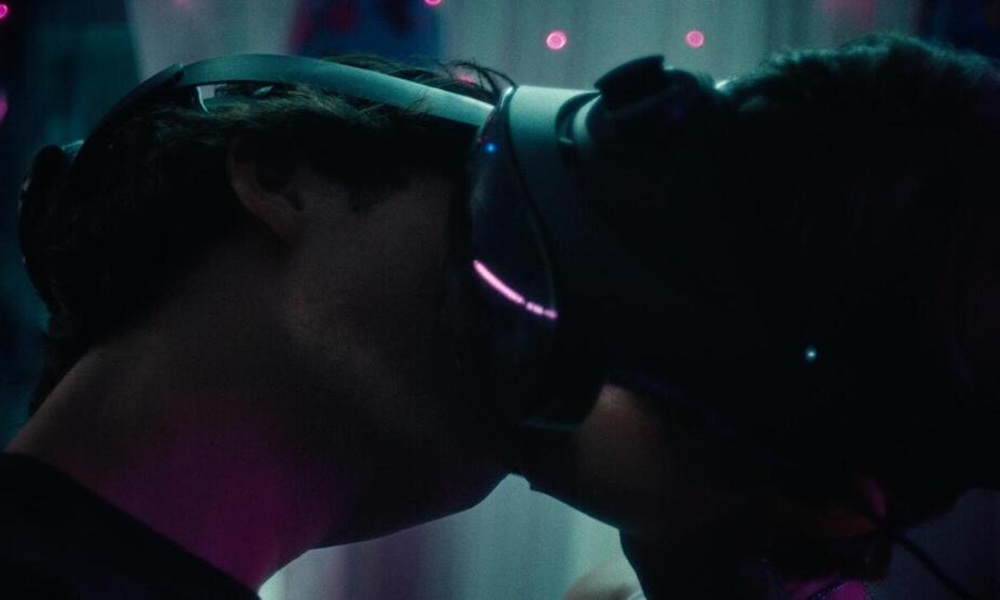

It’s a sly nod of what’s to come in “Verse” that of all the activities that Adam (Taj Cross) could participate in in the boundless world of virtual reality, he finds himself on a tennis court, playing doubles under the alias “BigAdam07” with “Princesssam” (Jesse LaTourette), just or Sam in real life, who would look more appropriate at a Sailor Moon convention than picking up a racket, but then again, getting away of some fixed identity is the reason for putting on a VR headset in the first place. The volleying back and forth isn’t limited to the tennis when Adam and Sam haven’t met in real life, but have developed an intense bond in the virtual space with director Noam Argov moving between worlds where both Adam and Sam can present as brawny and buxom, respectively, when creating personas with their own specifications, seemingly unconscious of the fact that they appear just fine from the way that they were born, making an actual IRL meeting a daunting prospect, though they live not far from one another.
There’s always going to be a little distance between them as close as the two get, strikingly expressed by the moment in “Verse” when they do finally meet in person and try to kiss and their headsets only allow them to get so far, but Argov bridges the gap far more elegantly in the ambitious short where the teens contend with not only the confusion brought about puberty and impending adulthood but in this present moment, being able to feel things in the digital realm that they can’t find in their physical reality. Argov and her sister Sappir, a longtime actor credited as a co-writer here, create a compelling tale around the sensation of touch when both tenderness and pain are perceived acutely by Adam and Sam in VR and it’s the physical world that can make them feel dead inside. But as a bully comes to terrorize the two in the VR space, it can look much more of a confining experience than what they already have in reality if they find the courage to express themselves fully and when Argov vividly renders both spaces in all their emotional intensity, connecting separate productions seamlessly, sparks fly in all kinds of ways.
With “Verse” recently making its premiere at Tribeca, the Argov sisters generously took the time out to talk about how they came to collaborate on their first professional project together as co-writers, how the technical demands of the 18-minute short required a two-and-a-half year production process and putting a lot of themselves into the film in every sense.
It’s so cool that one of you went into directing and the other into acting. How did that split happen?
Sappir Argov: I think I always wanted to do acting, but we were both always interested in writing and later Noam got interested in in directing too. We realized we were on all sides of the camera, so we tried to combine our efforts into this one big brain and start working together.
Noam Argov: Yeah, there was something there for sure. Sappir’s a natural born actress and then I came into it a little later. But we we grew up loving movies. So I think it was always bound to happen.
How did “Verse” become the right thing to collaborate on?
Sappir Argov: Noam originally brought the beginnings of the concept to me and Noam grew up very much as a gamer girl and I was a little bit more of the girly girl. But I grew up having some body dysmorphia and being bullied at an early age, so we combined both of the experiences we had growing up and we conceptualized this story about Adam and we thought It would be great to work on it together.
Noam Argov: Yeah, and then it also is so timely sadly, but luckily all these things are converging like online culture, body image, filters, avatars, and embodiment online, so maybe it makes sense because we grew up um around these things.
Sappir Argov: I had Instagram when I was 11, when it first came out, so it was the basis of my whole preteen life.
Is it true you did research into actual neuroscience?
Noam Argov: Yeah, the project was funded by the Sloan Foundation, so we got partnered with Dr. Eric Leonardis, a neuroscientist at UC San Diego and from the jump, as we were writing the script, we were going back and forth with him and his research into what’s called cognitive embodiment — how do we identify with our bodies, and what in the brain allows us to identify with our bodies. I don’t know if you’ve heard of things like the rubber hand experiment where they put a rubber hand on one side of a wall and they smash the rubber hand with a hammer, but it hurts your hand. Everyone automatically flinches, so we dug into that. We also consulted with a lot of VR influencers and gamers who clued us into Phantom Touch, which features briefly in the film, but how people actually feel their brain will trigger sensation when they’re being touched in virtual environments, even though they’re not physically being touched.
What Eric explained to us so much of it is sight and sound, which is so interesting for filmmaking, to just put it to a macro scale, like haptics were such a big thing in “Existenz,” “Ready Player One,” all these movies about VR from the last couple decades, and I think neuroscientifically we actually know that that’s lower on the scale than really just sound and sight, which I think explains why body horror is so compelling in cinema. So it was really interesting.
It’s really interesting that you end the film where it could begin and vice versa, by throwing audiences right into the VR world and then finding out the rules at the end. How did the structure come about?
Sappir Argov: We wanted to create this unified version of the game world and the real world, but like you said, throw the audience into this reality so it feels as real to them as it does to our characters who are constantly in it and use that world as their daily lives in a way and have this virtual relationship, so by throwing the audience in, it makes everybody take the world as status quo. Then suddenly we’re thrown out into into the real world and that’s really fun to play with.
Noam Argov: Yeah, we talked a lot about subverting how can we teach the audience that this is the world and then show another world and the structure of the film is really Adam’s internal experience of conflict between his virtual world and who he wants to be in the game.
What was it like to figure out how to how to do a production in two separate realms?
Noam Argov: It was so hard. From conception to finished product, the film took two-and-a-half years, which is a long time for a short film. But we’re very scrappy. We didn’t have a ton of money and it was my thesis, so it was a student film budget. The overarching plan we came up with is that we built the virtual set of a fake VR game in a game engine. We designed the characters and then we used motion capture with the real actors to shoot the the VR portions, the in-game portions, so what we did practically is we shot the all the live action footage first. And then we did the motion capture and by the time we got to the motion capture, they had lived all of their characters, so that was fun to play with.
Sappir Argov: I’m happy we structured the shoot that way because we got to to learn about them as actors, who came in and and gave it their own essence and then we got to build the the online characters with a mix of what the actors gave in and our original writing.
That is quite a commitment. How did you find Taj and Jesse?
Noam Argov: Yeah, we worked with Danny Gordon and Charlene Lee, who were absolutely wonderful [as casting directors] and Taj I had actually seen in a short film. I knew him from “Pen 15” and then I had seen him randomly in a short film of a friend that was also about social media and parasocial relationships and influencers, so I [thought], “Okay, there’s something here.” He’s just so nuanced in his acting, and also just such a pretty boy, so I [thought] this will be so much fun for him to jump into this character. And if you look at films from the ’80s, I think the instinct for a character like this is [for it to be] the nerd with glasses and scrawny, and what’s different in 2026 — and probably has always been this way — is that we all feel self-conscious. It doesn’t really matter what you [look like]. He doesn’t need to be classically nerdy, like we’ve been taught visually.
Sappir Argov: Yeah, and now with social media, I think people are realizing they’re a lot less alone in how they feel about themselves than they thought. So it’s good to see someone like Taj and Jesse, who are beautiful people, and they’re great actors, but it’s [making the point that] anyone can feel bad about themselves and want to look differently. That was part of what we were going for.
Was it interesting to connect the camerawork in the VR section where there was no limits to angles to what you could accomplish in reality?
Noam Argov: Yeah, we had a lot of restrictions, but it was a very collaborative process. We had an animation studio that we worked with, but mostly Stefan [Nachmann], our cinematographer, and I talked a lot about restrictions, which everyone says this, but it’s true – restrictions create creativity. We talked a lot about game mode versus cinema mode. In the game, when are we in [Adam’s] point of view, the way someone would be seeing it, we actually experimented with every time we were in the game just being in a first-person point of view, but everyone felt nauseous and we had to scrap that. But it also made the editing easier. We thought a lot about when in the game are in Adam’s game perspective versus when are we creating a more cinematic moment that we recognize from film visual language, so merging game visual language, which everyone now is really familiar with, and cinema visual language was super fun and exciting. The big thing for us was I wanted the [climactic] assault to be in [the game] POV.
Sappir Argov: Yeah, it was important for us to use specific moments to let the audience feel as if it could have been them playing the game.
The sound is also quite effective – or rather the silence that occurs when something like the kiss happens since it’s so unusual. What was it like to work on that part of the process?
Noam Argov: We worked with Daniel Timmons, an amazing post sound designer and I’ve worked with him on everything. He’s done a lot of bigger films and has been so kind to grow with me as a director. What we did for the biggest hurdle for sound was two things. One, how the in-game sound [would sound] versus outside in a way that’s not jarring. If you’ve ever played VR, you can hear conversations as you get closer to people, so we experimented with actually how games work with sound spatially. Then the second thing was the haptics because we did want to touch on the vibrations and that took a really long time to figure out. What Dan and I ended up doing, which was totally Dan’s idea, was to rig a PS5 controller to a synthesizer [because] PS5 controllers respond to in-game occurrences with the vibration. So we were watching the film and live scoring the haptics, if you will, on a piano, basically connected to a vibrating actual game controller. I think you hear a little bit of that in the kiss, but the kiss, phantom touch and the assault are the big moments [for sound], and then the song at the end is actually all composed on the PS5 controller.
Sappir Argov: Yeah it really blends the two worlds in a way that’s really fun and interesting because you feel as if you’re a part of both of them simultaneously.
After two-and-a-half years, what’s it like getting the film to Tribeca?
Sappir Argov: It’s so exciting. It’s crazy to have a project that one day it’s there on your computer and the next, you’re watching it [here]. Obviously there’s so much of a process in between those two, but it’s really exciting to have our vision come to life and and and tell the story we wanted to tell, collaborating with everybody who’s a part of it. I’m really grateful and really excited about it.
Noam Argov: I’m still on cloud nine from the premiere, and sometimes you can really feel the audience with you throughout the film and in the room. It was one of those magical moments that you dream of where everyone’s on the ride. I [thought] “Oh my God, let’s make another one.”
“Verse” will screen again at Tribeca on June 13th at the AMC 19th St. East 6 at 9:15 pm.