



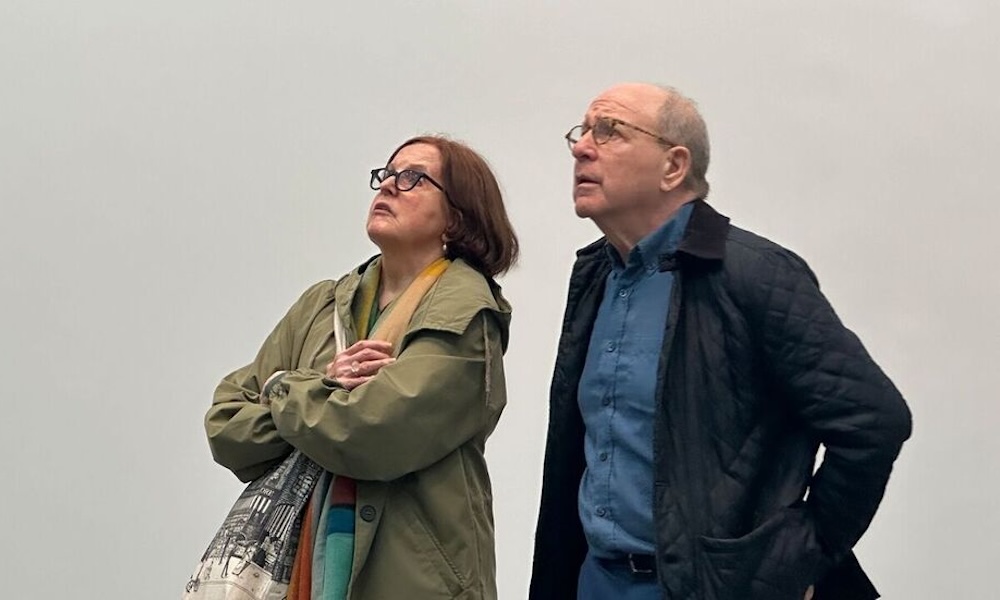

Jerry Saltz and Roberta Smith will frequently marvel throughout “House of Criticism” about how they can look at the same thing and process it so differently as two of America’s preeminent art critics for New York Magazine and the New York Times, respectively, and as a married couple. Though Smith can’t imagine taking a break from her writing as Saltz does to get coffee with a friend – she’ll have him pick up some from a local bodega to refill a Double Gulp mug to keep her going, the two are seen as largely inseparable, visiting 25 to 30 galleries a week for the job, never in such fierce disagreement that they’ll stop talking to one another, but clearly different enough to keep things interesting as the more enthusiastic Saltz will instantly come to conclusions that the more reserved Smith will take time to properly process. One of the biggest laughs in the film comes from one of its most telling moments when Saltz candidly asks if his memory is right that they slept within a week of their first date at a Rauschenberg exhibit, to which Smith demurs as much out of her better judgment as modesty.
In director Alison Chernick’s altogether delightful profile of Saltz and Smith, both his boisterousness and her introspection are on full display, as well as how complimentary those seemingly opposing personalities have been in building a rewarding life together as well as a career in criticism when they’re constantly challenging each other. Shown quite literally finishing each other’s sentences when working out reviews, the film tucks into Saltz and Smith’s Manhattan apartment where evidence of the extraordinary sits around the room from Saltz’s 2018 Pulitzer Prize to pictures of Smith’s time working for the artist Donald Judd, whose shrewd purchase of a building on Spring Street in the late 1960s gave a number of other important artists a playground to grow in the city, but the two will often sit at their computers in separate parts of the house shouting back at one another as they work on pieces. The takeaway rotisserie chicken from Gristedes that’s become a regular meal as they burn the midnight oil will disabuse anyone of the notion that they’re living a tony life of gallery openings and afterparties, but the film captures that high for finding the right adjective and the rewards in general of thinking through what wants to be said. (A particularly moving part of the film is how Smith considers this over a longer period of time than just one review, growing as a critic alongside specific artists who have come to surprise her for better or worse as she herself will find new things in the work from their past that she couldn’t see when she was younger.)
Chernick resists the usual temptation of having a cavalcade of artists speak to what importance Saltz and Smith have in the art world ecosphere throughout the film. Impressively, it goes without saying as inserts of lectures and artists talks they’ve conducted seamlessly show their contribution to New York’s cultural scene while illuminating their practice. Only close friends Carroll Dunham and Laurie Simmons – and yes, their daughter Lena, a goddaughter to Saltz and Smith – get significant screen time, really engaging as one couple to another rather than any talk of work. Having so admirably authored their own story as individuals when both recount unlikely paths to their current positions — with Saltz recounting a visit he made to the Art Institute of Chicago with his mother two weeks before she took her own life and Smith recalling an upbringing in Kansas that hardly suggested she’d find her way to New York — the two can reliably be counted on to tell it themselves in a compelling way. The film would be satisfying enough when simply spending time in the couple’s company, but it does curl around to having a narrative hook as Smith contemplates retirement, leading Saltz to talk to all the legendary figures in their orbit in an effort to give her her flowers. By then, what would appear as a grand romantic gesture by anyone else’s standards simply looks like business as usual for the pair that, whether holding hands or digging their feet in during a debate, are always showing their affection for one another, saying something profound not only about them but their profession when to be critical is to show how much you care about something.
“House of Criticism” will screen again at Tribeca at the Village East on June 13th at 2:30 pm and June 14th at 8:15 pm.