



Language is often quite literally at the center of “MexicanAmerican,” with director Eddie Sánchez placing subtitles in the middle of the screen as his parents will tell the story of their family in Spanish, their primary tongue, while the translation to English isn’t always only for the benefit for audiences abroad, but for the filmmaker himself when he was raised across the border from them, perhaps geographically within a few hundred miles but by all other measures a world away. Lalo, his father, can remember how it was the goal to work in the U.S. when he could remember everyone coming back in nicer clothes, though he and his wife Beby were far more enamored of their life in Mexico where they first met and fell in love and after they tried an arrangement where he would make trips north from Jalisco to make money to send back home, Beby grew tired of missing him after seeing so many other families broken apart after moving full time to the States, though she would give birth to Eddie in the U.S. with the idea that he could ultimately decide for himself where he would like to live.
The basis for “MexicanAmerican” is actually drawn from the video tapes that would be traded by Lalo, Beby and Eddie via his aunt, who cared for him in the States, and to a certain degree, Beby’s fears were realized despite her best intentions when the family bond was never severed, but certainly strained by the growing disparity culturally between the parents and their child. In America, Beby could never feel comfortable helping her kids out with their homework when despite being a top student herself, the assignments would confuse her in another language and in the present, Eddie will occasionally have to search for the right words to interview his parents in Spanish when English is his preferred language. Although at the time of filming the videos in the 1990s, the scenes of quotidian life that were shared may not have seemed all that important, the present day reflections bring them to life when they can reflect a distance that was there even at the time of experiencing them in the moment for those behind the camera and certain things can only be seen now within them with the perspective of time. While Lalo and Beby can start to understand the alienation Eddie felt during family gatherings where he could feel left out of conversations in Spanish, the director can start to make sense of the paradox facing his parents of doing right by the family when it was believed there might be better opportunities for their children elsewhere but wanting to remain home and connected to the community when only there did they feel like they had a stable foundation.
When Eddie learned the lingo from television, a byproduct of having few friends to converse with on either side of the border, it becomes fitting that he speaks so eloquently in a visual parlance where the home videos are occasionally broken up by what was on at the time, perhaps showing signs of tapes being rerecorded over but also providing glimpses of the world going on outside that was shaping the family’s consciousness and “MexicanAmerican” ends up speaking to the complicated relationship between the national neighbors as much as the one that’s between Eddie and his parents, as well as that of his brothers. With the film recently premiering at Tribeca, Sánchez graciously took the time to talk about the making something meaningful out of a difficult adolescence, working with his brother Eben on what was strictly set to be a school project until it was obviously something much more and being able to present a past that never entirely goes away in the present.
From what I understand, this started as a school project and not even really your own – how did you end up taking it on?
Yeah, my brother [Eben] was applying to film schools. We’re about nine years [apart] in age, which is pretty significant, but he needed something for his portfolio and it was during COVID, so I didn’t have anything going on. I just watched “ItalianAmerican,” the Martin Scorsese documentary about his parents and I thought, “This is a really simple idea,” and we made this five-minute short after doing these interviews [with our parents]. I was actually Zooming in from New York City because they’re in Oregon and [Eben] was co-directing, being the physical presence back at home. After we cut it together, we had all of this excess footage and I thought we could turn this into a feature, so I kept fiddling with it and for six years, on and off in between projects, I would come back to it. Then I discovered the the VHS tapes and with that, it became what it is today, and a more interesting formal experiment for me to take this footage and repurpose it into this feature that has all of these surreal images almost taken out of context to create a narrative out of.
I’ll jump right in and ask, did you know the footage could align with the interviews you had done when there isn’t always such a direct connection?
I knew that it was possible because some of my biggest inspirations for this, aside from the Martin Scorsese doc, were “Cameraperson,” the Kirsten Johnson film, “Hale County This Morning This Evening, and the work of Adam Curtis, all of whom have this uncanny ability to create a narrative out of seemingly unrelated footage. Adam Curtis, for instance, uses archival that has like nothing to do with the storylines that he works from. So I really studied those films and those filmmakers to really play with this idea of associative connections between footage and the narrative. We had the interviews of my parents on top of everything and I was almost striving to not make the most obvious decisions. There were times where they’re talking about a dog, so I found a footage of a dog, but oftentimes I wanted to really use other elements than that were that were maybe less literal and more focused on an emotion that would make sense psychologically for the viewer. That all came from those influences.
Most of those films you mentioned are directed towards a strictly English-speaking audience, which allows the narration to really do the heavy lifting. What was it like thinking broader with a Spanish-speaking audience also in mind?
From the get-go, I knew that it would appeal to people generally just because I think that my parents are very charming individuals, whether or not I knew or even understood what the story would be. I knew that they would be the hook for folks because they’re very funny and I trusted that the universality of their story would would translate across to other languages. I do feel like the use of the subtitles was something that was going to be important because I knew there would be a lot of them. I wanted to make this an international film that could speak to people of any language and I hope that as we look to distribute, we can recreate the subtitles with other languages. But I also wanted to do the translations from English to Spanish in yellow versus the Spanish to English in white so that we have those [distinctions] and I really did think about how the mechanics of the translations would be important to other languages. And the topic of immigration is not one that is specific to the United States. All over the world we’re dealing with a lot of xenophobia, and just the subject matter alone, more so the perhaps than even the filmmaking, would be my biggest translator.
When both you and your brother continued to work on it, how did you decide it would be told from your point of view?
I didn’t really want to be a part of it in the beginning. I really wanted to just be the director and step back and make it more of a biography about [our parents]. I quickly realized that one of the most important things in their biography is the birth of my brothers and I, so I knew I had to get involved, but at the same time, I felt that my middle brother had the strongest amount of conflict between my parents and for the purposes of a film, it was a lot more dramatically interesting, but still relevant to what I was going through when my main thesis for the film was bridging this gap between the person I became trying to fit in in mainstream American culture and the people that [my parents] were, being so deeply rooted in the rural Mexican Catholic background that they come from and how those differences led to this distance between us and being able to relate to each other. But whenever I would put in my voice in, I wanted it to be as minimal as possible and to just keep it to on screen captions as minimally as possible and let my three siblings do a lot of the talking for the more extreme versions of the things that we were dealing with growing up.
When you’re making a movie, does it feel like a protective shield to ask things of your family that wouldn’t generally come up?
That’s so funny you put it that way because I feel like a lot of people have been asking like how did you get so candid with them? Or was it difficult to to get them to loosen up? But I think that the fact that it was a film helped us to really catalyze those conversations in ways that I don’t think we would be able to uh get to otherwise because there wouldn’t be a point to it. Obviously [you could] have like a family therapy session to really work through these issues, but the goal of making a film almost drove us to be subconsciously, maybe more interesting and so more honest as a result. I’m really grateful for my brother and I to have had this idea to create this film because it did allow for these questions that I’d always had on topics that can sometimes be very uncomfortable, but we had those conversations with my parents.
Was there anything that changed your ideas of what this was or took it in a direction you didn’t expect?
There were several sessions of interviews, and originally I didn’t want to really be a part of it, so I was mostly asking my parents about where they came from, how they made it to the U.S., and why they made those decisions. And in subsequent interviews, it then really became like, “Hey, Dad, I remember this one time when I was in my early teens and you asked me ‘Are you are you racist against Mexicans,’ because of the way that you have a hard time participating with our family?” That was a really intense question for me. But it also felt like that is the reason why I was making the film in the first place. I was seeing myself distance myself from a heritage that is so beautiful, so rich and so diverse in and of itself that I set aside in favor of the mainstream. Because of this film, I discovered that the real thing that is going to move people is the thing that is hardest for me to talk about — the lingering guilt that I had about how I neglected my own culture for so long. Once I just started to become more comfortable with how much more I was going to involve myself in this, that shaped the direction of everything, including with the videotapes. That made it so that I originally wasn’t looking for clips of me in there, but now I’m going to go back and look at all of those clips. That’s how the movie came together.
I was quite moved to learn that the reason the tapes were filmed in the first place was so that you and your family could share each other’s experience across borders. Did the context in which they were made affect how you wanted to tell this story?
It was a head trip and secretly one of the things that fascinates me most about the project Is that I am watching videotapes that were created to transcend this border, separating my family from their family back home that they couldn’t physically be with. And as I’m watching them, I am seeing my own early life happen before me in these videos and it’s as if I’m seeing the world through my parents’ eyes. And now I’m taking those videos and creating a home movie of my own to now a different, more figurative border with my parents, as our understanding of the world, our values, our cultural frames of reference were diverging. And I am the one creating this film out of the footage that my parents shot, communicating with them through their communications with me and with their family. So there’s layers to that that really excited me and really made me take this seriously beyond a project that I was doing with my brother for his college applications.
Another great part of this is setting up the cultural context of this by making the home videos seem as if some might’ve been recorded over some TV at the time and there are points where the music seems quite organic yet I imagine you really played with some of the cues. What was it like to incorporate pop culture into the fabric of the film?
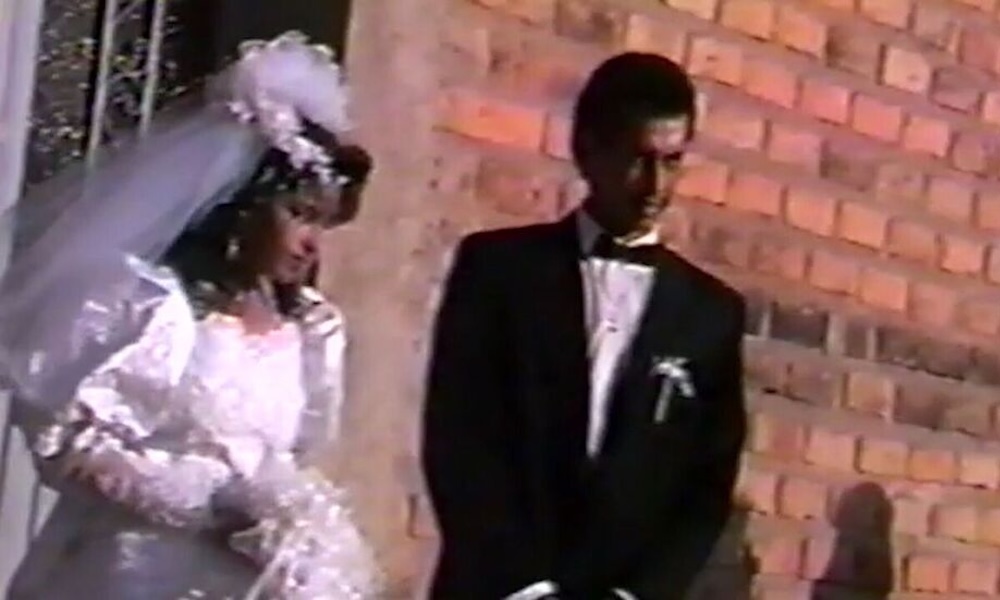
That was really important to me because what was really exciting [because] for those of us who are old enough to remember, if you put a VHS tape into the VCR and you’re just flipping through channels, sometimes you accidentally press a certain button and it records the TV broadcast on top of like your wedding video. There was something about it that felt so alien and so intrusive on these quotidian family videos that I think was so perfect because at the end of the day, this [film] is all about culture. This is all about me interrogating the media diets that we were each having at the time. and the differences between what my parents were interested in and what they consumed and how that shaped their identity [versus] how my identity was shaped through what I was watching. And I wanted to use this medium of documentary and archival essay film as almost extra-dimensional transmissions that was representative of how we looked at ourselves or what we identified with at the time. That was my favorite part of the project because all of those clips were in the videotapes as is. I barely even touched them.
It makes it feel really handmade and heartfelt. What’s it been like sharing this with audiences this week?
This week has been one of the most extraordinary weeks of my life. This is my debut feature and my first time applying to film festivals and for this to be my first film festival, I’m so lucky and so grateful to Tribeca for that. It’s very overwhelming and I’m very tired and would like a nap, but I’m sure it’s going to ruin film festivals for me for the future, just because I am having such a great time and Tribeca really takes care of their filmmakers, especially really putting their money where their mouth is in terms of platforming new talent in a way that I’m incredibly grateful for.
“Mexicanamerican” does not yet have U.S. distribution.