




Eran Riklis may have been an unusual choice to direct “Reading Lolita in Tehran,” Israeli by birth and British-trained as a filmmaker after spending much of his early life abroad in North America and only hearing of the Islamic Revolution on the news, yet like so many that picked up Azar Nafisi’s bestselling novel, he couldn’t help but be moved by the idea of stories that transcended cultural borders. It’s what he’s long dedicated himself to in his own work, breaking through on an international level with “The Syrian Bride” where he also helped raise the profile of Hiam Abbass with the story of a marriage potentially imperiled by the cultural conflict around the couple and went on to team again with Abbass on “Lemon Tree,” in which a Palestinian widow takes a stand against the encroachment of member of the Israeli government who’s just moved in next door, and though he didn’t instantly understand some of the words being said on the set of his latest film, he understood the fundamental sentiment in casting a lens on a collection of women whose book club becomes a refuge in a country that fails to live up to the promise of freedom that propelled the Islamic Revolution of 1979, ultimately returning to the rule that people fought against in the first place.
The adaptation of Nafisi’s memoir pulses with the spirit that the women surely felt reading books by Henry James and Jane Austen, starring Golshifteh Farahani (who previously appeared in Riklis’ 2017 drama “Shelter”) as the future author upon her initial return to Iran to teach at a local college, planning to rebuild the country in one way as her husband works towards a different kind of foundation as a civil engineer. However, reviving the dream of the country they grew up in is quickly subject to the reality that authoritarian rule hadn’t died with the overthrow of the Palahvi family as the Khomeini family took power and only a brief window of time opened in which women might be treated as equals and outside culture was embraced. Still, it’s cracked open just enough for Azar to introduce classics of English literature to a group of students who stick with her even after a crackdown begins, with abayas once again necessary for women to walk out into public and foreign books considered verboten by government officials. Though some are imprisoned for any measure of protest or subject to horrific treatment within their own homes when husbands can act with impunity, the ability to gather and discuss their own experiences under the guise of novels in which they can fully lose themselves in proves liberating.
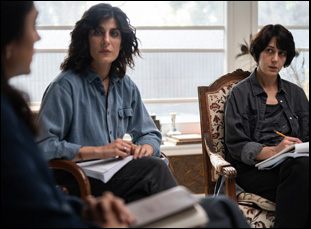
“Reading Lolita in Tehran” would seem to make a statement in itself when it brings together an impressive ensemble of Iranian exiles, including Zar Amir of “Holy Spider” and Mina Kavani of “No Bears,” as Nafisi’s students, though Riklis delivers a breezy entertainment where time flies by in the decades-spanning drama, not losing the weight of the experience that Nafisi had yet appealing to the same energizing sense of resilience and resolve that left readers unable to put her book down. With the film now arriving stateside after premiering at the Venice Film Festival, Riklis spoke about what drew him to the story as well as why it wasn’t as crazy as he might’ve thought to volunteer his services to direct it and making accessibility a priority when the story itself was about how culture can cross oceans.
 How’d you get interested in this?
I read it in 2009, and this was after I did “Lemon Tree” and “The Syrian Bride,” so I was already in this world of women and resilience and political situations. I felt, “Wow, this is a story I can tell.” But then I said to myself, how am I, as an Israeli director, going to jump into this Iranian world? It seemed quite complicated and I was already busy with another film. So actually it took me another four or five years to come back to the book and I was surprised that it was not made in America because it was a very popular book here. So I looked up Azar Nafisi on Facebook and I found her. We talked on the phone and the first question I asked her was, “Is it okay that an Israeli director will tell your story?” And she said, “I think it’s fantastic.” So I traveled to Washington and I came back with the rights and I jumped into it. It took me a long time, both to get the script developed and to cast the movie, and to find the money, but finally here we are.
When you make a film like this, you end up surrounding yourself with Iranian exiles, at least in the cast. Was that interesting when you might’ve felt like an outsider to the culture coming in?
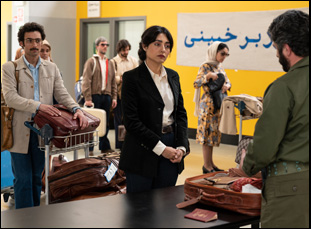
Yeah, I have good partners on the screen and everything is very accurate. The language is very accurate, the setting is very accurate, and behind the scenes, I also had some advisors. But I in a way I trusted my instincts because I did a lot of research into Tehran of the ’70s and ’80s and I remember walking into the University of Rome — because we shot the film in Rome — and I said to my crew, “We’re going to shoot the Tehran University here,” and they said to me, “Are you crazy? How do you know?” I said, “I don’t. I just know.” And then a week later my Iranian advisor came to check the locations and I was really nervous that he’s not going to like this particular location. He walked in and he started crying. He said, “My God, you’re taking me back to my days as a student in Tehran.” So it’s always a meeting between the facts that you have to research and you honor these facts and on the other hand, you have to trust your creative instincts.
But it’s not a very big budget. You’re not in Tehran, so you’re working and I have to make sure that [for instance], looking at the bookshelves behind you, these books were really published in Iran because if not, I have to take it out. I spent a lot of time making sure that the small details are totally accurate. And I can tell you that today, after many screenings with Iranian people [abroad], I get only compliments on the fact that everything is accurate.
 You previously worked with Golshifteh Farahani on “Shelter.” Was she in mind from the start?
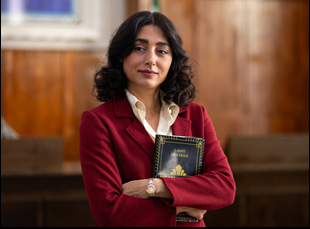
It’s an interesting story because when I talked to Golshifteh, she said, “I’m not sure I want to do a Iranian story.” She didn’t do any movies [set in Iran] since she left Iran in 2008. She did a film with Ridley Scott and she had a lot of problems and she said, “I don’t want to go back there. I’m now a European actress,” and I said to her, “yes, but Golshifteh, this is you. It has to be you.” And she said, “Okay, but you will never make the movie anyway. You will never find the money.” [laughs] So she wasn’t worried. And then when I called her [saying], “Listen, I have to financing. I need your answer now,” she said, “Okay, I’ll do it. But she was the natural choice for this because she has the talent, of course, and she has the charisma, and she also has the history, which was very important.
The film definitely acknowledges the painful history of Iran and you’re able to elegantly tuck the more traumatic moments into the story without overwhelming the overall narrative. Was it difficult to find the right tone.
It was really feeling not to be afraid of anything, so I was testing myself in a way, even as a filmgoer that “Okay, can I manage a moment of violence when a woman is whipped in in the jail suddenly [juxtaposed with] a nice moment at home.” I felt that after we see so many things all the time on the news and in cinemas and on TV, we as people in the world today are very trained to watch extremes, so I was not afraid. And again, I trusted my own emotions and instincts, but I was not afraid of anything, and the book, beyond the story, is quite intellectual, and quite sophisticated in terms of literature and I tried to make it accessible to a wide audience.
I felt I had to reach out from a common place to really make sure that everybody can understand this and when I say everybody, it’s not only every walk of life, but also every nation. It’s quite a sophisticated book, [especially] when it comes to literature [too], and my editor kept saying to me, almost like a joke, “Who’s the Great Gatsby?” Never heard of him. “Who was Lolita?” Never heard of her. So it was almost like, let’s make sure that everybody can connect with this movie.
 Was it a challenge to tell a story across a long period of time like this with the same cast?
That’s probably one of the biggest challenges because on one hand, I wanted to be a little bit adventurous and play with time, even if, for a moment, it’s difficult for the audience maybe because they’re saying, “Where are where are we now? Yet I said to myself, time and place is something you always play with, so it’s not even adventurous. There’s always this tension between convention and revolutionary ideas, so I was trying to play between those. This was not difficult, but it did take some testing when we jumped from 1979 to ’95.
What was it like to find the right color palate for it? It has a liveliness to it, even if it remains subtle.
That was a very big choice of both me and Helene Louvart, the DOP. I chose a woman because I felt it’s important that the woman is with me there, especially the intimate scenes and we chose a color palette, which is [a bit] subdued. But you feel the energy underneath it because when you think about Iran, the color palette that we know nowadays is very monochrome, like black [with] all these women in veils, but underneath is a whole world, so that was a little bit my approach in terms of [thinking of it as a] monochromatic world that is full of color underneath.
Did anything happen that you may not have expected but made it into the film and you really like about it now?
Everything was very carefully planned because it’s a difficult movie, mostly in Farsi, which I don’t speak, so the whole thing was quite a process But there was one scene that was not in the script, and I kept telling my assistant director, I need to do this scene and it’s when Azar is in front of the mirror and she puts on the veil and then she takes it off and she goes to the university and then she gets into trouble. I felt that I need this moment of her with the veil, looking at herself into the mirror, saying “Am I obeying the rules or not? And she decides not to obey them at that given moment.” And I fought for this hour that I needed in the schedule, but I found it and in retrospect, it’s a small moment but it’s very crucial because it’s almost like a turning point in the movie.
What’s it like getting this out into the world so far?
It was actually our world premiere was in Rome, they told me, “We have the biggest red carpet in the world, even bigger than Cannes, so I said, “Okay, nice.” And we brought all the actresses to Rome, so it was quite an image of all these amazing ladies and the male actors and that was the beginning. There were about 700 people and it was fantastic. There was a standing ovation and when I think about the release in France and Spain and Italy and Germany, all these countries, sometimes you think, “Okay, maybe there’ll be some trouble, because the whole Iranian and Middle East situation is so conflicted at the moment. But I’m happy to say that so far, the film is so well received and all I was met with was sympathy and support.
“Reading Lolita in Tehran” is now open in New York at the Angelika Film Center and New Plaza Cinema and opens in Los Angeles on July 17th at the Laemmle Royal before expanding across the country. A full list of theaters and dates are here.