



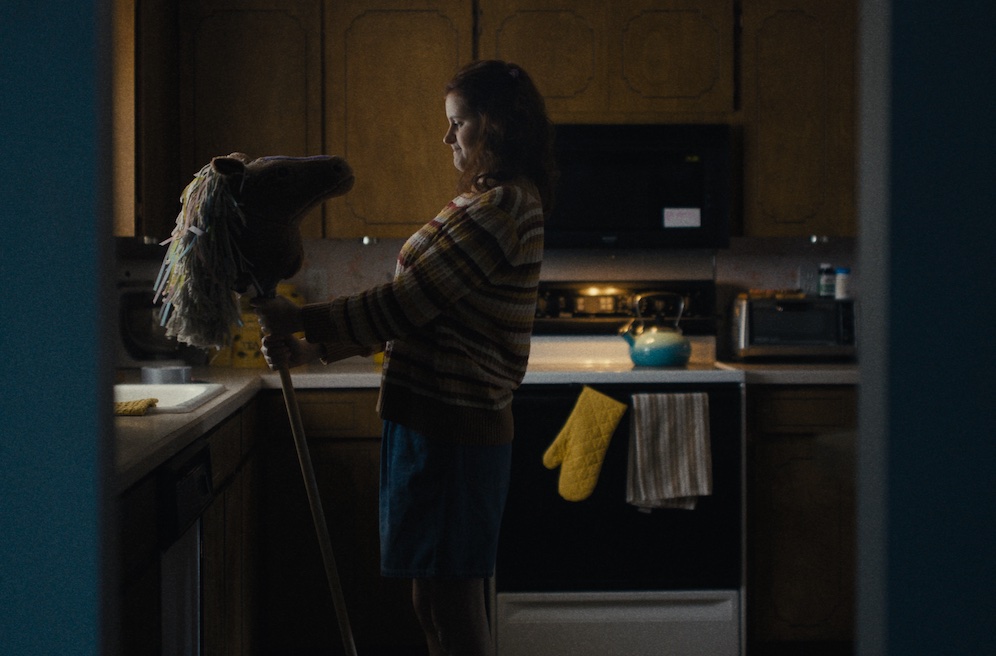

There’s a glow coming from inside a dance studio in “Horsegirls” that Margarita (Lillian Carrier) can’t help but resist the pull of, about a decade older than the 12-13 year old girls inside who are prancing about on hobby horses, but as they imagine everything from the neck down on the faux animals, Margarita’s own mind reels at the possibilities. This isn’t the first time she’s felt as if she’s been on the outside looking in as someone on the autism spectrum, but something’s different as she’s moved to actually take steps inside — her mother Sandy (Gretchen Mol) has been gently prodding her to start taking on the responsibilities other young women of her age would in terms of getting a job, but the hobby horses have a strange, irresistible appeal that don’t come with any expectations but her own and soon enough, she’s signing up with Coach (Jerod Haynes), who runs the extracurricular activity and is thrilled to have her if for no other reason than it gives the squad the right number to be a part of the state competition.
The feeling of invitation to be a part of something bigger isn’t limited to only Margarita in Lauren Meyering’s tender drama where Margarita’s horizons are broadened at a time when it turns out they need to be when her mother learns she is dying of cancer. There is no other guardian to take care of her after her father died in a car accident years earlier, and to some degree, Margarita’s limited understanding of her mother’s condition is a blessing when it lessens the pain in the interim that she’ll likely soon be on her own, but it adds to Sandy’s heartache that there’s little she can do to prepare Margarita for her fate and perhaps a tinge of sadness in not being able to see where her newfound passion is going to take her. Although Meyering is watching over what sounds like a slow-moving tragedy, it never feels that way as Margarita comes to stand on her own two feet and will often have the camera gallop about the room with the boundless energy that Margarita has and starts to find a focus for. The film opens with a gentle magic about it as Margarita takes a bike ride further than the road itself provides a runway for, but though the tires stop touching the road, Meyering is able to keep the film just grounded enough throughout so it becomes easy to see the wonder in the every day that’s both around Margarita and inside of her, just waiting to be released.
After taking the festival circuit by storm around this time last year at Tribeca and the Seattle Film Festival where it won a Grand Jury Award for Best Feature, “Horsegirls” is now being let out into the wild at theaters in New York and Los Angeles this week and Meyering spoke of the friendship that led to the making of her enchanting debut feature, the search for a real star in Carrier for the demanding role of Margarita and finding her way as a filmmaker.
Is it true this all started at a convention for the ABC fantasy series “Once Upon a Time”?
It’s so funny that it started from that, [with] this film being based on Marguerite, the sister of my absolute best friend [Mackenzie] who’s a producer on the project, her sister Marguerite. And in 2018, we went to a “Once Upon a Time” convention with Marguerite because it was her absolute favorite show and she went from being very shy and reserved to all of a sudden [being] at that convention and it was just like I’m watching this girl completely come out of her shell, surrounded by people like her who were so equally excited and passionate about this very niche thing. When I saw that, I had seen randomly a video of hobby horsing and I [thought], I want to tell a story of someone who is obsessed with that and humanizing these people that are obsessed in something so, so niche that most people had never heard of. Now, thanks to TikTok and the internet, a lot of people have seen videos of hobby horsing now, but I [thought then] “Why not tell a story about that?” I always start with an interesting character in my brain and based off a true person. That just happened to be Marguerite, but it was a really nice way to marry the two subjects together.
What was it actually working with Mackenzie and her family on this?
I feel like the luckiest person alive because I know how impossible it is to even get to say that I had the honor of writing and directing a movie in general, especially how tough it is today to even get a movie made, and I just was so lucky that these producers took a chance on me and believed in me, having not done a feature before. But having [Mackenzie] by my side through everything, we were just able to support each other. We stayed in an AirBnB together through the whole process and to just get to come home and she’d cook dinner for me or I’d cook dinner for her and just have that person you could lean on and talk through things together, and because it is so closely based on her family, getting to process that together and brainstorm and bounce creative ideas off of each other, I couldn’t have asked for a better experience, just to get to be able to do that with someone I trusted so closely. I remember at one point I had to rewrite a bit of a monologue for Gretchen Mol’s character, Sandy, and Mac is a really talented actress. I would give her a monologue that I wrote and she would act it out for me and then we’d go back to the drawing board and [think], “Okay, that doesn’t feel right, let’s try it again.”
You end up writing some really dynamic parts. What was it like finding actors that could pull them off, particularly Lillian?
Yeah, I genuinely believed casting the character of Margarita could take up to a year because you want to get the right level of someone obviously who is authentically on the spectrum — and finding someone on the spectrum in itself shouldn’t be too difficult, but also she had to sing karaoke to a click track [where there’s no actual music]. She had to float on a bicycle, she had to work with a live horse, and slot in flawlessly to a group of 10- to 15-year-old girls [for the hobby horse team] and learn how to hobby horse and do a dance that we choreographed. I [thought], we are asking so much of this actor, and then in comes Lillian, and I don’t even know how to explain. She is not a real person to me. She is beyond talented and ironically, she was in the first group of self-tapes I watched.
I remember [thinking] “There’s no way…” because her audition was incredible, and with a self tape sometimes you think, “Well, maybe they just nailed it and it was so rehearsed, but when you get into the live audition, how well can they take direction?” But she could take direction and apply it in a way that genuinely amazed me. By the end of the film, she needed one or two takes and nailed everything. And if I gave her one tiny performance [note], she just embodied it and could do it. She took everything in her stride when she met all the horse girls, and she brought them like beading kits to make bracelets with them. I could not have asked for a better actress and I don’t know if I’ll ever work with such a talented actress ever again. She is going to go so far. I joke, “Just remember me, Lillian.” She is just incredible.
When she started working together with Gretchen Mol and that mother-daughter relationship is so integral to the film, what was it like to see that dynamic unfold on set?
It was such a quick turnaround from when we were casting and getting our crew together and we all were arriving in Portland, where we filmed the movie, at different times. I got there probably two weeks before [the actors] and by the time they came in the room, it was so funny because Lillian, if you’ve seen the film, she is just so magnetic, loud and unapologetic and when [Gretchen Mol] came into the room, [Lillian] was very quiet and I remember thinking, “Oh my God, is she nervous? What is this?” And it turns out she’s just a little bit quieter in real life. Then I remember Gretchen coming to me and going, “I’ve talked with her and we get along so great, but I’m so curious to see her perform as Margarita,” and I [was curious myself because I] remember thinking in the audition, it was the scene with her and her mom on the trampoline, a much more calm scene, and the first scene we meet Margarita, she bursts into the doctor’s office and is like, “Hey ladies, how’s it going?!?”
So we had a rehearsal together, and I was talking with them about their process and [asking whether] we prefer more rehearsals or less to keep it authentic, and [then] I was like, “Let’s try and put this first scene on its feet.” And all of a sudden I’m like, “All right, action!” And Lillian just transforms [and delivers a big] “Hey ladies, how’s it going?!?” Gretchen and I just look at each other, like, “Oh my God,” and I was like, “I know. Can you believe?” It was such a testament to Lillian as an actress and she is similar to Margarita in a lot of ways with her humor, but at other times, she’s a lot more introverted, so it was just incredible to see her transform. And from there, they connected and because it was such a fast turnaround, we did not get a lot of rehearsals, but that just speaks to the testament of their talent because we would get in the space and they nailed it. I couldn’t have asked for a better duo and dynamic between the two of them.
This also asks a lot of the actors in terms of the cinematography when you have these long takes that likely require a lot of careful blocking to get right, but they work wonderfully. What was it like figuring out the visual language?
I know. My producers probably thought I was absolutely insane, and I never set out to [make] a film where I just want to impress with a bunch of [long] one-takes, and it wasn’t anything to do with that. For me, I wanted to stay in the perspective of Margarita’s head and especially with Lillian’s performance, I just wanted to keep it as authentic as possible and oftentimes when you’re shooting so much coverage, you’re constantly calling cut and it breaks up the momentum of the scene. [I thought] the more cuts that we had, the more it would break up the scene. My DP and I were like, I just want this to feel fluid and we cut the least amount of times to just keep us in the space with her.
That first scene [of Margarita in the doctor’s office], we had the camera on a dolly — it was not on a steadicam —and it required moving a chair with an extra strapped to a chemo IV as the camera pulled backwards, and we had our production designer pulling the chair back as we were moving. Gretchen and Lillian even came to me with some concern at first and [said], “I don’t know…this is a very difficult way to film a movie” and after we saw and sent them the dailies from the first day, they [said], “Oh, we get it.” So day one, it was tricky and hard to adjust, but the crew was incredible and by the end of the film, they were just pros and I think it really spoke to the language of the film.
It shows quite a bit of confidence. Although you had a wealth of experience before this, what’s it like getting something as substantial as a first feature under your belt?
Before this, since I was in high school, I knew this was what I wanted to do and I didn’t want to go the office assistant route because I knew I’d probably get stuck there. So I just started freelancing and thankfully because of that, I would ask my friends who were musicians, “Hey, could I make a music video for your song?” Financially, it was definitely not the responsible route. However, it allowed me to have a portfolio of work where even though I hadn’t directed something bigger or longer than a 10-minute narrative short, producers saw how much work I had and they were like, “You know what, we will take a chance on you.”
And when I arrived in Portland [for the start of “Horsegirls”], I spent the entire first day having a mental breakdown and crying because I was so afraid. I was like, “How did this happen?” You just have all the feelings of imposter syndrome and I was 29, walking onto a crew [where] everyone is exponentially much older than me and so much more experienced. I remember just thinking during one of the first technical rehearsals [where someone from the crew asked], “Okay, Lauren, explain the scene…,” and I have 40 or 50 people staring at me as I walk through the scene, and ironically, I broke through that imposter syndrome barrier and it just made me feel so much more confident in myself. Now after having this under my belt, it just felt like the first time I could call myself a filmmaker, not that the title matters, but I really conquered my own fears and push past the imposter syndrome to make it happen. It was the scariest thing I’ve ever done in my life, but the most rewarding thing for sure.
“Horsegirls” opens on July 17th in New York at the Angelika Film Center, Los Angeles at the Laemmle NoHo 7 and Scottsdale at the Harkins Shea 14 before screening on July 26th in Rockland, Maine at the Strand Theatre and opening July 29th in Fort Lauderdale at the Savor Cinema.