


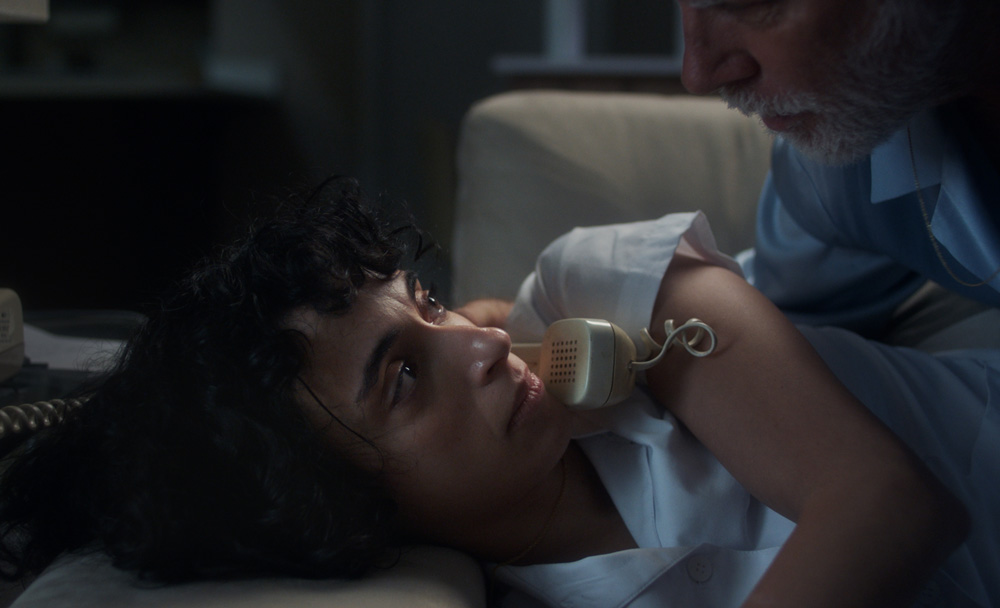

A phone cord is made to look like bondage in the opening scene of “Night Nurse,” wrapped around a body in which a young woman is describing the pain of being involved in a car accident and politely pleading with someone on the other end of the line to wire the cash needed to keep her out of prison. The call would be suspect even if were heard rather than seen when the breathy appeal to “Grandpa” comes across more as a seduction to reach around the front than to slip into someone’s back pocket and it is undeniably arousing, if not to the direct recipient, surely to Eleni (Cemre Paksoy), who is revealed to have placed the call at the behest of Douglas (Bruce McKenzie), the man she’s become a caretaker for in his advanced age.
In Georgia Bernstein’s wonderfully lurid drama, it turns out Douglas hasn’t lost a step, but he preys upon those in his peer group that have with the help of Eleni, the latest in a long line of nurses who have become entangled in more than phone cords when in his employ, only hired for the gig after the last complained to her superior (Mimi Rogers) of being hit on when he mistook her for his wife. Eleni may think she’s going to get a sense of satisfaction from the job by taking care of someone who’s thought to need assistance getting around when they’ve been diagnosed with early signs of Alzheimer’s, but the attraction proves to be something else when Bernstein finds that Eleni is turned on by the prospect of having someone be at her mercy to some degree while she finds herself at theirs, being at Douglas’ beck and call as she’s drawn into his illicit means of paying off his medical bills and having a whole fleet of nurses around to help him.
Perverse in ways that are hardly limited to the kinky excitement that Eleni starts to get from her work in elderly care, “Night Nurse” is one of the year’s true unexpected pleasures when it isn’t only the phone call that seduce but the resplendent portraiture of “Family Portrait” cinematographer Lidia Nikonova within a maze-like house, filled with the intrigue of never knowing what the next room brings while it can feel as if its walls could be closing in on Eleni at any moment, and the mischievous tickling of the ivories in Sam Clapp and Steven Jackson’s piano-driven score that brings a bit of elegance to a situation that only gets more messy as it wears on. Although Eleni has to fear losing control over her emotions — as well as any oversight she attempts to have over Douglas, Bernstein looks uncommonly assured in what is her feature debut, making a film both frisky fun and unbearably tense at times and following the film’s premiere at Sundance earlier this year, it may get as hot inside the theater as out the summer, but proves an ideal way to blow off some steam as it opens around the country. Recently, Bernstein took the time to talk about the unlikely inspiration for the erotic thriller, giving it weight literally and the film’s unforgettable introduction.
 From what I understand, something similar really happened to your grandmother, but how do you get from there to an erotic thriller?
Yeah, I like to say that the scam almost happened to my grandmother, except not erotic. [laughs] That part came from me. But the scam that happened to her — or almost happened to her — [was that] someone called her pretending to be my brother and he needed help and she went to the bank and the tellers told her that this is a scam and I just became obsessed with this idea that these people were out there doing these super-performative crimes where they were pretending to be somebody else. I thought that was ripe for making something out of that could be very cinematic and strange. I had Cronenberg’s “Crash” on the brain, and I [thought], we could twist this up into something culty and weird.
Is it true you actually shot in your grandmother’s house? It’s an incredible place with that patio tucked into the center of a relatively small space.
Yeah, I wrote the entire script for her house and the location was so important [because] my whole team would come to the house and it was a little bit of a practical decision because I wanted total access to this space where we could really spend time designing it and blocking and staging, making it exactly what we needed it to be. Of course, it had all of those elements like the patio, [which is] an atrium in the middle of the house, so we designed it very specifically for her house and it just worked out really perfectly.
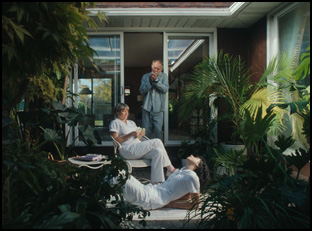 It looks like it might’ve been a tight space to shoot in as well, but that figures into the camera language in such an interesting way. Did the space dictate the style?
Because the film takes place in a retirement community, I wanted this slow camerawork that had a weight to it. We talked a lot about using a steadicam and how that would fit better in the space and it’d be easier, but I felt like the steadicam has a real lightness to it and I needed that heavy weight of the dolly and it just so happened that the dolly that we really wanted to use fits perfectly in my grandma’s house, like through doorways. We couldn’t have designed it better. Of course, it wasn’t a set where we could remove walls, so we really were like working within the house, but we made it work. Everywhere we could, my amazing team would pick up the tracks, move them and put the dolly back down and we would always be on the dolly, moving from room to room.
As far as the script was concerned, you have the same line of dialogue for this phone call a few times and I can remember Tony Gilroy saying in an interview for “Duplicity,” that was both one of the great challenges and great pleasures of working on that film when it had to move the story forward and keep it alive. What was it like for you?
I wanted the characters, when they would say the lines of the scam, to actually be saying other things in their head, so the repetition [throughout the film] is very much on purpose. We return to these calls. but each time they take on new meaning because our characters are progressing throughout the film and then they want to say things to each other that they can’t, but they can say through the scam and my goal was [for] them to be talking to each other, even though they were talking on the phone.
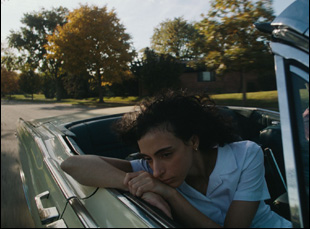 Once you get the actors together and working out the dynamics of a scene, did anything change your ideas about it?
Definitely. All of my actors are just incredible performers, so everybody brought their own style and a big part of directing is how do you bring people’s natural sensibilities, which are all very different and put them into one film, one scene, one shot. It’s a balance of cadences and style and that’s something that I thought a lot about with “Night Nurse,” especially in the edit as we were crafting our pacing. Everyone’s natural sensibilities played really nicely to the tone of the film and I think everyone was really on the same page. I would have everyone watch some films ahead of time so we could get in the same mindset.
Sometimes I would have a tonal reference and [say] this film is a character reference for this particular scene, like for Bruce, we watched some [John] Cassavetes’ movies, which he was familiar with already, but “Faces,” one of my favorite films. has a brilliant party scene and we have a party scene that I really wanted to feel like that scene. Of course, Cassavetes’ style is so different and handheld, but [I thought about] how could we bring that spontaneity or [feeling that] I love about Cassavetes’ movies [where] they feel like they’re improvised even though they’re very written. That’s what I try to do with my work [where] it feels so in the moment, but it’s all heavily crafted. That’s the sweet spot and hard to do, but it was a lot of little decisions along the way, adding up to the final product.
The piano score is really a great accompaniment to this. What was it like to work on the music?
When I was writing the film, I would listen to “3 Women” score, [which is] such an awesome, atonal score that’s really remarkable, eccentric and strange and it was a natural starting place for score and we realized that our score needed a little bit more structure than that score had. I worked with Steven Jackson and Sam Clapp, who are both so brilliant, and eventually we brought in [Francis Ford] Coppola’s “The Conversation” because I wanted the score to have this looping feeling, like a theme that we are returning to. I love films that have a theme [like] Godard’s “Contempt” — that score that’s truly so haunting — and then of course, we were also looking at “Crash.” Steven, one of the composers, is a brilliant piano player and he and Sam would create these melodies, so the piano became like the backbone of the score, and then the flute we would sometimes call [Eleni’s unconscious and we would try to think of how the flute and the piano would interact and progress [throughout] the film. So we had a whole story for the flute and the piano and and how they moved. I’m so impressed with Sam and Steven and so proud of the score.
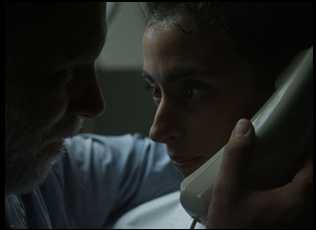 The opening sequence is also something you should be quite proud of – I can’t think of another I’ve enjoyed more this century as far as setting the tone and acting as a true credits sequence with just this undulating phone cord as you hear the call. Was it in mind from the start?
We actually shot it after the fact. It wasn’t in the script or in our principal photography and then I think our assembly had a placeholder version of it, using just the phones and we would fade in and out. But it was just clear to me in the edit, we needed an opener and then we did a pickup to get it, um and I worked with my amazing DP, Lydia Nikonova, and we had discussed how I wanted it to be the phone cord wrapped around [Eleni] and following the phone cord, so she conceived of this idea of it being on a robo-arm, which I had never worked with before, and a pro blend, which is typically more used for commercial photography of [something] like a Coke can [where] they keep super close in [and twirl around the object]. So it was these interesting instruments to achieve the shot and Lydia did a brilliant job. There was a version of us of this that wouldn’t have been as amazing and we fought to get that robo arm, but we were like, we need this to be like James Bond and it’s very genre and hearkening back to the erotic thriller to do an opening sequence, so I’m really glad we did it.
“Night Nurse” opens on July 10th in New York at the IFC Center and Los Angeles at the Laemmle Glendale and Monica Film Center.