



“Sometimes it’s hard to talk about the moment I like decide to film with someone because it’s instinctual where I’m like, ‘I can see the scenes. I can see how this could be my main character.’ It just starts to come at me a 100 miles per hour how this could be a movie,” says Liza Mandelup, who took that velocity and seems to channel it without impediment in her latest project “Grandmasters.”
Her unique vision as a nonfiction filmmaker hasn’t been limited to how instantly she can identify an interesting subject, but how energetically she can bring it to the screen, which might seem like a contradiction when her first series is set inside the world of chess where patience and deliberation usually wins the day. It might’ve come as a slight surprise when was approached by “Chef’s Table” and “Cheer” producers Boardwalk Pictures to make a three-part series — her first — about the development of a new league fronted by the superstar Magnus Carlsen, but Mandelup picked up the game fast in every sense of the word when “Grandmasters” draws on the intensity of its subjects as they plot their next move both on the board and in their careers.
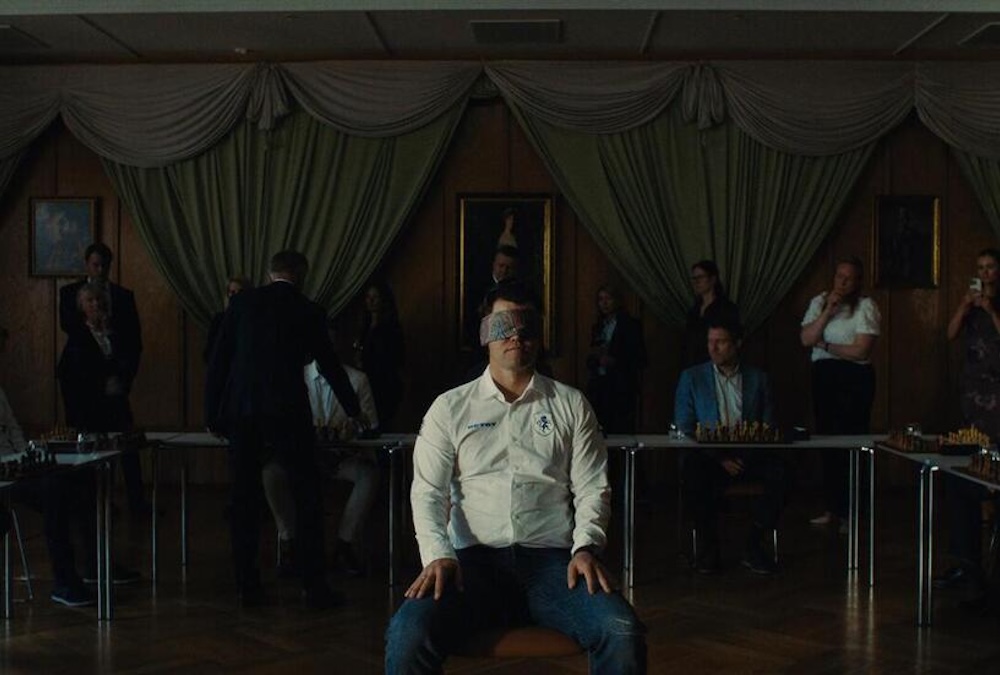
A bombastic electronic score and propulsive zooms may be at odds with the classic nature of the sport, but it’s fitting for the swagger and intensity with which the players carry themselves as well as the fact that professional chess itself has reached a critical juncture in how it would like to be seen, aiming to capitalize on a new generation of spectators that the prodigal Carlsen has brought while the star has said to become “bored” with how the game is traditionally played. With Carlsen busy reimagining the type of league he’d want to participate in that’d be more akin in presentation to E-Sports, Mandelup tracks two competitors who could have great sway in which direction the sport trends to, having both beaten Carlsen and have distinctly different approaches to chess. The introverted Wesley So would seem to represent the old guard, carefully mulling each move and spending leisure time watching the Bobby Fischer biopic “Pawn Sacrifice” with his mother Lotis, while the cocky Hans Niemann appears as a creature of the future, regularly streaming on Twitch embracing a bad boy reputation to build a following, gaining significant notoriety when it’s rumored he cheated to his win against Carlsen with the use of vibrating anal beads to anticipate moves during their match.
When Mandelup’s work so far at the cutting edge has been fueled by the tension of keeping up appearances in the digital age — her first feature, “Jawline,” embedded inside a house of teen influencers where the reality inside was different than the one projected onto Instagram, and her second “Caterpillar,” centered on a Brooklynite convinced that changing the color of his eyes with a highly experimental surgery in India could lead to a shift in his self-esteem — the filmmaker is ideally suited to convey the pressure felt internally to make over the sport in exciting and entertaining fashion (leading by example) and it remains a marvel how she can make the subjects of her nonfiction work feel as if they’re leading their own David Lean epic. With the pilot for “Grandmasters” recently making its premiere at Tribeca, Mandelup graciously took the time to talk about the globetrotting adventure she had making it and taking what looks to be a departure from her previous work and finding instead a powerful continuation of themes she’s long been considering.
How did you get interested in this?
It is the first project I’ve ever done that came to me and I’ve learned about myself as a filmmaker that I do have to have a genuine connection with what I’m making and that I can do my specific craft with it, which is this immersive filmmaking that’s scene-based. I want to discover a story and feel connected to the characters, so being handed something has never fit with my style. And this actually came to me [as a pitch] could you come up with an idea that takes place in the chess world? And I really had never played chess and had no idea what was going on in the chess world, but that’s how my brain will start a project where I [think], what’s happening in this world? Even with “Jawline,” I was like, “What’s going on at these meet and greets?” And with “Caterpillar,” I was looking around in the beauty industry and the cosmetic procedures, so the way [“Grandmasters”] came to me was very similar to my [usual] process and I was able to jump into it and start poking around. I actually found characters that I really liked and storylines that I thought were incredible.
As a series, was this actually bigger in scope than other things you’ve worked on or just a bigger canvas?
It was my first series, so by nature it was bigger in scope and the travel was so insane, but I love that because I’m trying to immerse myself and be on the road with these people and this was in a very short period of time, which felt so intense. It’s such an insane challenge. Once we started looking into the chess world, it was actually funny because the storyline that we kept coming back to was that the rest of the world has isn’t catching on to what’s happening inside the chess world. There’s so much happening and it’s growing exponentially all the time, but to the outsider it still is just this niche sport and in the chess world, they were trying to figure out how do we make this more commercial, more interesting, more alive, more exciting? And it was a funny meta experience where I [thought], “Well, I have to do that for the film too.”
This actually seemed like it was really in your wheelhouse as far as having this wild outside world usually conveyed with social media and the internet versus the private, more circumspect experience that someone has on their own away from technology. Could you see that connection from the start, or if it was even there for you with your past work?
I myself was surprised by how I was able to find this exact thread that I love to pull at, which is why I [thought] it’s like a miracle that this project came to me that also allowed me to like personalize it and do what I do. I do tend to love characters that have these larger than life obsessions when as a filmmaker, I relate to that. It feels like this like this huge, crazy dream you have and you have to be all in and it takes over your life and we ended up calling it “Grandmasters” once I started to dig into the chess world and I found myself gravitating towards characters that were the best chess players, but also the most extreme. They’re the ones making all the sacrifices and their whole life revolves around it. It’s like life or death because it’s all they know, it’s all they have, it’s all they want. So it was the question of when you are that immersed in something, what does that do to you? That’s where the reality or real self versus your online self [comes in and] they’re all turning into these personas that they are in the chess world [because] everybody has their player archetype, [which was] really interesting to see like who they are versus who they are as a chess player. And oftentimes, they were one and the same.
When I imagine there’s a certain schedule of tournaments and the actual event infrastructure that you have to adhere to, did that make it easier to build a production around being able to anticipate certain things or make it more difficult?
I naively thought it would be a baked-in structure [where] they go to the world championship and they play these matches leading up to it, but actually the chess world is not centralized. You can choose what matches you play and it’s all based on a point system, so we actually had a really hard time figuring out how to put the story together in a competition sense because it actually was not something that was obvious. Everybody is playing at different tournaments all over the world all the time, so we had to figure out which tournaments to players we were filming with would be playing together and we might not know that until like last minute because they have to win other things to even qualify, so it was actually extremely complicated.
We thought we would start by tracking that and then back into characters and then after we couldn’t figure out how to produce that. I had to take a step back and [say], “Let’s focus on characters first [rather than who’s playing where].” And that was another amazing thing because that is more authentic to my process than being like, “Okay, it’s the sports season. Let’s just follow that.” I started there and we didn’t find the structure within that and then I went back to what I know, which is pick a character and commit to their story. That’s when we found the show.
You mentioned before the idea of making chess exciting, but still it seems counterintuitive to apply such a maximalist modern electronica score and all the cross-cutting to such a classic and typically quiet sport. Was that style there from the beginning?
We kept calling it the “chess rave” where every time you sit down on the board, we should just make it feel like you’re at a rave. At a certain point, I knew I was going find these characters and the emotions and the storyline that I want and then it became [about] how am I going make someone feel like they’re having a good time while watching this because I did feel this commitment to the fact that it is a sport and there’s an intensity to it, but the intensity is in your head. And it really goes back to filmmaking where you go into people’s emotions all the time in films through music, so what is the feeling we should be conveying with music and I would just picture that as the intensity of what was happening. For you, it’s just watching two people quietly sit at a board, but to them, they’re at the most intense moment of their life and everything is sensory overload at every moment, every minute and I was just trying to put that into the music.
The edits started with less music and then I just kept [thinking] I love when the music comes on. Everything comes to life and we just kept adding more and more. It was just something that I felt as I was going along with it and I’m just trying to use all the tools I have as a filmmaker to bring this to life. I also think a common thread [of my work] is I do love a challenge of taking something that people inherently don’t think is cinematic or visual and having to prescribe a language to it. When I did “Jawline,” there were no [influencer] social media films yet. “Caterpillar” is at the base level about an eye surgery and with chess, people don’t have this grand vision associated with it and that is something that I love because I’m like, I can create something here.
I think you’re the right person to do it. What was it like getting to this point with it and screening the first episode at Tribeca?
It’s amazing. I’ve never done an independently financed series and everything is shifting all the time in our industry, so I’m just excited to try new things. Tribeca, just being in New York City in the summer, the whole thing had such a great vibe and it just felt really cool to do a series, but then have this theatrical premiere with it. It really inspired us when we had a whole event after and a party and it made me realize that having an experience with your show or your film is so important and we’re talking about that moving forward with the release as well, where we want this show to be an experience, not just something you put on and passively watch while cooking dinner. It’s something you should go and out experience and have a core memory with. That’s really important right now for filmmaking.
You also recently had the short “Luigi,” premiere at Sundance as well, and obviously, the subject probably helps dictate what shape a project takes, but are you starting to think differently about the form your work will take?
I actually was just talking about this last night with a friend, [saying] I want to do it all. In my mind, I’m an artist more than a filmmaker and I have scripted projects right now. I have a TV show I’m developing. I want to do shorts. I want to do a YouTube channel. I want to do more doc features. I don’t have any commitment to one form and I actually feel excited to move between it all. Some projects take too long and you want to make a short. Some projects take too long to come out and you want to put them out faster. I just always want to make stuff and I feel like that is why I’m a filmmaker because I just have this like need and obsession to make things and however I can feed that, I want to feed that.
“Grandmasters” does not yet have U.S. distribution.