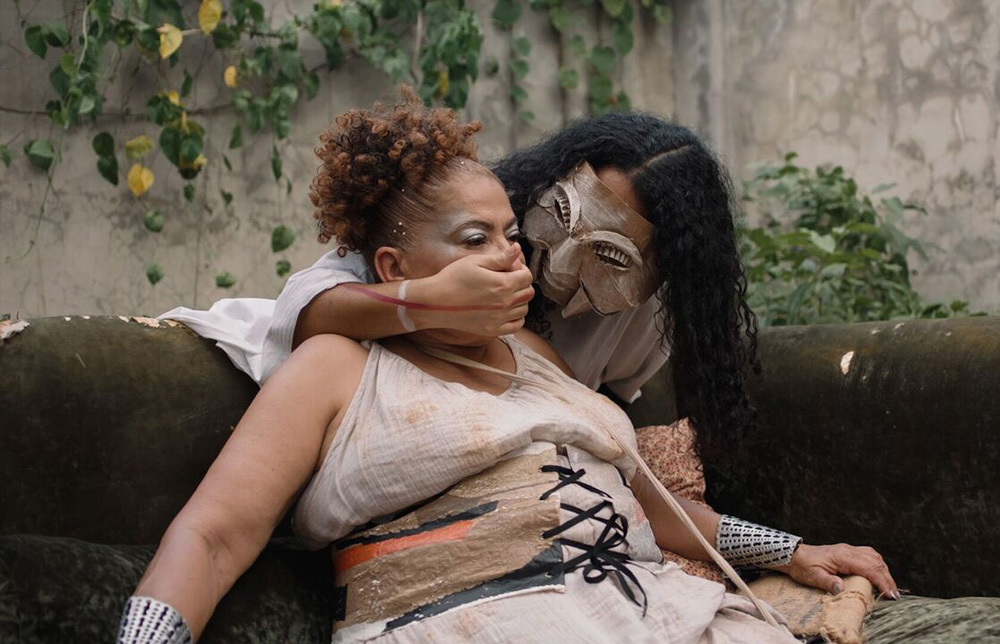

The title of “Matininó” starts out as a mythical place, the name of an island that’s said to be comprised of all women “where nobody lives with fear,” as someone is told as she’s handed a book, but it gradually becomes real in Gabriella Diaz Arp’s nonfiction/narrative hybrid. In Puerto Rico, the director is able to carve out a corner of the island where the cool breeze wafting off the ocean isn’t the only way in which it feels there’s fresh air as the women of the Villanueva-Rodriguez family are given a variety of ways to express the trauma they experienced at the hands of men, recalling how the mere jangling of keys at the door of an apartment could trigger shudders. When some among the three generations of women are old enough to remember a time in the Caribbean where women were actively discouraged from an eduction and outright forbidden to read and write, the oral tradition is seen as a durable form of resistance, but Diaz Arp asks them to take things one step further by crafting their own folklore, ideally softening the harsh memories that are resurfaced to be expressed in terms they can be comfortable with.
The recollections become a foundation of strength as the women reimagine themselves as warriors, creatively fashioning their own colorful armor out of available materials in a physical sense, but doing so in a psychological sense as well when collectively sharing their stories starts to create an impenetrable bond, long feeling at fault for their fate and realizing that they were actually the heroes in their own story. As they imagine a different future for themselves, Diaz Arp may follow the women to fantastical places as they act out the tales they’ve written involving a cyclops and human-sized spiders but a world in which they thrive suddenly seems within of their reach when they take control of the narrative. What was once emotionally overwhelming in one way becomes so in another and the film recently bowled over audiences at Tribeca where it made its world premiere. Diaz Arp graciously took the time to talk about how she engineered a vessel for such sensitive stories to be excavated and ultimately let go of so ecstatically, finding subjects so open to an unconventional filmmaking process and now being able to see them celebrated for their candor.
 How did this come about?
This is my first feature film, but in general I do a lot of shorts and experimental films that blend reality and imagination and it makes me really excited. So I was thinking about my own family and how we have all these secrets that we never share with each other, even though we have a lot of love between us. And information I think is really important to be able to break cycles and to continue those things from happening over and over again in a family. My family is from Puerto Rico originally and unfortunately, my grandmother and mom are not here, so I don’t have all those generations to explore. But these are things that because I’m a creative person and we have a lot of creative people in our family, I wondered if there’s a way for a family to talk about really difficult issues in their past in a way that leans more on imagination than just plain conversation. So we put a call out on social media in Puerto Rico and we had the Villanueva-Rodriguez family write us back and that’s how the whole process got started.
To build something like this, it’s a psychological process as well as a filmmaking process. How were those things intertwined?
We chose the Villanueva-Rodriguez family because they were so open and willing to explore that with us. We did a lot of experimentation in the process. Initially, we started in the pandemic, so we have a lot of Zoom workshops, talking about storytelling in general and we did a couple of creative exercises as a family. Before we even talked about anything within their family, we just wanted to introduce them to the ideas of storytelling and how stories have been used in the past. And then once we met in person, the first thing we did was we did the script writing table, writing the fantasy film based off of a prompt that we gave them. And then from that table, other conversations started to come up. We started to do individual testimonies from the family that the other family members got to watch and obviously conversations between the mothers and daughters. We also did a lot of exercises to try to get those feelings out beforehand, so what you don’t see in the film is that there’s a series of facilitators — some psychologists, some movement therapists — who are there helping them not just get their emotions out, but become comfortable in their bodies when the acting process starts and to try to recognize what those emotions that they feel around these issues of fear and pain and also joy and hope feel like so they could translate that not just to their testimony on film, but also to their acting in the fantasy film.
What was it like just getting to know the family? As you say, the idea was inspired by your own, but obvious every family has their own dynamic.
It was really crazy. At times, really beautiful and at times really stressful. I always tell people it it’s amazing because we started out really giving them full autonomy and telling them that their imagination has no limit in this process. But then some of the younger girls came up with some of our main characters and archetypes like the Spider Woman and the Cyclops [for the fantasy film] and even though we were so amazed by their creativity, and we were like, “This is all amazing, but how are we actually going to make this on an indie film budget?” So we really leaned on an amazing film crew and community in in Puerto Rico. We worked with a lot of local artisans and fashion designers and puppetry makers, and we ended up having the family draw these characters and describe them to us. Then we went off and fabricated them all from found materials from the environment around us. We slowly started making this world that we never wanted to feel like was too far from reality because even though this fantasy is really an expression of this world that they want to see and the power that they want to feel and have, we wanted it to feel that this isn’t something so far off and so imaginative that it’s actually not attainable in reality for an audience.
When it’s connected to myths from the region, was there actually much of a reference point for the costumes? They’re quite inventive.
A lot of it wasn’t really based on the myth, but because the family is from Puerto Rico originally, a lot of these myths are just part of daily storytelling and I think subconsciously it was part of their process. As you can see in the film they all have their unique visual style and the family contributed in finding some of those [found] materials for their costumes and for the characters. All of the clothes that they have are actually either pieces that they already owned or things that we thrifted or found around us, so it was really cool to find these things that represented who they were and who they wanted to be from things that they already have.
The locations are also remarkable in that regard as a foundation for these fanciful tales. What was it like deciding where to shoot?
The documentary was all in this place called El Caño, an abandoned park and playground right down the street from their house. After Hurricane Maria, the park had really been left on its own — the government hasn’t kept it up — and it’s really become a place that is run and managed by the community, so it’s a place where people are have wild horses and there’s all this beautiful wildlife and organic community activity happening all the time. There’s constantly kids coming in with their motorcycles and it’s so close to [the family’s] home that it was a place for us to go to and have them feel like they were in a new environment, but also a place that felt very familiar and in many ways wild. We were really pretty firm about doing all of the documentary there, so that it would be easier to blend between the [documentary and the] parts that were fantasy. We tried to find places that matched that aesthetically and referred back to the playground in some way.
What was it like to fuse together those different shoots in the edit?
We went through this in a unconventional way because of how we ended up getting funding for the project. In an ideal world or a more traditional structure, we would have filmed the documentary and then filmed the fantasy. But we ended up getting in a co-production with the Dominican Republic to film the majority of the fantasy film, but we had to act on that within three months of receiving that news and we weren’t done with the documentary. So we had some of the fantasy that was fully fleshed out [in terms of] how we were going to connect it to the documentary just from a couple years of filming with them. But then we had more documentary afterwards [with] more of their testimonies and more of them sharing, so in some ways, we had to find ways for like the film that they wrote to connect with their real life experiences.
Some of the scenes were really hard. The cyclops scene in particular, that was developed by Ebony, who at the time was 13 and she had come up with this creature and this whole experience with her family and the confrontation that her mom has with the cyclops in order for them to move forward. We really couldn’t find a place for that in the film or figure out how to connect it. And then when Maria shared her story about how the violence that she experienced as a kid morphed into her becoming violent against her daughters at times, it felt like such a beautiful way to express her going through that emotion and her decision to stop the cycle and being violent in that way. So in the film, before she told us any of the story, she had put her sword down and we thought what a powerful metaphor for what she’s internally done as a process and when we saw those two stories together in the edit, we just thought, “This is somehow subconsciously related to that.” And what makes her acting so powerful is that there’s something intrinsic in her that made her put that down with such an emotive force.
There were a lot of moments like that where we just put scenes next to each other and saw how they spoke to each other. Because we had eight women, we didn’t do the traditional making of a film where we have all the behind the scenes [footage] because from a structural standpoint, we wanted to have every woman have a a moment in the film and a place to share their testimony, so it becomes more of like a passing of the baton through generations until we get to the end.
You can see it on screen now, but what was it like to watch this family be able to express themselves and their trauma in fantasy, in real time?
It was a really beautiful process. There were times that we all were really moved and emotional on set. What really made it feel so big was that for so long in the process, the family kept saying, “We’re not creative. There’s no way we could do something like this. We don’t have the imagination to make this world and to create these creatures” and step-by-step seeing their creativity emerge. At the end when we finally got all the sets together, we saw the family together and just how natural they all were at acting and embodying these powerful warrior women, and it was just so moving to us and to see them as a family having fun and enjoying the process together and learning about each other, having this intergenerational dialogue. It was such a special moment for me as a filmmaker.
What was Tribeca like for you?
It was so incredibly special. I couldn’t have asked for a better premiere. I’m originally from New York and the Puerto Rican side of my family, most of them live in New York and the women in the film have spent time in in New York as well, so there was no other place that we really wanted to premiere and the whole diaspora community in New York and having both sides have family there and being able to fly all eight women to the premiere was incredible. They showed up and were as fancy as ever and just did such a beautiful job, responding to questions I think their presence really moved people in the audience and it was really beautiful for me to watch them watch the film. and see their reactions and to be surrounded by so much love and support.
“Matininó” does not yet have U.S. distribution.