


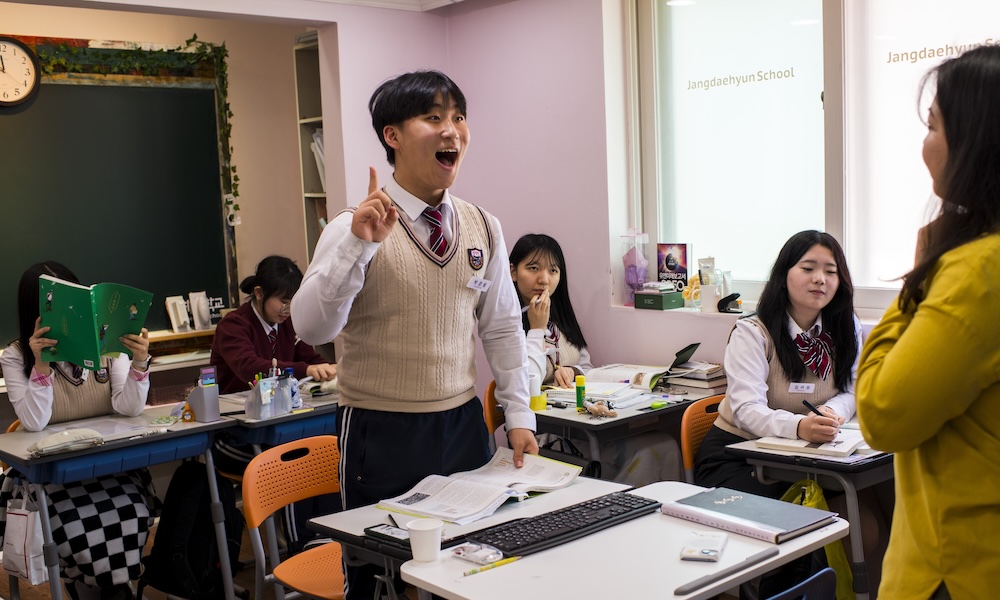

“What’s important is to teach [our students to be] decent people,” Changho Lim, the principal of Jangdaehyun School in South Korea says in “School for Defectors,” dismissing grades as the most significant mark of a student’s progress. That attitude may be unusual for secondary school in, but Jangdaehyun in Busan is a unique school, one of only a few in the country that designed to accept students that previously lived in the totalitarian state of North Korea and the only one that is a boarding school, limiting their enrollment to just 20 students to give them the attention they need when students are getting an education but also actively unlearning the type of life that they and their parents fled. It would seem to be remarkable enough to simply get a camera inside such as place as director Jeremy Workman has for one year, but the filmmaker who has a long shown a real compassionate touch, particularly towards the tale of outsiders such as the alternative artists of “Secret Mall Apartment” and Lily Hevesh, a rare female domino toppler who rises to the top of her field in “Lily Topples the World,” elucidates a path towards acceptance in Korean society that rivals crossing the border in terms of how dangerous it can feel for a teen.
When that part of the journey generally can’t be captured on camera – and often is left to the imagination even for the kids who could be too young to remember and their parents are reluctant to share details of their harrowing escape – “School for Defectors” can depict the growing confidence that students gain in a supportive environment, made up of other students that share their experience. While the valiant efforts of the teachers Mr. Park, Ms. Noh and Mr. Lee to encourage conversation are noted, Workman largely turns things over to the observing the students, whose disorientation may not be evident to the casual observer, but gradually comes to the fore as they share what they went through as part of class and regular chit chat. Those outside Korea may not be able to detect an accent, but many of the students speak of being ostracized in public schools for having one from North Korea and when often having to stay over in China before heading to South Korea, they are mocked as foreigners, with one remembering being called “Coronavirus.” As if that weren’t enough, they may have strained relationships with their parents for no reason than having an entirely different perspective on events and beyond the adults having a reluctance to transfer the burden of their pain onto their children by telling them about North Korea, a growing gap also emerges in their kids having access to knowledge that their parents didn’t and are long past the point of easily picking up, having raised themselves in a country that suppressed information.
That isn’t easy stuff to bring up to the surface, both in terms of how abstract it is and when it can’t be easy for anyone to talk about, yet Workman and a predominantly South Korean crew craft their story with gentle persistence and they get a stroke of good luck when one student Jinhee, tired of the misconceptions she hears, spearheads an effort eventually called “Stories in the Shadows” as a school project to collect memories of North Korea from fellow classmates and their families, not only allowing for some of the most traumatic experiences to be aired out once and for all, but structurally giving the film the chance to introduce its subjects in such a way they haven’t been afforded in life, defined exclusively by the place they were born. Although it may be difficult for North Korean defectors to shake off the attitudes of the culture they grew up in, it is suggested that the perception and general public sentiment of them in South Korea and beyond is also unfortunately ingrained at this point, making the strides that the students, and the 12th graders in particular that are applying to colleges, take towards simply changing how they see themselves and become more conscious of the world around them seem massive. Education rarely feels so tangible as it does when Jinhee starts to consider learning German as part of her search for colleges when it was a country that eventually sought reunification or finds the courage to start asking her own mother questions about her past and as a whole range of possibilities seem to open up from a new foundation of knowledge to the students, “School for Defectors” holds the same feeling of enlightenment for an audience.
“School for Defectors” does not yet have U.S. distribution.