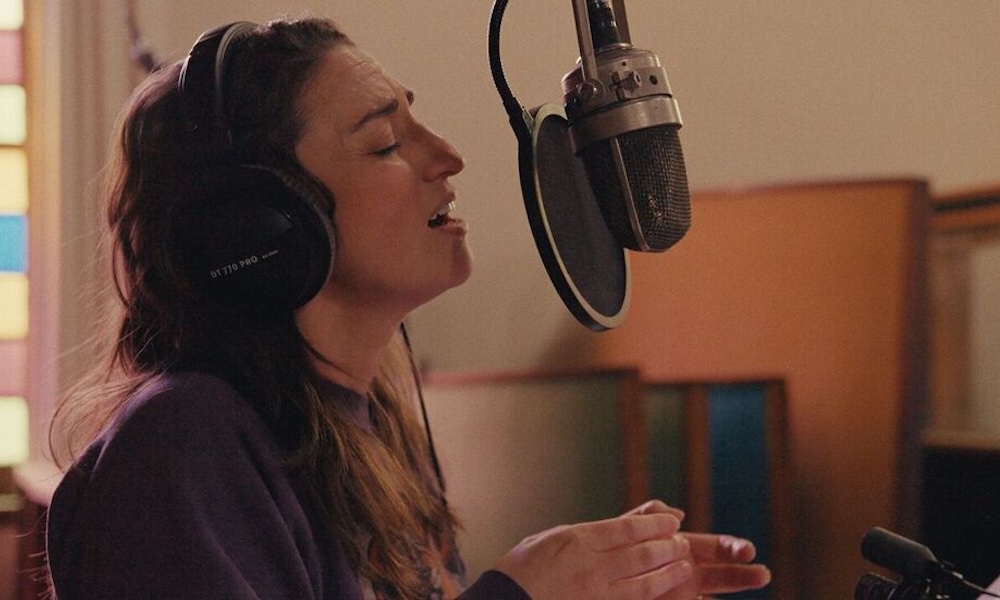

“Give it the most amount of ache you can” Sara Bareilles tells her sound engineer while working on her latest album in “Sara Bareilles: Good Grief,” just having laid down the track for the song “Ladies in a Line.” She has already supplied plenty of her own for what will be her first record since 2018, a period in which she had remained active with a starring role in “Girls5Eva” and various stage productions in the wake of the success of “Waitress: The Musical,” yet as it becomes evident in Josh Alexander’s fly-on-the-wall documentary about the sessions for her return to recording music, there was something else that kept her away, even seeming to dance around it with her collaborators — the drummer Charley Drayton, guitarist Butterfly Boucher, keyboardist Misty Boyce, bassist Solomon Dorsey, multi-instrumentalist Rob Moose and co-producer, recording engineer and mixer Jonathan Low – over the six days she spends in a former church in upstate New York putting “Good Grief” together when asking if the intent in the songs is clear.
As it always has been with Bareilles, who has long been known for delivering sharp emotional lyrics with pop panache, the message resonates as she goes about putting together an album’s worth of “joyful, sad songs,” not only grieving a recent personal loss but contending with a future she might’ve imagined for herself but may be out of reach as she and fellow musicians describe issues with starting a family — within minutes of the female backing band showing up, there’s more talk about IVF treatments than chord progressions. When the singer/songwriter wanted to devise a collaboration in which all the musicians assembled would bring not only their instruments but their experiences to pour into the music and the emotions would be raw, she invites in Alexander to watch as the album is built one song at a time, usually accompanied by some recovery time when the performances can get quite heavy and the director doesn’t leave the walls of the church except for only a couple choice moments, observing a real catharsis take place.
“Sara Bareilles: Good Grief” aims to turn the Beacon into a similar cathedral when it premieres this week as part of the Tribeca Festival, accompanied by Bareilles’ first public live performance of songs from the album and while the New York event promises to be a one-of-a-kind experience, Alexander graciously took the time to talk about capturing the chrysalis of this intimate new music for all to enjoy and bearing witness to another artist’s creative process, capturing true lightning in a bottle at such a tender moment.
How did this come about?
It came about because Sara and her husband Joe are good friends of my wife Aya and I. We we really got to know them deeply starting in 2021, but it was kind of a fast friendship. They have a place upstate near our place and over the course of the last five years, we had these very long conversations about life and relationships and some of the things that Sara was going through. So I was aware of what a tender and vulnerable time the last five years had have been and last February, I’d had a big doc project fall apart and I said to my wife, “Oh, I just wish something nourishing and nurturing would come my way.” And literally the next day or two, I got a text from Sara and she said, “Hey buddy. Crazy idea. I’m going back into the studio for the first time in seven years with some of my closest friends to live together at a residential recording studio in Woodstock to make an entire album of songs about loss and grief. Do you want to just come film it?”
And my first response was “Yes, of course I want to do it,” [being that] I was a Sara fan from 20 years ago, but I said, “I know the music is gonna be great, but I really want the whole lived experience. I want the walks and the talks and the meals and the late nights and the early mornings and the coffee and the wine.” So we got together and had some coffees and she talked to everyone else that was going to be there and miraculously everyone agreed. Then we had 10 days to put it together, so my producing partner, Daniel Chalfen and I had 10 days to raise the money to get a crew together and get a crew there, but 10 days later we were filming.
I know even the most modest of productions requires a lot of prep and crew, but because intimacy of this, what was it like figuring out the smallest footprint as possible?
Yeah, it was very clear to me from the beginning that it had to be a tiny crew and I needed to bring some people who had deep experience with this type of observational cinema verite storytelling. There’s a DP that I’ve always loved her work for years, Jenna Rosher, who filmed a lot of R. J. Cutler’s films. I’ve always been a fan, and I didn’t know her, but I knew that she’d spent 175 days filming Billie Eilish and her brother Finneas when they were teenagers, and I [thought], if anyone can get two teenagers to be that comfortable with a camera around for that long, I want to talk to that person. I reached out to Jenna and [asked, “Are you a Sara Bareilles fan?” And she wrote back and said, “Uh, yeah.” And she pulled out of another job and came.
Then I knew that the sound was as important. If I had a guy with a big boom constantly following everyone around the entire time, it was gonna pull Sara and those musicians out of what was happening, so Nikola Chapelle, an incredible sound recordist who I’ve worked with for years, I knew that he would get this right. We recorded 19 tracks of continuous audio the entire shoot, and he mic’d every single person and all the spaces. He was also working two separate mixers the entire time, so we had this incredibly skilled, small group of very, very experienced craftspeople working on the [crew] side.
But Sara had told me about her intentionality of who she was bringing that week to record with her — she was very aware of the tenderness and needing people to show up with their own tenderness, so it was also clear to me and my producer that we needed to bring a crew that would show up in the same way. One thing that Sara and I decided early on was that we wanted the film crew and the band to have all of our lunches together. It was very important that everyone felt like we were here doing one project. It wasn’t a film crew just filming something they were doing. We were all here together making the same piece of art, so those those were some of the things that helped create the environment for that kind of intimacy to be possible on camera.
It’s a bracing moment that I don’t exactly want to spoil, but when the other musicians first come in to meet Sara at the beginning of the sessions, things get emotional quick fast as they talk about personal things in their lives from the past year. What was it like for you actually experiencing it?
It was insane. That was the first scene we filmed. We came in with [Sara] that morning and it happens exactly as you see it in the movie, and at the end of it, not only were the three women in tears, but Jenna, the DP, and I were in tears as well. I turned to Jenna and said, “Do you think this is what this week is going to be like?” And she looked at me and kind of nodded. And that’s what it was. Every day, there was this rawness, this brave vulnerability that was happening between this incredible group of collaborators. And what was so beautiful about it is that you would then see the freedom that enabled in the art, in the music making. So the same qualities of intentionality in the listening and and how they related to each other as friends, you then would see that in their collaboration as musicians. I [thought], how how is it possible that each day the scene would happen and then it was the perfect container for the song that was getting recorded that day? Literally I’d come in and when those scenes would happen each day I would know, “Okay, there’s the scene that happens that day and then we watch the music that’s recorded around it.” And we were in a church. It felt divine. It felt like some something spiritual was happening.
You really don’t put any ornamentation on the footage as far as interstitials or archival footage, with one exception. Was that part of the initial design or did you know you could let the footage stand on its own?
I’m obsessed with the great cinema verite music documentaries, like “The Last Waltz” and “Don’t Look Back” and “Amazing Grace,” the Aretha Franklin doc, and I think as the doc space has been filled with a lot of celebrity biodocs over the years, that form has started to crowd out a little bit of the artistic gesture that you used to see in some of these films. So I was very clear that the music doc that I wanted to make was not a celeb biodoc. It was not going to be archival. I didn’t want to do B-roll or [have] behind the scenes cut against the finished songs, which is what you see a lot in music marketing promotions. I also was aware that there’s been a lot of extraordinary music documentaries about concerts or tours, but I’d never really seen one about the recording process itself, so I wanted to do that.
I’ve also made 16 docs at this point, many of them as a writer, so I’ve spent thousands and thousands of hours in edits and there’s something wonderful about a container. So from the very beginning, the idea of a group of people arriving, something happens and they leave was the form I thought it has to take. We’re not going to shoot any more after that, and whatever unfolds is what unfolds and you don’t know what’s going to unfold. You don’t know if there’ll be enough story for a film, but I did know from the very beginning that I wanted it to be just this one week. And then it was an extraordinary, deeply emotional week that was six days and seventy-nine hours, so then the art becomes how do you distill all of that time and and those things into the ecstatic 90-minute version of them.
Was it like to find the breaths in it? There’s at least one moment where you’re able to step outside during a song, but you’re also breaking things up between the performances and the conversations between, so it must’ve been interesting finding a comfortable rhythm.
Yeah, my editor on this film, Armando Croda, is one of the great doc editors working and this is our sixth film in a row together, so we have a beautiful language of how we work. One of our rules in an edit for documentary is that we will not cut a single scene or even a teaser before we watch all the footage. We watch everything first because I want the footage to tell us what the story is as opposed to trying to put some predetermined idea that I have of what the story should be onto the footage. What was clear when we watched the all the footage over a couple weeks was that the film needs to be chronological.
There is a deepening that occurs emotionally for Sara and the rest of [the musicians] over the course of this week that you had to be very, very strict with — there’s something really powerful artistically when you’re committed to a particular set of rules structurally and then are intentional about when you break them — so there’s only two moments in the film that break time – and you mentioned one of them and that’s just something that Armando and I found in the process. We knew that we needed to show the acceleration of time in that sequence you’re referencing. The way that the film lives is there’s a slow first act as you’re helping an audience understand who everyone is. what’s at stake, how recordings work, what overdubbing is, how what the spaces are, and then there’s this acceleration that really starts until the end when it slows down again into the final part of the stretch of the film. There’s a wonderful new book by Walter Murch about sound design and editing, “Suddenly Something Clicked,” which is just absolutely what happens — these moments of glorious serendipity and alchemy that happen in an edit process where the structure reveals itself to you.
There also aren’t any formal interviews, but you have these confessional-type scenes with Sara speaking into her phone. Were those actually something you arranged?
That was totally a surprise to me. The last day of filming as we finished, she took me aside and said, “Hey, by the way, I recorded a couple iPhone videos during the week. I’m going to just send them to you in a in a Dropbox.” And she did. And they’re extraordinary. I saw them and I immediately realized that one of them needed to open the film. It was a better setup and invitation to what this film was and was going to be than I could have ever dreamed. And the second sets up the end of the film and that was a total surprise. I don’t know what motivated her to record them, but it’s clear in the film that Sara had a real intuition that this needed to be captured and one takeaway for me is that grief is something that needs to be witnessed. It can’t just be something that’s experienced alone. There is a process of it being witnessed by others. I think that’s why in most religions there’s been rituals around death and rituals around birth — they’re not done alone, they’re done in community. And that’s true of grief. I think Sara knew that she needed to metabolize this stuff with people and that she wanted it to be shared. She needed it to be witnessed by others.
“Sara Bareilles: Good Grief” will screen at Tribeca on June 4th at 7 pm at the Beacon Theatre, June 5th at 2 pm at the Village East, June 10th at 8:15 pm at the Village East and June 14th at 11 am at the AMC 19th St. East 6.