


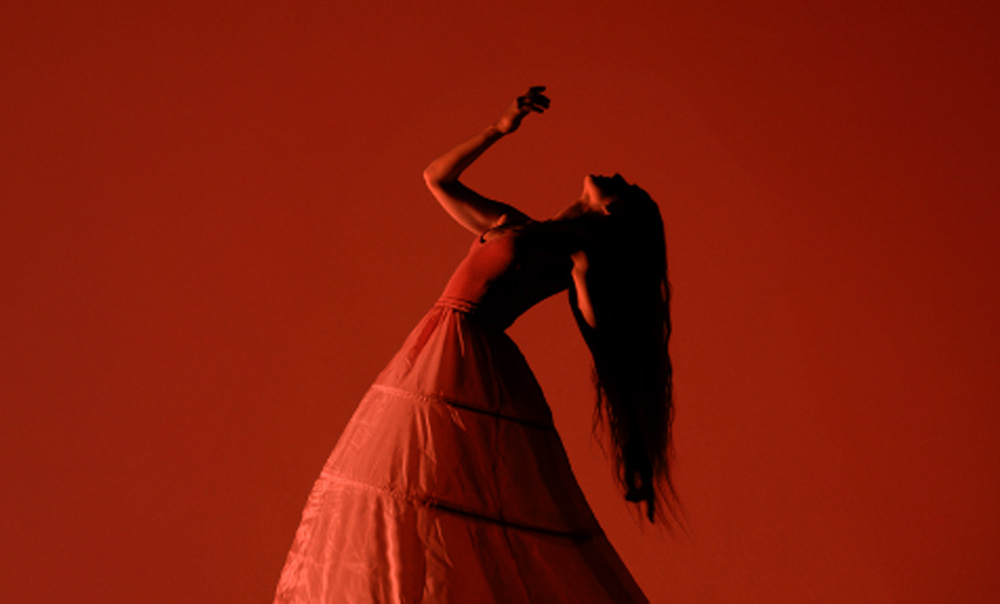

There’s a point in “Room to Move” when Ian Stuart asks his wife Jenn Freeman who she’s actually performing for, having dove headfirst into producing a show around her life after receiving a diagnosis that she had autism spectrum disorder at age 33. The performance piece “Is It Thursday Yet?” was intended to express the disconnect she felt between her mind and body, but pulling it together in time for a staging at San Diego’s La Jolla Playhouse en route to her native New York with its various multimedia components and other creative and logistical challenges was a stressful endeavor and Stuart can be seen saying, “The last thing you should be doing is a show for the outside world,” wondering with all that she’s putting into, how much she’s actually getting out of it herself. As it happened, this was exactly the question that director Alexander Hammer had wanted to get at when he first approached Freeman about being involved in a documentary, not necessarily being about her specifically, but more broadly about reversing the question he had long pursued filming concerts about what an audience gets out of a performance to what the artist does. Still, like Freeman, he could be overwhelmed in trying to find an answer.
“It was one of those projects where we were like, ‘Well, where do we end? Where does this stop?” says Hammer. “This is where the film exists, but what was happening is that one thing would happen after the next, and it just grew to a point where something that I thought was going to be this small, intimate thing grew much, much bigger.”
Nonetheless, both Hammer and Freeman seem to get their arms around a most difficult thing to tackle as Freeman starts to understand how neurodivergence has altered her perspective, only able to recognize now with a proper diagnosis that when her parents thought she loved to dance as a child, it might’ve been a symptom known as “stimming” where the body attempts to get back to a normal state as a reaction to a sensory overload. While Freeman ultimately gained a passion for the artform, Hammer is around with a camera when the celebrated dancer and choreographer starts to question it, feeling more pressure than ever as her career has gained traction yet never more disconnected from her instrument. Hammer, who previously followed around Amy Schumer for the series “Expecting Amy” in which the comedian’s impending pregnancy led to the discovery of other medical issues, shows sensitivity in observing Freeman find her footing after seeing her life through an entirely different lens after her diagnosis, and is knocked off-kilter himself when he starts to have health concerns of his own, captured in the same unflinching detail that he applies to his main subject.
“Room to Move” offers both a chance to look back and properly process what led them to this moment where they can see things anew and when neurological conditions such as autism may not be readily apparent, the film not only provides a model in Freeman for finding strength in what she thought before a diagnosis was a malady, but perhaps may lead some who haven’t yet be diagnosed to discover what may be ailing them. Following its premiere at Tribeca around this time last year, the film recently made its way onto Netflix and Hammer spoke about how the project ended up feeling fated, creating an experiential doc that mirrored what Freeman was going through and getting lucky with how well-documented her life already was.
It’s explained a bit in the film, but I was taken with the idea that you actually contacted Jen on the day of her diagnosis unexpectedly to both of you. Did you actually have what this movie was in mind?
It was definitely kismet with how all of this came together. [Jenn] had seeing my previous project [“Expecting Amy”], which included someone who received a later-in-life [autism] diagnosis that was just part of the story. It wasn’t the main focus, but from that, she saw herself within it and pursued the diagnosis. But crazily, [Jenn] and I had worked together about six years prior on one project and we were in each other’s orbit, but not communicating in any way, like Instagram friends. She followed my work and I followed her work, but she saw my last project and unbeknownst to me went through the the diagnosis process, which of course changed her entire life.
Separately, at the same time, I was developing a project that was following the idea of movement-based therapy, or movement for self-expression for people who may not be able to express themselves verbally. That was the impetus for what I was starting and it was casting a very wide net. On the day of her diagnosis, [which was] unbeknownst to me, I DM’d her on Instagram asking her if she would like to be involved in this project that I have to explain the whole thing about dance movement therapy, which is quite literally what this film is still about, just under the guise of someone’s very particular journey and what dance and movement means to them and how it’s helped them communicate through their life. So ironically, we were not far off. When she and I started, we didn’t know what we were going to do. There was no show. She just learned this [diagnosis] and we were like, “Let’s just see where this goes.”
Nothing could prepare you for a shoot like this, but at the same time, like “Expecting Amy,” you’re entering a couple’s personal life at a very sensitive time. Did that experience give you a base to approach this with?
It absolutely did because it was actually Amy Schumer who was the one that plucked me out of some of the work that I was doing, which I’m very proud of, but it was a different world, [which was] not necessarily doc heavy or story heavy, and also not directing. She saw something in me and said, “I think you could do this,” and it turned out to be one of the best and fulfilling experiences in work that I’ve had, so that immediately fueled [this idea], “Well, this is great. I want to see where this goes. What can I do next?” That was immediately after this started to unfold, almost five or six years ago, but at the time it seemed like it was really quick.
There’s a moment late in the film where you’re talking about how this film wasn’t even supposed to be about autism in the first place, and you’re pulled more and more into the film as an active part of the story. How far down the road were you with another version when you realized this was the best way forward?
It was different was along the way. We really went into it without a roadmap of any kind. I think that is even apparent in the film. We were like, “Okay, let’s just do this.” And then from there, it goes crazy. As far as me being in the film, I originally wasn’t in it at all, not even behind the camera asking questions. It was much more of a standard verite doc. But the nature of my experience with [Jenn and Ian], which were not really captured on on video or film, were so tied to Jenn’s story that I was convinced that it was necessary to put it in. And I did. That’s why a lot of the footage of me is very stolen moments or someone’s iPhone here because I wasn’t part of the project in that in that regard. The lenses was not turned on me, and it was a challenge, but also a big decision to make, but I think I think it was the right one.
I have to push back slightly because early on the camera does turn back on you, or at least Ian’s iPhone and it seems like he filmed a fair bit inside their apartment. What was like having a partner in him to capture this?
Ian was incredibly valuable to this project. It would not exist in the way that it does without him because originally he started as a subject, but now is a producer on the film and his relationship with Jenn and his lens was just invaluable and intimate. It captured things that I would never have been able to do myself um simply because I was not in their lives in those moments, but because of that we do get this really intimate deep portrait of Jenn’s story in their lives.
What was it like figuring out the editing style to match the experience that Jenn was having?
I’m very much someone who figures everything out in the edit when it comes to the story style, whether it’s something that’s very simple or complex, or seemingly simple but very complex. So many of these things just naturally came to me or I would see patterns within movement and dance. ASD is about processing image and sound and repetition and routine and moving forward, so that was my approach not only just in the edit, but just as far as how visually it looked and I was trying to capture and express how these moments were to her and I. And this is only her story and a bit of my story. We’re not trying to say this is a blanket autism documentary that covers all, [because] it is only Jenn, so I was able to really focus in on how these experiences feel to the two of us and I know it was successful for me and her because it does feel that way to us. I just hope it translates to additional viewers.
You’re able to open the film with a recording taken of her parents talking while she’s in the womb since apparently Jenn’s father was quite active documenting everything. What was having that kind of archive like at your disposal?
It was another incredibly valuable thing. Her father basically had a camera glued to him at all times, so he was filming Jenn not only when Jenn was actively in front of the camera realizing she’s being filmed, but when she didn’t [like when she was] playing and running around, stimming and everything that she was doing. Not only was it valuable to the film, but it was invaluable to her diagnosis process because a lot of getting an adult diagnosis is looking backwards at who you were your entire life, not just who you are right now, because a lot of people who are on the spectrum that are high masking have at this point navigated the world in a way that they’re at least able to navigate through it by changing themselves in a way that fits everybody else. So it’s harder to determine based on who you are just today. Having this back catalog as a case study of Jenn in all her glory since birth was very helpful, not only for the film and for her diagnosis, but for me to understand [her].
What kind of engagement was there with the stage production? A lot of the archival is also incorporated into the background of her dance, so was there any cross-pollination as far as unearthing things?
Yes. A lot of people who are involved in the stage performance are also involved in the doc, and the stage performance wasn’t made after we knew everything. It was being made while we were discovering, just as we were filming as well, so the parallels between the understanding and knowledge we were gaining and the obstacles both in creating and designing the show are happening at the same time within the film, so they are definitely interlinked.
What’s it been like seeing audiences engage with this film so far?
It’s funny because I’m not used to holding on to a project and obviously this one is incredibly personal. You can be working on something for years, but once you release it, the day you’re done working on it, you’re done and it’s for me out of my mind. But this has been very different. It’s been finished and just with our limited festival run with small groups of people or a theater full of people, every time we always have an incredible story or several stories that people share [about how] they were inspired because of something they saw in the film. They expressed that to us and some really heavy and deep things in a really positive way and that’s been something I honestly didn’t really expect. That’s made me proud that that we were able to to knock this thing together as we did because making an indie documentary is not easy in the sense that people aren’t asking for it. You’ve just got to do it and hope people respond to it.
“Room to Move” is now streaming on Netflix.