



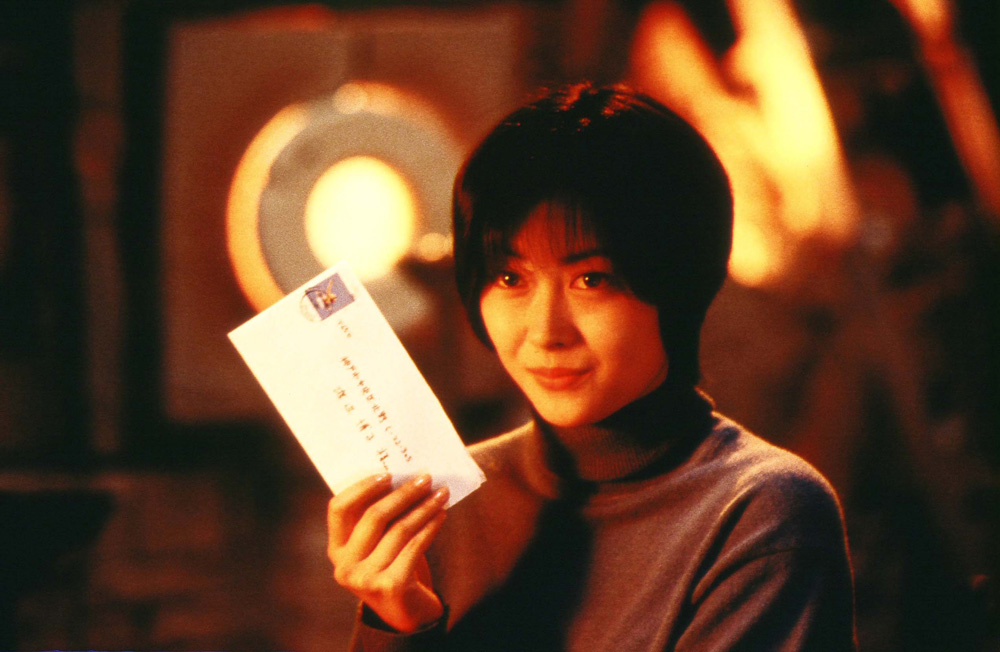

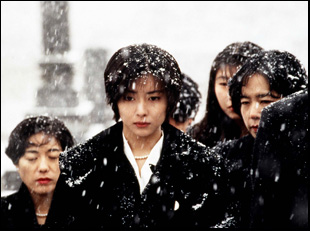
It’s rather remarkable now to look back on “Love Letter,” Shunji Iwai’s debut feature, to realize how it captured a moment and transcended it simultaneously, introducing itself at first with the type of soft focus, carefully composed shot of a snow covered village that might’ve been expected of a slow burn drama from Japan at the time of its making in the mid 1990s, capturing the ennui in the air as a young woman named Itsuki (Miho Nakayama) doesn’t exactly know what to do with all that she’s feeling in the wake of her fiancé’s sudden and unexpected death. At a funeral where only her late partner’s mother doesn’t feel like a stranger (and the feeling is mutual), there’s a stillness that suggests time has stopped for Itsuki, but Iwai gradually begins to take the camera off sticks, literally shaking things up in tune with what Itsuki is actually feeling in the moment where there remains a fluidity when life won’t stop for her to mourn, yet captures her restlessness as she awaits the unknown that’s next.
The blending of the two camera styles without calling much attention to it now seem like a generational break as much as a reflection of emotions, an innovation that Iwai carried on through a career that’s being celebrated this month at New York’s Metrograph with the series “The World at Full Volume” and kicks off a nationwide rerelease of “Love Letter” from Film Movement that would feel rejuvenating even if it hadn’t been newly restored. When the film was surely influential as a narrative – the 2000 Korean romantic fantasy “Il Mare” (subsequently becoming the Keanu Reeves/ Sandra Bullock drama “The Lake House”) liberally lifted some elements from the story of Itsuki being transported by the discovery of an address that used to belong to her fiancé and after deciding to write a letter, unexpectedly receives a response from beyond the grave – it may have been more so when Iwai worked in a seemingly new visual language, naturally coming up in the world of music videos when he pursued music as much as movies in his youth. A rejection of classical filmmaking ended up yielding some actual classics when the experimentation that began with “Love Letter” would be both refined and somehow made even wilder in his exuberant portrait of youth “All About Lily Chou-Chou,” fittingly made at the turn of the century that it felt like the director was actually changing the hands of time on himself.
On the eve of Iwai appearing in person at the famed Ludlow St. cinema this weekend, the director spoke with the assistance of a translator about how a unique path to filmmaking led to such a distinctive personal style, being blessed by the film gods with perfectly inclement weather when he needed it and how he’s never been entirely able to let go of his first feature, even revisiting the idea twice for 2018 and 2020 variations in Chinese and Japanese, respectively.
 You have so many different creative pursuits. What was it like tackling a feature for the first time? Did you find it a culmination of everything you had been working towards?
I first started making films when I was a university student as part of a film club, so I was working in 8mm, making films very freely and composing music for the films. But once I entered the industry as a professional, I didn’t have the same kind of freedom, so I spent about a decade making music videos, and then I slowly had producers around me that really supported my work. It was when I was around 30, 32 years old that I was finally able to make my first feature, “Love Letter,” and I remember feeling like I was finally at a place again where I could have the same kind of freedom that I experienced as a university student. I really think of that time as a university student as the moment where I had the most the highest or most intense motivation towards making films. Even while I was making “Love Letter,” I thought I really can’t can’t beat the level of motivation that I had when I was a university student. That was back when I was 32, so now that I think about it’s been 30 years since then, it really makes me so pleased to think about the fact that I’ve been able to continue to make films.
In the visual language, I’ve always felt that there’s a restlessness in your films that that starts out with “Love Letter” where you’re on sticks for part of it, but you do a lot of handheld. What was it like to develop a language that felt right to what the characters were feeling?
I think that I’ve arrived at this style that incorporates handheld camera when I realized that it’s what fit my process and my vision the best. Flm cameras at the time were incredibly heavy and unwieldy, and especially on Japanese sets, they were things that you really weren’t supposed to move very much, but the fact that I was still young, I thought it might be interesting to use these big film cameras as if they were handicams and to see what happens. The more cinematic elements actually come from the process of location scouting and then thinking through the production design elements. That’s where the images really come about.
 One of my favorite things about the film is that Itsuki’s potential flame Akiba is a glassblower because of the great environment that you get to shoot those scenes in with the roaring furnaces around. Was his profession in mind for a location as much as who he was as a character?
You’re totally right. It had everything to do with the location. The city of Otaru is actually known historically for having a lot of glass studios, so when I saw that studio on a location scout, I decided to insert that element into the script.
When “Love Letter” was set in winter, it looks beautiful, but was that much of a challenge?
It wasn’t difficult to film in the snow, but we had to film during October through the beginning of December of that year. And I was told by locals from Hokkaido that there probably wouldn’t be very much snow during that period. But we weren’t able to move the the production schedule around because we had to build it around the actors’ schedules, so we had prepared to bring in fake snow to be able to film the snowy scenes, but then very miraculously the timing just kept working out. If we needed a snowy scene, it would start snowing. And if the next day, we didn’t need snow, it wouldn’t snow. Our actors were traveling between Tokyo and Hokkaido, so we couldn’t move the schedule around to have them be around for the snowier scenes. We really had to work on a very set schedule. So it was like just miracle after miracle happening that if I was a gambling man at a casino, I’d be a millionaire. It was that level of coincidence. It actually is a scary thought to think if we would have been able to make the film had the weather not been on our side.
It was clearly meant to be. In 2020, you actually revisited the idea of “Love Letter” even if it wasn’t exactly a remake or a sequel, but you got everybody back together from your original cast with a similar idea. What was the desire to bring everything back together all those years later?
After I made “Love Letter,” I had many offers and requests from people from various countries saying that they wanted to remake the movie. I had no qualms with that. I made the film that I wanted to make and I felt like everyone else should make their version of “Love Letter” if they wanted and there were projects that were going to happen in the U.S., in Korea, and China, but in the end none of those remakes came to fruition. That was across 20 years. In that time, things had changed drastically, so much so that the culture of letter writing had already started to disappear. So I had an idea to make a short film around this idea of the letter and grappled with that challenge of that culture of letter writing not existing anymore. Today, if you want to send someone a message, you could just go on social media and quickly send one off and I really couldn’t think of how you could remake “Love Letter” today for this generation. But when I worked on that short film, I had the idea for “Last Letter,” and I thought this idea will allow me to make a version of “Love Letter” that’s adapted for our times. And then I thought, wouldn’t it be nice to try to make it in the same world of “Love Letter”? I don’t want to call it a self-homage, but I did try to make the story, although not the same, similar to the original “Love Letter.” And I filmed it in Japan and in China. It was a film that I really hoped that fans of “Love Letter” would enjoy.
 The original film is such a great expression of memory and you made it as a younger man. Has it been interesting in the years since to look back on as you’ve gotten more experience in that regard?
It’s been 30 years since I made “Love Letter,” and I think this idea of memory from that period is very different from how I think about memory today because the characters in that film, when they’re looking back on their life, they’re looking about ten years prior and they’re feeling a sense of nostalgia. At the time, I thought of that sense of nostalgia that might be triggered from the act of remembering as something that would be unchanging and shared across all generations. But 30 years later, today, I realize that it’s not so simple. I really thought that a regeneration would have a specific kind of nostalgia towards their memories of their childhood, that they could imagine the landscape from when they were kids. But that’s clearly not the case.
Today we have things like the internet and social media, and it’s not hard for a person to get in contact with a classmate from 10 years ago. We’re also not in the same kind of generation where we’re surrounded by black-and-white photographs. Now you’re able to film in 4K on our phones. Everything is a digital image. We have things like Instagram. And I think that those artifacts actually will be unchanging for a hundred years and won’t age in the same way that physical photographs do. So this idea that nostalgia is only connected to this idea to memory is certainly very different today. Thirty years on, I think that the only thing that physically ages is our physical bodies, that everything that we produce as objects don’t age really. I don’t know whether that’s a good or bad thing, but that’s something that I notice about our generation that the idea of things being memorable or the act of remembering and the concept of nostalgia are not as simple as I thought they were back then. It is a new kind of theme that I want to tackle now when it’s become clear that it’s much more complex.
“Love Letter” opens on June 5th in New York at the Metrograph ahead of a North American tour with dates at the Beacon Cinema in Seattle on June 15th, the Cinema Moderne in Montreal on June 17th, the Digital Gym Cinema in San Diego on June 23rd, the Cinematheque in Vancouver and the AFS Cinema in Austin on July 2nd and the Cleveland Cinematheque on July 16th.