



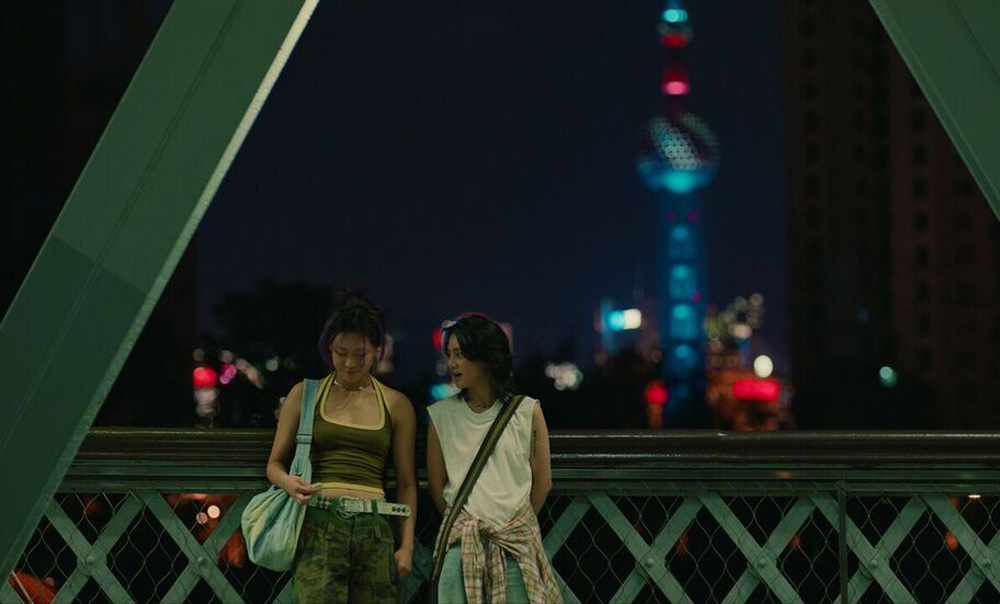

“Do you think everyone has a jigsaw universe?” Tori (Shu-Yi) asks Asher (Yvonne Shuyu Zhang) in “Ephemera,” learning of her new flame’s past split between Shanghai where they are now and Los Angeles where Asher spent her teenage years before returning to the mainland in her twenties. While Asher has to consider how her own experiences align, not feeling entirely at home in either place, it feels like a mild miracle that things have lined up to be in this moment with Tori, her hip-hop dance instructor with whom she’s finally worked up the energy to ask out for a coffee after class, long discouraged by the number of others who usually crowd around her, and not that Asher lacks for confidence – she’s a vlogger who has built a significant following putting her life on display – but it’s her last night in China before moving back abroad and it would seem as if there’s some unfinished business if she didn’t take a chance on talking to Tori.
Ever since Julie Delpy and Ethan Hawke’s Celine and Jesse spent a night walking around Vienna in “Before Sunrise,” there have been many to follow in their footsteps when there are so many interesting backdrops for such a walk-and-talk to take place for a day that neither of its participants will ever forget (as well as a budget-friendly production model), but writer/director Shan Jiang takes things one step further in her enchanting feature debut, actively considering the place such a day will spend in their minds well after it happens as part of the ongoing conversation. Although Tori and Asher make small talk about career goals and local restaurants, a deepening connection leads to not only romantic sparks starting to fly between them but a comfort floating really big ideas like spatiotemporality, the notion that time and space are linked to shape experiences.
An outsider is likely to start falling in love with “Ephemera” a little before Tori and Asher start to with one another as Jiang breaks the screen into boxes to express the idea relative to its surrounding context that might not make it into most people’s thinking about what they’re living through, and it sets the stage for an interesting conflict at the center of the film where Tori is in the dark for much of the film about Asher’s impending move, ultimately really upset to learn that no sooner than she thinks she’s about to have a long-term partner, she realizes this is strictly a one-night stand. It throws the stark difference between how the two perceive time into sharp relief with Asher looking to live in the moment as much as she can, perhaps recording for posterity but relying on her YouTube and TikTok accounts to bank her memories rather than her own mind, while Tori is willing to practice patience in the hope of something that endures, having a life in Shanghai where she’s kept conscious of what comes before when it’s likely determine what’s ahead.
The actors make a convincing pair with Jiang supplying lively repartee, which is more than enough to overcome the fact that the director is a bit inconsistent with some of the film’s bolder creative flourishes – split screens that can isolate the pair can potently make a point but deployed at idiosyncratic times, and a nod to parallel universes towards the film’s end can be more confusing than it was likely intended because of an abstract set-up. Still, the desire to take a well-trodden narrative path in a different direction is appreciated and the film projects a different image of Shanghai than most, appearing more like a European city with ivy-covered buildings and bridges and makes Asher’s rumination about cultural disorientation really land, describing such strange adjustments in a modern globalized world as thinking KFC was a fancy sit-down restaurant for families as she did in China where it was a relatively new phenomenon and learning it was fast food when she moved to the States.
Fittingly when “Ephemera” itself wears its cultural influences on its sleeve and pulls from all different nationalities, it ends up being a mix of familiar and foreign components that becomes singular, considering growing comfortable with what makes someone or something unique but also the alienation it can create when it feels like there’s nothing else like it. As Tori and Asher make a connection, however brief, it isn’t a bad thing to say the world actually feels a little bit smaller when any differentiating distinctions fall away and like the characters, Jiang makes the most of the moment at hand.
“Ephemera” does not yet have U.S. distribution.