



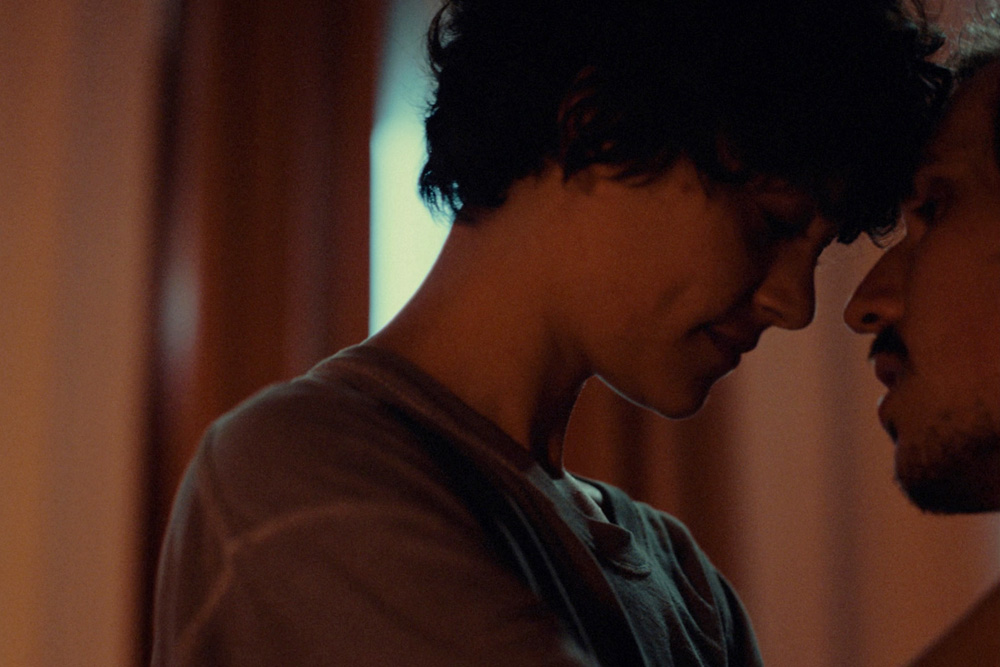

Dennis (Maximilian Isaacs) doesn’t exactly look like the type to be eager to be a father in “Sunday’s Children,” pushing his thirties in New York and barely able to take care of himself without a steady job and his body littered with evidence of hard living, yet he is upset to learn that his girlfriend has gotten an abortion, precipitating a breakup, and an omniscient narrator informs that he always imagined that he’d be settled upstate by 30 with offspring when raised in a nuclear family where his mother knew within 30 seconds of meeting her husband of the kind of life they’d share together. Although that kind of storybook life hasn’t happened for Dennis, he finds himself stuck with those expectations inside of Reuben Hamlyn’s amusingly perverse comedy with the British-born director bringing his best Alistair Cooke impression as the off-screen commentator where the young man must decide if a promising new relationship is worth continuing when his desire to have a baby isn’t shared.
You could easily see it going either way when Dennis locks eyes across the room at a party with Kasia (Blu Hunt), who clearly is a keeper when she is entertained by Dennis subsequently performing an interpretive dance version of what led to his last breakup rather than be scared off with it. They passionately make love to the point that Dennis is already thinking of “what color they should paint the door” of the eventual house that they’ll buy together, yet he probably shouldn’t start visiting Zillow just yet when besides not having anywhere near the cash for a down payment, he learns that while he’s infatuated with Kasia’s free spirit, she is naturally inclined to keep that agency without being saddled with a newborn and as he starts to see more and more signs he should be a father (perhaps irrationally), she starts seeing more and more red flags with him.
As Hamlyn mischievously tucks the hymn “Will the Circle Be Unbroken” into the background over a car radio when Dennis and Kasia reach a breaking point on a drive home, the film touches is able to bring a sharp sense of humor to one of the great arguments of the current moment as fewer millennials have either the means or desire to have children though some still long for what the generation before them had. The director shrewdly conveys a conversation that could go in circles visually, working out some long, spherical takes with cinematographer Mélanie Akoka of the couple as they first find each other and eventually begin to drift apart over their differences, but it does break at least one pattern when Hamlyn shows a real distinctive sensibility as a filmmaker and has a pair of strong performances from Hunt and Isaacs that make it stand out. On the eve of the short’s premiere at the Cannes Film Festival, Hamlyn spoke about the personal inspiration behind the film, doing something different from even his own previous work and all the considerations required of a fluid four-minute long take.
 How did this come about?
The seed of the idea came from a friend of mine who who wanted to be a dad and I thought it was a bad idea. I personally am not a big fan of children, and I had the idea [for the film] when I was 30 [since] this idea of having children is coming into the lives of many people I am close to and I was fascinated by which friends were starting to really think about children and which friends would not consider it and the reasons that they were giving for the desire to have children or the desire not to have children. This is such a big decision and and any explanation you give over at a dinner party is is so reductive. You have to distill all of these complicated influences into a succinct 20-second soundbite, so I wanted to explore the real complex reasons behind it and the way that we lie to ourselves and others, or simplify these influences.
I also found it striking when this is a generation that seems to think they can’t provide for their children in the way that the previous generation had. Did that actually contribute to the idea of framing it as a storybook, given that has long been the dream?
Interestingly, this film always had this architecture around it, but the initial idea that we actually shot was terrible. It was like a conversation between Dennis and this fictional son that framed the whole film and it didn’t work, so the storybook came later, [which] worked in a similar way to the original idea. It’s good to be honest [about it since] we make out ideas and hopefully we can fix them in the edit and the storybook idea works so much better. It helps contribute to the whimsical tone that I wanted to generate and also it is a nod to this sense of lost innocence that we have as a generation to the way that people viewed the future for the majority of the 20th century, not all over the world, but in privileged nations. Everyone believed that the future was going to be better and we no longer believe that and that’s very much impacting the life decisions we make.
It may not have been intentional, but it made the Christian Lorentzen cameo at the party at the beginning especially amusing when there’s this idea that the relationship initially has to overcome this loud slightly older guy at a party in order to proceed. How did that enter the mix?
I’ve known Christian Lorentzen since before I moved to New York. I just went to a party where he was at and he’s very much a presence when you’re in any room with him. His voice does boom across any room and you hear him over anybody else, so I wanted to like generate that. And that story is his own story. I just asked him to try and do his best to entertain and flirt with Blu [Hunt] and God, he delivered. Once I heard that story, I wanted him to repeat it again and again and again because I knew that was going to be what covered over that whole take. The original plan was for it to be an Altman-esque [camera pan around] where as we moved through the room, you’d get snippets of different conversations, but Christian’s monologue was just so brilliant that that ended up scoring the whole scene.
What sold you on your other two stars Blu Hunt and Maximilian Isaacs?
In the audition, we did a version of the dance scene and just let them improv and it was [Max’s] physicality in that scene which completely convinced me. It’s a very physical part and the way that he moves his body is is so compelling and and looks so good on screen. He also has this really lovable innocence to the way that he performs the character and he’s a very sweet, kind man [in general] and I wanted that to counteract the more reprehensible aspects of Dennis’ character. Max was really able to bring that that sweetness to the role. And Blu’s a fantastic actress. I’ve seen her in a number of things before and she’s incredibly charming and compelling to to to look at, but she has this real fire within her. She can flip between being bubbly and endearing to suddenly having a real passion and anger within her and because of the way that the film culminates, I knew we needed someone who could bring that intensity and that levity. She can perform both of those in an extraordinary way.
And [the two of them] really got along. I was like, “Thank God,” because there’s so much intimacy in the film and the relationship that the characters have, I wanted them to feel comfortable with each other and I wanted them to go for a drink together before shooting. Blu flew in from L.A. and the plan was to do it the night before the night before shooting, but her flight got cancelled, so she only had the night before we were shooting and I [thought], “God, are we going to go for a drink before an early call?” But I did actually think it was worth it to have a beer together and break the ice. So we did go for a drink and they loved each other from the start and it just made it so so easy.
When you mention how physical the role was for Max, the camerawork is wonderful and has so much personality, but it’s also so economical, so I imagine there’s a lot of blocking. What did you demand from the actors?
My previous fiction work has felt very, very static, and I knew that was something I wanted to change. I’m an editor as well, so because of that, I think less in camera movement and I always considered that a weakness of mine as a director, so I [thought] I’m not going to fall back on that in this film. I was so fortunate to work with Melanie Akoka, an unbelievably talented cinematographer and a good friend of mine, and she’s also very argumentative, which I love because I think that’s how you get to the best ideas when you defend your case for what your intentions are, so a lot of the blocking was planned in advance. We went to the locations and some things had to change a little bit on set, which is always very stressful when time’s ticking down. But for the most part the way that the character shots were devised did limit the actor’s freedom to move around in the frame a little bit, and I was so grateful for the patience of Max and Blu for bearing with that and having those strictures placed on them. Now I think it was all worth it because the movement within the frame with Melanie’s incredible camerawork is one of my favorite things about the film, so I think that choreography paid off.
The car shot, which has the camera in the backseat and the actors start the scene outside of the car and find their way in as an argument unfolds, is really incredible. Did that require a lot of takes to get just right?
That took a very long time. And even after that one [that’s now in the film] we still ended up doing more takes and that took many iterations to get there. But I felt good about it. Obviously it’s a very crucial dialogue scene and a four-minute take, so we wanted to make sure we had lots of security there. We even shot singles for that scene, which I knew I didn’t want to use, but we needed as a safety net. That was meant to be shot on our last day of filming, but we [were scheduled] the day of the floods in New Jersey, so we had to kill that scene and eventually shot it later and we actually had a lot of time to make that scene work. It’s such a complicated scene, not just the movement into the car, but it’s a shot looking at the back of their heads for most of the scene, so you have to devise natural ways for them to turn and animate the frame by handing things to each other, otherwise it really starts to feel stagnant, so we were finding all of these little actions which can keep that frame alive, despite the camera’s [static] position behind them. It was a real challenge, but it’s the scene I’m most proud of that we managed to get it there in collaboration with the actors and and of course [our cinematographer] Mel.
It’s such an achievement already. What was it like to find out you were headed to Cannes?
I honestly I was shaking for two days afterwards. I’ve always dreamed of this. I’m such a Cannes fanboy and I can’t believe I’m finally getting to go. It still doesn’t feel real and it’s going to be an honor to show the film there but also just to be part of tthis moment with this thing which always felt like the pantheon of the elite filmmakers that I love that felt so inaccessible. This is still just a humble student film that is going there, but it feels like a miracle and I’m so grateful.
“Sunday’s Children” will screen as part of La Cinef Program 3 on May 20th at 2:30 pm at the Salle Buñuel.