



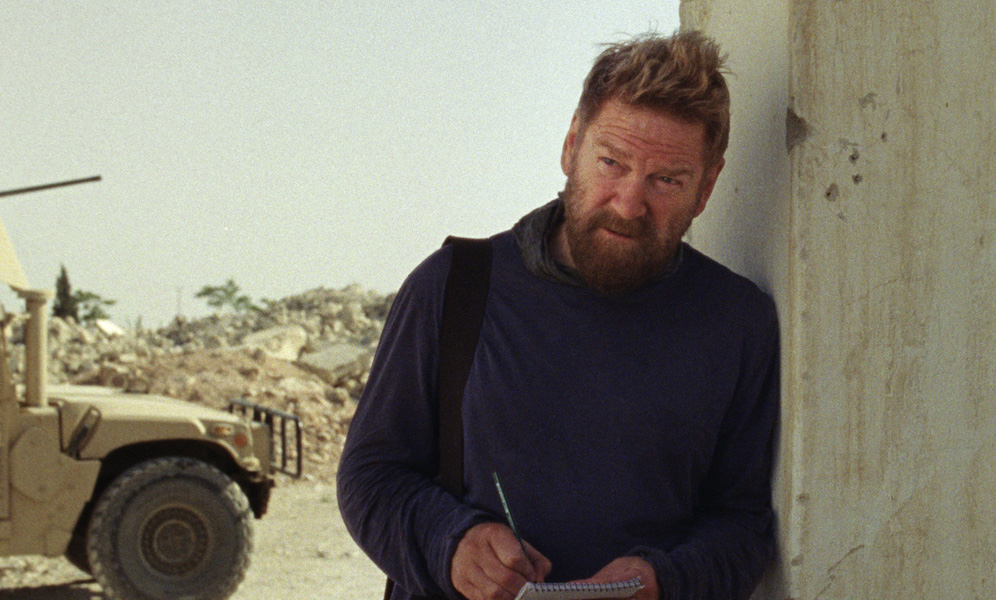

Reed Van Dyk had read “Atonement After Iraq,” Dexter Filkins’ 2012 article in the New Yorker while he was grad school and the magazine he first picked up was never too far away as he became an accomplished director of shorts, eventually earning an Oscar nomination for his 2017 drama “DeKalb Elementary.” It was a thorny article that stuck with him about the Kachadoorian family of Armenian descent that had been living Iraq during the American invasion of 2003 and literally caught in the crossfire when trying to escape their home under siege, Marines fired at their car without realizing they were civilians, killing both sons of Nora Kachadoorian as well as her husband, leaving her and her daughter Margaret as the only survivors when they eventually made their way to America for asylum. Filkins would say later that the most intense experience of his professional career wasn’t in any of the conflict zones he covered as a veteran war reporter, but the meeting he was asked to arrange with the Kachadoorians by Lu Lobello, one of the Marines who was responsible for the gunfire, taking place on a quiet day in Glendale, California where the tension could be cut with a knife.
The meeting, which inevitably serves as the climax of “Atonement,” Van Dyk’s staggering debut feature, is made to appear even more hard-fought for than what led to the tragedy that precipitated it and the writer/director brilliantly finds a way to show how a world of hurt on all sides of the situation lays the foundation for something approaching peace, as uneasy are all parties are about finding it. Lightly fictionalized and divided into four chapters, the film first bears witness to the day of the tragic attack that the director painstakingly captures the intensity of without turning it into lurid entertainment before following those that have to live with its consequences in subsequent chapters, whether that’s Maryam (Hiam Abbass) and Nora (Gheed), the Iraqis who ultimately resettle in America after the men in their family have died, or Lu (Boyd Holbrook), the soldier who continues to be haunted by the deaths his platoon was responsible for with support group meetings and medication for his PTSD failing to ease his pain. After a reporter (Kenneth Branagh) writes about the incident in Iraq, Lu reaches out with the hope of connecting with the family to offer his sincerest apologies, but even if they were amenable to such a meeting, no one could know what would come of it and if it could simply reopen old wounds.
Van Dyk handles the material with the sensitivity that Filkins did in brokering a meeting, affording all the characters the grace to show them working through their mixed emotions ahead of time with remarkable performances from Abass, Holbrook and Branagh in particular and the director fostered collaborations with the actors that went so deep that beyond their turns on-screen, Van Dyk and cinematographer Jon Peter took inspiration from photos he saw of Gheed, the Iraqi actress who plays Margaret in the film, for the film’s color palette when it came to depicting the Middle East. All the care that was clearly put into the film makes it beautiful to behold despite the heartbreak at its core and after moving audiences at Cannes and the Toronto Film Festival, “Atonement” is now opening in theaters and Van Dyk graciously took the time to talk about finding the right meter for the drama, handling the necessary depiction of violence responsibly and how he could make a film constantly rooted in real life.
 The structure for this is so intricate in terms of moving the story forward while allowing each of the characters the time to understand where they’re coming from. How did you first think of how to crack it?
I think it started with [the idea] this article and the story itself has different perspectives and I knew that I wanted to start with and embed the audience with the Iraqi family, who is very tragically affected by this incident. That was a starting place, and then I also knew that I wanted to to move between their perspective and the Marines who were coming in so that we could understand and look at both sides of this neutrally with some form of clarity or at least where each side was coming from.
Then you don’t do it intellectually in the moment, you’re working intuitively, going, “Then maybe the story just kicks forward ten years and we drop in with this man who we saw just act in this way and in a way, he’s the catalyst for what happens, which is this eventual meeting between him and the woman who survived this incident.” In hindsight, the structure seems to work as these storylines intersecting in an opening act, us breaking them apart separately, seeing how each are affected before bringing them back together as a group at the very end and this balance of perspective became very important, because there’s the way [Lu is] working through the moral implications of what he did and then there’s the way she is working through these losses that she suffered, so I thought it became very important at the last act and this eventual meeting that happens be something actually told from her perspective.
When you start out with this 12-page article, was there anything in the research you did on your own that changed your ideas of what this was?
So much. The conversations with Dexter, Lu, and the Kachadoorians, there was so much. Watching the movie [recently], I reflecting on how some of Michael’s lines, the character that Kenneth Branagh plays, were actually just transcriptions more or less of conversations I had with the family where I went in with certain questions about their experience. For instance, Michael has a question in the film where he’s asking, “What is it like for you as Iraqis to be living in America after having had suffered so many losses in Iraq due to the the U.S. invasion?” But these were things that I was interested in that found their way into the movie.
There are also things that didn’t appear in the article that were either pieces of texture or actual lines, but again in my interactions with the family, I knew from what they said that they had this wild experience of both seeing him as this man who killed their family members, but also feeling this inexplicable sense of reminding them of one of the sons that he killed. So things were said to me that found their way into the film and that step of talking with everybody was imperative to fill in things that Dexter [Filkins] didn’t have the time or space to develop, but the contours of the story are very similar to Dexter’s.
 Something that struck me in both this film and “DeKalb Elementary” was how conscientiously you depict violence so as not to glorify it while getting the point across. Was your earlier experience actually instructive as to how to convey war?
I’ll credit Michael Haneke, who as a young filmmaker, I fell in love with the way a camera and the mise en scene can talk to the viewer and maybe induce a different way of experiencing violence. His films were really instructive [as far as] even the ethics of on-screen violence being an idea that in my memory I pulled from him, which is how do you really feel the impact of violence without sensationalizing it or making it in any way entertaining. In the case of this story, [it was keeping the camera] on the people who are injured and killed and on the person who’s pulling the trigger of that machine that’s creating all this carnage.
When I was thinking about how to film combat, I also noticed that there’s a typical way where it’s our side, their side, and it’s almost like a sporting event where it’s like, “Who’s up, who’s down, we got one of theirs, they got one of ours.” And I wanted to do away with that as something that we’re consciously not paying attention to. So it really then became “I’m not going to show any death on that side. I’m just going to point the camera at the young men who are tasked with pulling a trigger.” That became the approach, at least on the marine side of it and we do experience this tragic incident also from the perspective of the family, so that again required a very delicate balance with how do I show this violence in a way that we can feel its impact on the characters, but without [being explicit].
I have a feeling that the support group that Lu attends back in America was comprised of real vets. What was that day like to shoot?
Yeah, everybody in that room are real vets and the women there are their wives and girlfriends. They didn’t know each other prior to that day, so that was effectively a support group that materialized for the purposes of this movie, but it was important to me to leave room [for their experiences]. I talked in depth with each of the men who were going to be speaking, one of whom we see in the finished film. And I’d heard their stories and we tried to hone them down a little bit and then we just shot and I would ask questions as if I were a member of the support group and get people talking about different things. There was a way that I wanted the shots to progress and then it was also just important to feel these real men and their real emotions and the rich life of it all, so it was an interesting and really powerful day.
 In a broader sense, I understand you were able to shoot the chapters in the sequence they unfolded in the film. Did you feel that really added something to the end result?
It definitely did. I thought there would be real value in that when we were planning our schedule and each section was shot in chronological order. Lu’s section of the movie, some scenes were shot relatively out of order, but I kept the emotional arc intact for our actors in each section. And so I thought that It would be really important that they had gotten to live these experiences in front of the camera before we arrived at that last meeting. Everybody holding the memory of shooting it I thought would be a real service to to the scene itself. We had set up for a quick rehearsal of the scene and the emotion was just spilling out of everybody, so we just paused the rehearsal and put it to camera, so [that schedule] ended up doing us a lot of favors to do it that way.
Speaking of emotion, the recent screening in Toronto had a lot of it in the room and it was really touching when Kenneth Branagh said he really felt the audience was completing the experience of this one for him. What’s it like for you to see this film out in the world so far?
Yeah, the way I understood what he was saying was that the audience engaging with it is that’s how the work is completed and not until then. It’s completed in [the artists’] own minds and audiences’ minds, so it’s always really rich for me to hear people not just in their responses to the movie, but what thoughts and feelings it stirs in them. What I’m always going for is not telling you what to think, but inviting you in the case of this film to feel a lot of different things and I’m really fascinated by what it is within a multi-character, multi-perspective movie. But it’s been meaningful. You make something, you want to start some form of a conversation and it’s fun to hear people talk back.
“Atonement” is now open in New York at the Angelika Film Center and the Jacob Burns Film Center and October 2nd in Los Angeles at the Nuart Theater before expanding across the country. A full list of theaters and dates is here.