



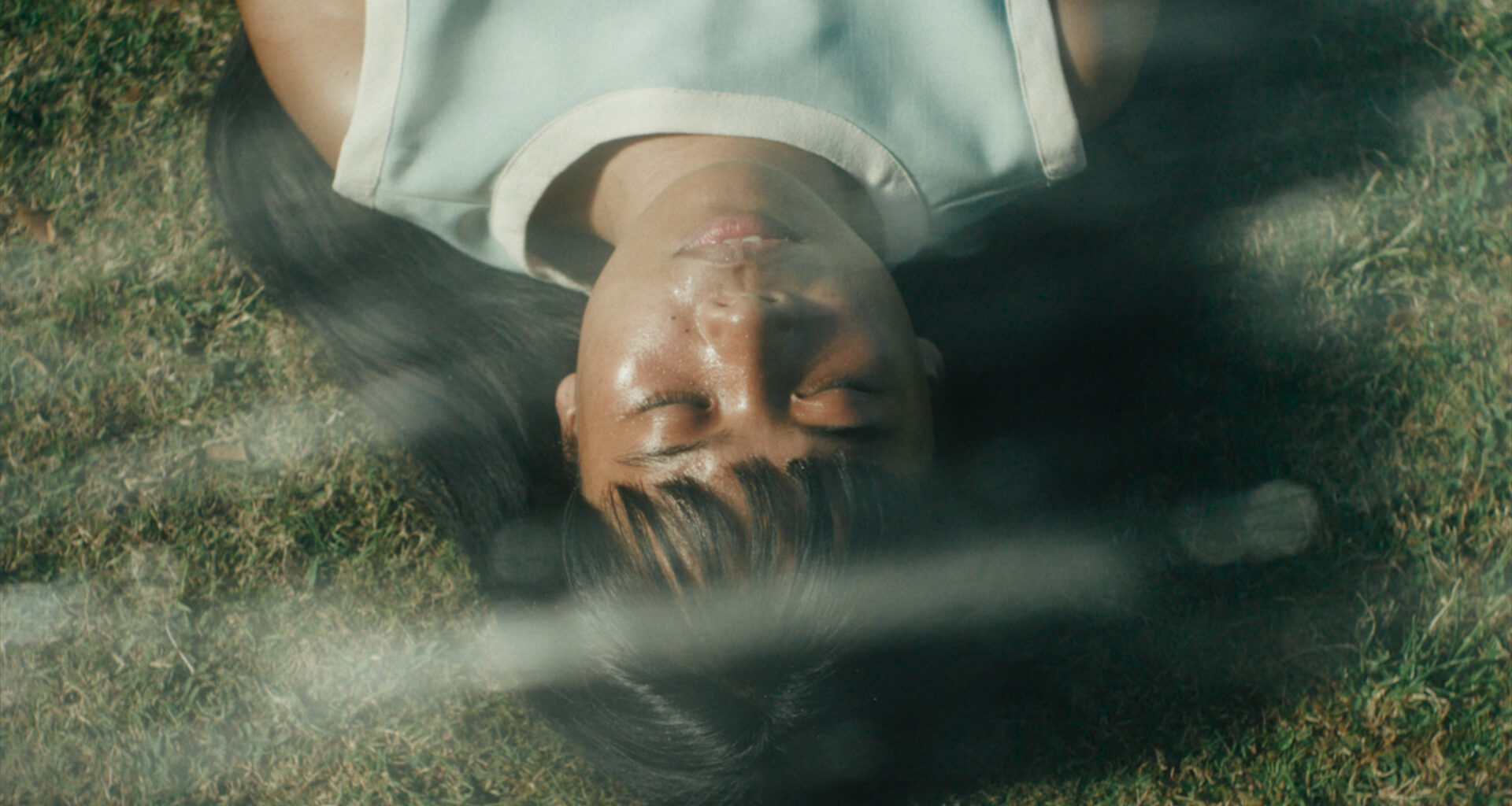

It takes a lot of work to maintain a beautiful place such as the golf course where much of “Filipiñana” unfolds, with 17-year-old Isabel (Jorybell Agoto) one of hundreds of employees of the country club’s director Dr. Palanca (Terry Guzman) that toil tirelessly for a privileged few that come there for leisure. Isabel’s job is less strenuous than most, at least physically when she is a tee girl, handing golf balls to patrons ready to hit them onto the green, yet what muscles she doesn’t use to lug around the laundry or tend to any weeds she employs to steel herself against unwanted attention from guests and the daily drudgery of remedial tasks, the repetition of which seems to create a rhythm for all that warps reality into a vision of life that only management would want when nothing can be imagined outside of it.
Writer/director Rafael Manuel spares no effort himself when creating such a decadent world to enter, but it’s all in service of presenting it as a superficial layer that can be pierced as he does with a sharp satirical wit in his debut feature, juxtaposing the immaculately constructed image of the Philippines that tourists can come away with while illustrating a far sweatier situation unfolding just underneath. A student of Jia Zhang-ke, who serves as an executive producer on the film, Manuel takes in the perspective of two women around the same age when besides Isabel, who hails from the rural Ilocano region where a job at a country club in the city is made to feel like the best she could hope for, the camera also finds Clara (Carmen Castellanos), the daughter of a top administrator at the club who could afford an education abroad and now faces a dilemma when her horizons have been broadened enough to resist a cushy position at what has been the family business.
Although the film speaks directly to the country where it’s set, it will surely echo plenty of others around the world as Isabel and Clara come to reflect the future of a nation built atop a colonial past that persists into the present where there’s no middle class and the rich see investing elsewhere as a better opportunity to maintain their status while there are no opportunities whatsoever for upward mobility for those born without wealth, destined to be on a hamster wheel for the rest of their days. It’s a grim view, but one Manuel makes it fun to contemplate as the extravagance can be made to look silly and the director actively demonstrates how much local talent there is in his home country just waiting for a chance to shine. Picking up a Special Jury Prize for creative vision at this year’s Sundance Film Fest en route to stops in Berlin and San Francisco where Manuel won the Golden Gate Award for New Directors, “Filipiñana” is one of the year’s great discoveries and as the film’s theatrical run is now underway, the director graciously took the time to talk about how his love for film grew out of music and the techniques he could apply from traversing both artforms, as well as the film’s arresting opening shot.
 This started off as a short. Had you always envisioned a feature?
It started off as a feature I wrote when I was still in film school, maybe like a 30-page treatment, and being still in film school, I was quite naive and I thought that, “Oh, I’ll just go to the Philippines and raise the the funding that I need for a feature in three months.” Obviously that didn’t happen, but then I got really good advice by a experienced Filipino producer to take the financing that I was able to raise and to shoot a short instead and build a profile for the project, which is what I did.
When you studied film abroad, could you feel like you were returning to the Philippines with fresh eyes?
I think so. I think time away from the country, especially from a global south country is always a privilege and there’s a responsibility that one has when one is afforded that privilege because not a lot of Filipinos can afford to go abroad and to study. So it really was important to me that when I did come back, I was able to make something for the Philippines. Spending time away from a place is good from a structuring point of view to get the bones of the narrative, but you really have to be in the environment to put on the meat, so that’s what I did.
Did you have an idea early on of what shape the story could take given the lay of the land of this country club? Did the geography of it give it a certain contours?
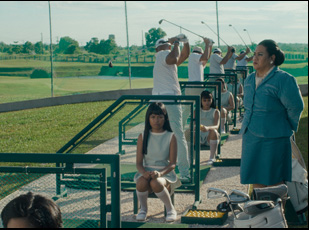
In the film, it’s one country club, but it’s a fictional country club that we just amalgated from like eight or nine different golf courses, but it’s very much based on this one country club where I grew up. My whole life I’ve been surrounded by golf and my father was the president of this country club. He was Dr. Palanca [the character with that job in the film] and the name of their business is Golf Depot, that’s Uncle Renato’s business [in the film]. So it’s very much a work of autofiction in the setting, at least.
The short centers on Isabel, the worker at the club, but in the feature, she has a parallel in Clara, for whom work is optional. At what point did you think of introducing that character?
It was definitely not in the original short and something that through time I realized that in order to evolve the short into the feature, I would need to explore the milieu, the environment, the golf course through different perspectives because I realized I was uninterested in laying any blame on one particular social class. In order to be able to be fair to everyone, you needed a multiplicity of perspective so as I started to develop the feature in various labs and workshops, I started to develop that.
You retained a lot of the cast and crew from the short. Was it interesting to build the feature along with them, having that foundation?
In that regard, I very much come from a band perspective. I grew up in the suburbs in Manila and there’s really nothing to do, so all we did was make bands and make music, so that influenced the way that I crew and cast [films] and for me, the first question that I always ask if I want to crew someone is, would I be making music with them at like three or four in the morning? If the answer is yes, then it’s a yes. And then it’s really important to really grow with the team that you have, so a lot of these people I went to film school with and it brings me so much joy to see them when we were on set every day because I really truly love these people. I know that they’re giving 100% of themselves to this project, which I think you can see through our frames and through the sound. A lot of craft and a lot of love went into this.
I can see just behind you some musical equipment. How did we get so lucky that you got interested in movies as opposed to pursuing a career in music?
I think that they’re adjacent. In the Philippines because there’s a lack of access to world cinema and we don’t really have independent cinema, the gateway into alternative cinema is through music because you discover songs and you see that there are soundtracks of these films or that these artists work with these filmmakers. For me, art is such a multidisciplinary thing that I’ll say that I’m a filmmaker, but that’s just me talking now. First and foremost, my first love is and will always be music.
That shows up in the rhythm of the storytelling as well, I feel, and you’ve spoken about how the process of sound design was opening up different portals as you were working on this. Were there any discoveries you made in that part of the process that were really exciting?
Yeah, I edited the film myself and I remember I only really arrived at the final version of the film after I took a two or three-month break from editing and focused entirely on music. So I switched programs — I edited on the AVID [initially] and I finished on Da Vinci, and I switched over to Ableton, which is what I make my music on and I just immediately realized that when you look at a timeline on Ableton, a music program, things are measured not in terms of time, but more specifically in beats and measures. That totally changed my perspective going back into the video editing software. Instead of seeing five minutes, 10 minutes, 30 minutes [go by], I saw beats and measures and this really renewed editing with the rhythm.
The opening scene in the film is the only part that’s set outside the country club, yet in just a few images you have to set up the entirely of the Philippines that sits outside the gates as it’s a crowded intersection with people waiting in line for water to take back home. What was it like figuring out that scene?
That sequence is very important because for me it’s a little bit my wink or I suppose my concession or my critique of orientalism and what a Westerners view of what Philippine cinema should look like. If you think about the a lot of the contemporary films that come out of my country, they’re in settings just like that one that introduces the film, so It’s me introducing the film and saying, “Hey, we’re in the Philippines. This is what you’re used to seeing,” and then when the title card comes out and goes to the golf course, it’s me saying, “But this is also the Philippines,” so it’s a way for me to set up the golf course as a microcosm of the Philippines.
It was very effective. What has it been like seeing the film get out into the world so far and perhaps change people’s views?
It’s been amazing. There’s no other way to put it. It’s a humbling experience seeing full theaters and people really responding to the film because I can’t help but think about the feature that I wanted to make seven years ago and no way I would have imagined so many people seeing the film. Despite the fact it can be viewed as a challenging film in some regards because of the pacing or the minimalism of it all, the fact that there’s so many people hungry for alternative ways of telling stories gives me hope for cinema, or at least the kind of cinema that I want to make and believe in and want to support.
“Filipinaña” is now open in New York at Film Forum and starts to expand nationally on September 4th. A full list of theaters and dates is here.