




“Everybody’s got something to hide,” a student tells Professor John Jorrisen (Jack Huston) after she was savvy enough to suggest that she could end his career with knowledge she had about him, though the two can have a laugh when it’s revealed she doesn’t know specifically what that transgression is in “The Basics of Philosophy.” The issue has passed when she scores high enough on her latest exam to assure her graduation, but a few weeks earlier, her fate was less certain and a visit to John’s office could’ve ended a few different ways as she made a threat to expose him after her initial approach likely involving sex was rebuffed, leading to a sense of relief for them both when spared of doing something stupid out of desperation. The scene has just about everything that audiences have grown to love and hate about Paul Schrader films when the power dynamic at play may be a bit antiquated, but there’s still plenty of juice in the moral conundrum at its center as it reaches an unexpected end, and as much as his latest may frustrate in some of the details, the director proves time and again he’s still got his fastball.
There is in fact something truly sinister lurking in John’s past, but his father Melvyn (Bill Pullman), a titan of industry who now lays dying in a hospital near the university where his son is a philosophy professor in Kansas City, has done well enough to keep it under wraps over the years with his vast fortune. The cover provided should last well beyond his death, but John’s curiosity can’t help but get the best of him at the funeral when he sees Miguel (Daniel Zovatto), the beneficiary of the settlement Melvyn made on John’s behalf who he hasn’t been in the same room with since he taught him the piano as a teen. It was a life-altering event for them both when the money Melvyn paid off Miguel’s family with provided the foundation for a thriving real estate business that his parents would’ve been hard-pressed to help with as undocumented immigrants and any ambitions John had abruptly ended when his father’s money would bail him out of any legal trouble but tie him to a humdrum existence in the midwest as Melvyn continued to keep a watchful eye.
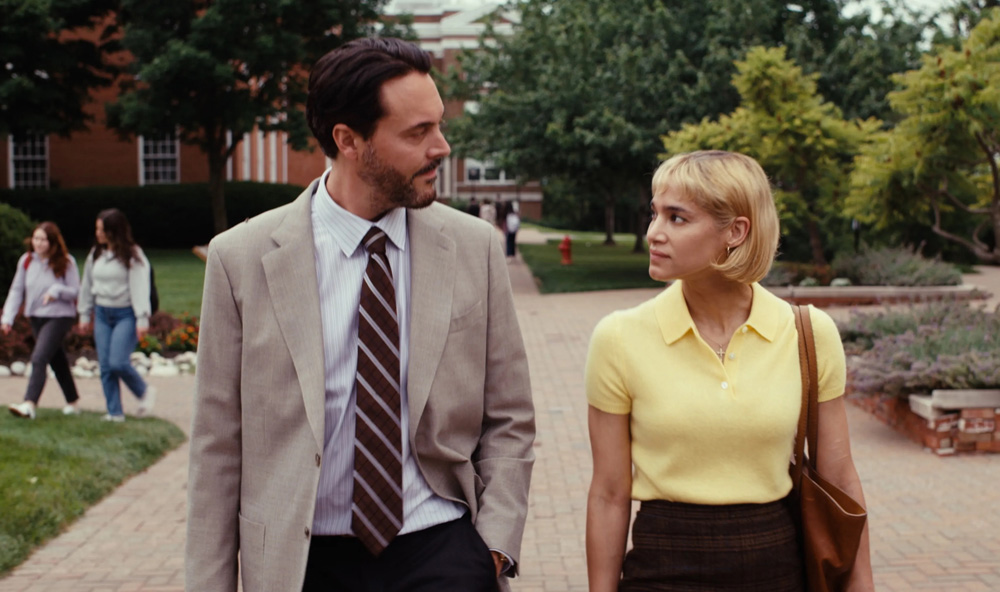
“The Basics of Philosophy” continues Schrader’s “Man in a Room” series that began with “First Reformed” when John spends much of his time at a desk, toiling away on a book about the contrarian Baruch Spinoza when he isn’t at a lecture hall and naturally the Dutch philosopher’s thoughts on forgiveness and redemption — or rather his ambivalence about it — become of particular interest as he tries reaching out to Miguel. There will certainly be those who can’t stomach what John did, or just as likely Schrader’s unsophisticated rendering of anyone with a different socioeconomic background than John (or the evocation of the small town gay bar he follows Miguel into, which comes across as frozen in time from the ’80s). But the film is a bit less solemn for better and worse than the director’s last few films – there’s line dancing and a dream sequence actually involving Spinoza – and the crisis at its center holds considerable intrigue when as John grows potentially suicidal, he becomes conscious that his death sentence may have already occurred long ago, fearing that he’ll start dragging others along with him as he contemplates a more serious commitment to his colleague and girlfriend Rebecca (Sofia Boutella, doing her best despite looking woefully out of place as a small liberal arts college professor who could certainly do better than her current beau).
In a film where Miguel actually has to mention that his alma mater Brown University is in Rhode Island when he finally sits down with John, there’s some regrettably clunky dialogue, but also gems like a throwaway line Rebecca has about “students complaining in the cafeteria while we’re in the teachers’ lounge complaining about the students” addressing the impossibility of change that seems casually profound. As crude in all kinds of ways as the film can feel, the bluntness can be refreshing. That’s also true of the aesthetic with clear-eyed, largely unfussy framing, which is very much in line with recent Schrader films despite the notable addition of frequent Safdie and Nathan Silver collaborator Sean Price Williams as cinematographer, and the oversaturation of the black-and-white flashbacks sprinkled throughout can be so intense it can appear as a mistake until the brightness that obscures starts to read as the blinding memories that John still holds. Schrader may be unapologetically direct with the language in the film, but it becomes part of what makes grappling with how to make amends in other ways ring true.
“The Basics of Philosophy” will screen again at the Venice Film Festival on September 5th at 5 pm at PalaBiennale.