



During the long train rides Mariia Voloymyrivna Ponomarova would take to visit her parents in Ukraine, she had plenty of time to think about how she might make “Patronymic,” bothered by the fact that whenever she would have her passport checked, it was missing her middle name. As per national tradition, she held a variation on her father’s surname as her middle name, but it wasn’t deemed necessary by foreign governments, a seemingly small indignity that could come across as an incremental step towards something far more sinister when the stripping away of her identity coincided with the Russian invasion of Ukraine has threatened to erase the country as a whole including any cultural history it has.
In finding a wildly creative way to express the toll of the unfolding tragedy, Ponomarova gregariously resists the effort to wipe out the humanity of Ukraine’s citizenry as even reporting death tolls from the war now can reduce people to statistics that fail to elicit much emotion. Instead, the director offers a rousing rebuttal that involves a grand chorus to sing about her frustrations with getting through the three transport transfers she has to make along the 26-hour train ride since plans can no longer safely fly into the country and she turns a passenger car into a theater where she can reflect on the meaning that her middle name has to her when she has such a strong connection to her dad Volodymyr, a true gentleman who can be seen spending his afternoons peeling oranges to pass the time (albeit with the kind of long blade you’d see on the battlefield, but that’s as close as the peacenik would get). As Ponomarova notes, she’s one of the lucky ones when so many in Ukraine carry the name of a father they haven’t seen in years when they’ve been enlisted to fight for their country in an endless war.
After Ponomarova confides that her mother Aelita claimed all the visas that she accrued from her bureaucratic nightmare “turned into my best photo album,” the filmmaker is inspired to transform a trying personal experience overall into a thrilling document of value to people well beyond herself and the nonfiction short is bound to stick with you for a long while. With the film recently making its premiere at the Toronto Film Festival, the director generously took the time out to talk about finding plenty to explore even within her own name, crafting the film’s hybrid approach to storytelling and having an eye towards the future.
How did this come about?
In our case, it took us four-and-a-half years, from November ’21, and I was already toying a bit with the idea that I noticed that my patronymic — my middle name — is not in my documents and [I thought], if it’s not in my documents, it’s probably it’s not in the documents of my friends or probably the whole Ukrainian community. I don’t know how it is in other countries that use patronymics, like Bulgaria. But it’s like a stone in your shoe [not to have it acknowledged], it’s a bit annoying. And then I saw a film that greatly inspired me at IDFA in Amsterdam and everything clicked. I rode my bicycle home and I wrote the first draft, and back then, it was only a documents-based story that I thought I’d make only out of scans of various kinds of archival. But the world changes drastically in February 2022. My dad was 58 back then, and I was scheduled to go for a shoot for my feature documentary and by the time I finished [that] in August ’22, I woke up and [thought], “Oh, wait. I want to do ‘Patronymic.’ But now there is this whole other layer to it with urgency, and I felt that it’s not only my story. A lot of people with different kind of name politics and sensitivities can read it in their own way.
That’s when we started developing it and I felt only documents would not work. I had a wonderful story consultant Tom Bakker on board and that’s when we started trying to see what it could be. I always knew it’s going to be a voiceover-driven film — I’m a talkative person, so I feel comfortable with this. [laughs] Then the first time I went home after the beginning of the invasion was in January ’23 and it was such a different bodily experience. I lived abroad for a long time and even the transfer in Warsaw was three to five hours [to get to] your home and that’s just the experience going physically through the journey and come back. I also spent my childhood on light trains, traveling to Ukraine on the road, and that’s why the film starts this way. It’s such a liminal space. You’re in the compartment, but you’re also somewhere else, talking to strangers in a train. That’s also a universal [feeling], so that’s where I felt, “Okay, we’re going to do the train journey, and we are going to deconstruct it and use the compartment in different ways.” It was ambitious, especially for a short. But it was my second film together with my producer, so I knew that she knows that I would want to explore something, but we need to find a way and it paid off.
I’d say. You’re obviously very close to your father, but is it different to work with him in the context of a film?
I recorded that conversation [that is central to the film] in the development phase when I told him that I’m going to make a film like this because we are very lucky to have such a close relationship. I knew that he would be on board, but I still wanted to let him know what I’m up to and I felt a wave of such an unwavering support because it’s about him opening up to his own vulnerabilities. He’s a very kind man. I hope you could feel it on the screen and I also wanted to celebrate that because in different life circumstances, not everyone is having such an opportunity. I knew that whenever I would be asking him about things, it would be about his own experience and not something that I would know in a rational way. It would be more about stepping closer. How does he feel it? How does he experience things?
Also in the film, I bring it up that it’s sometimes easier to ask about peeling an orange than about some things. For example, the situation in Ukraine in last two weeks is different [than what it was], not in a better way. It takes me time to shape those questions and sometimes asking something because you’re making a film is easier and sometimes you just hope that they will emerge themselves in some conversation. But in the particular case of this film, I knew that there were things I would not be able to ask — you cannot ask online, you cannot ask on the phone, you have to be physically there. He has to be sitting in the same kitchen as you. So I’m really cherishing this moment in person because that’s also what the film is about — this longing of being in the same place, which is very sparse for us. I cannot really plan it often, so it’s more about asking him things where he also feels that he’s sharing and we can experience his closeness.
Were the oranges an obvious activity to hone in on, something he usually does?
We have a part of that interview with the persimmons as well. [laughs] Just because he’s a fruit lover. Oranges are his ritual like [taking off] the peel and it’s beautiful and explored how gorgeously it turns. But I think it’s very nice that he has some steady routine and in these very uncertain times, you sometimes cling to something that you can repeat that would offer some comfort. One of these shots [of him peeling oranges] that we then projected onto the compartment on my mobile phone was already [filmed] pre-invasion, so I already started noticing that he does that and different people have different things and that’s his thing. I don’t think he ever reflected upon it – and he has this massive machete — but that’s also the magic of filmmaking when you offer someone a different perspective on themselves. He’s quite playful person. He salsa dances. I also used to have a part of voiceover that was [layered] in the editing, but that [he says the orange] is a communal fruit. You can slice it different ways like a persimmon, but like mandarin or orange, there is already a piece of it that you can give or you can take and it’s a sweet thing where you’re offering someone a piece with you. During the shoot, he offered it to my crew and he made sure that the girls are fed.
It seems like the playfulness was passed to you. How did you decide to bring a choir into this?
I’ll often work with dance in my films. My previous doc was here [in Toronto] at Hot Docs, about cheerleaders, and I had a contemporary dancer in my previous fiction short, “Family Hour,” so I am [usually] working with other people who are expressive in some way. With the choir, I thought that it’s a perfect match to convey that there is no one opinion on the patronymic, neither inside nor outside Ukraine. Culturally, historically, or because of personal relationships, there’s going to be a multitude of these voices and I didn’t want to [suggest we] remove patronymic or keep patronymic. But I just wanted to find something that would allow me to propel the film creatively, and also would be tapping into the richness of the Ukrainian singing tradition.
I was just really blessed that the choir composer, who I met her because of some other occasion, said, “Hey, you’re a filmmaker, if you ever need a choir, let me know.” And then I called. [laughs] We assembled a completely new choir, and it was beautiful. The first rehearsal, when they were all wearing black and they started singing, I [thought], “Oh my God, this is real.” There is synergy in it, [because] when you have a lot of archival material and mobile footage, you have a train, and then you have real people vocalizing in synchronicity with one another, it gives [the film] palpable energy. That’s why it was so heartwarming for me during the premiere that people reacted to that as well.
Was it difficult to find the structure for this?
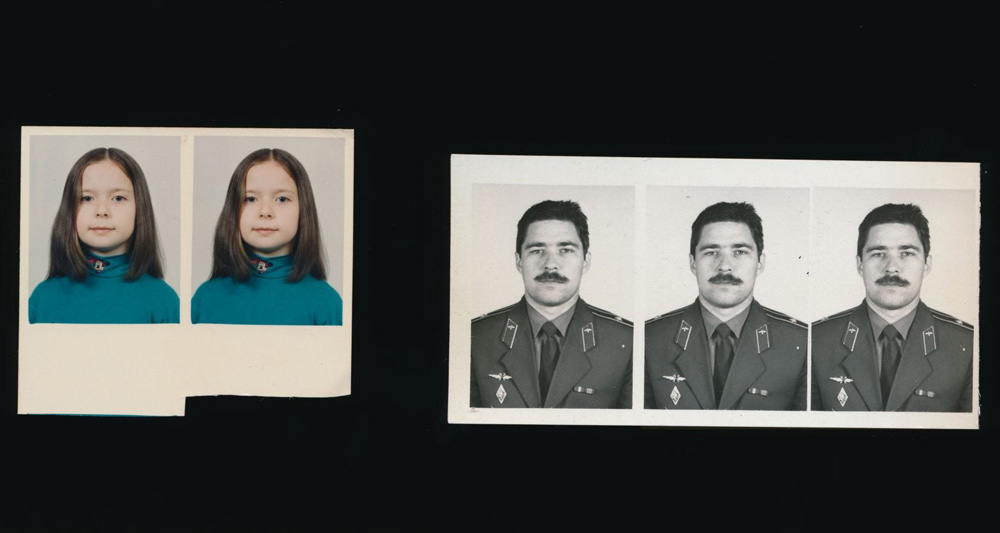
When I would go home to Kyiv, it was a goal for me to find something that would convey something about my relationship with my dad and my mom, within our family, within other social structures. I wanted to find something that would be also be a timestamp because the ’90s after the fall of Soviet Union were quite particular. We wore these school uniforms and the summer camp in the middle of the 2000s, it was a different time. It’s also all analog. So I came to the understanding together with my editor, (Dawe Dijkstra), who is a filmmaker and artist himself — he won Locarno as one of his shorts — and was absolutely brave and playful in how we scanned the material. When we really put in a super high resolution [where] it gives you the richness of this grain, you’re not structuring your archival only because this is transformative and emotional, but also it gives you the sense of the texture of the material and the sense of all these documents that we also scanned.
I felt okay, we’re going to have so many documents and all these pictures. We looked at the patterns. Our poster of the film was also the pattern of Ukrainian passport. I also deeply respect people who work in design and work with typography, so I thought let’s also honor their work. And for my mom, as an author of many of pictures with my dad, I was so happy when I found the same style picture with these scarves [she wore], because it gave me creatively the best way to bring her into the story. And with archival footage, we [usually] don’t credit people who took these pictures. They’re just our contributors, so I wanted to honor that she was producing this imagery of me and my dad and she is part of the story as well.
You alluded to it earlier, but what’s it like to get to this point with the movie and start sharing it with audiences?
It’s absolutely fantastic and I’m so proud of our crew. It was a long journey as I even say in the film. We got here to TIFF and it’s beautiful because of course TIFF programs fiction and documentary and everything in between, and having a hybrid here is fantastic. I’m developing a new fiction feature and a documentary feature in parallel, so I hope my short will open up the conversation about the new project and it could also showcase that you can be brave [with storytelling] and it can [work in] other mediums and still be gripping. You shouldn’t need to choose to work only in documentary or only in fiction. So I hope it will serve as an invitation to engage the right people for the next endeavors.
“Patronymic” does not yet have U.S. distribution.