



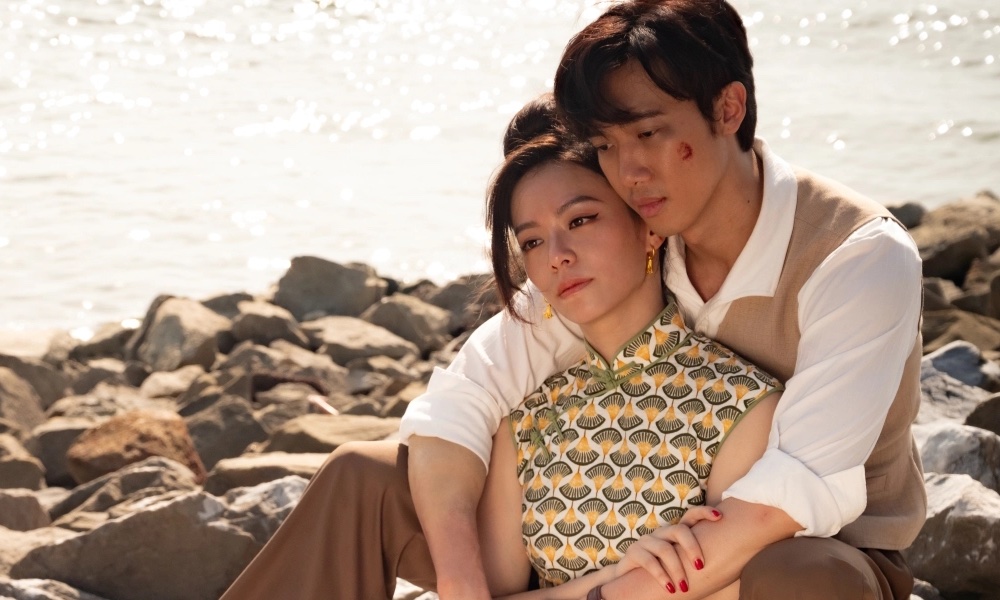

Perhaps more attention should be paid to how the story of “The Age of Goodbyes” is introduced than the story that’s actually being told, as a young man named Kai (Troy Liu) is treading the aisles of a library in his native Malaysia and comes across a book where many of the pages have been ripped out, leaving him to start the novel on page 513. Certainly it would make more sense to pick up something he could start at the beginning, but the handwriting inside can’t help but intrigue and soon enough he is engrossed by the plight of Du Li An (Vivian Sung), a lonely ticket-taker at a local movie theater in 1969 who meets the love of her life the same night that the cinema seemingly attracts a curse when a well-known patron with political ambitions dies during a screening. It can bring a smirk when director Edmund Yeo saves the title card for the decades-spanning epic for 45 minutes in, as if the film version of Li Zi Shu’s beloved novel is starting on page 513 itself after untangling all the elements that made many think it was impossible to adapt, and although “The Age of Goodbyes” isn’t free of the issues that led to such skepticism, Yeo fashions a worthwhile drama from the book’s core ideas as reading about Du brings comfort to the isolated Kai and likewise, the fact that her history was revisited at all ensures it won’t be lost to time as so much else has.
Starting out in 1990, but eventually cutting back to 1919, the film follows Kai as a bit of a time traveler as he flips through the pages of the book, with Yeo occasionally bringing him into the same spaces physically if not chronologically as Du, the woman he reads about as she juggles jobs at the Majestic Cinema and fixing the charred noodle dish kway tiao at a roadside stand. The director doesn’t do much to differentiate time period and threatens to confuse the issue even more when not only Kai believes he’s seen his own doppelgänger in the streets of his own time, romancing a girl he likes, but Du falls in love with Yip (Stanley Lau), a man she comes to learn later has a twin, yet once the details are ironed out with the lovely cinematography of Chi-Wen Chen to engage even when the narrative snags on where things actually stand, the parallel storylines start to make sense as Kai can identify with Du’s desire to be loved and the compromises she makes to survive, agreeing to marry a gangster as she bides the time to discover what happened to her true love Yip, who believed all the men in his family were cursed to die before the age of 30 and disappeared before he could suffer such a fate in front of her.
If a myth holds such sway over Du’s life, it’s fitting that the narrative demands of “The Age of Goodbyes” will often take precedence over characters when constantly shifting back and forth in time where they are faced with getting lost at sea, but the film remains compelling throughout when all the movement has a point as it becomes about what will stand out as memories fade and history is recorded. It definitely isn’t necessarily the fact of what happened as Yip is led to believe a fantasy about his grandfather confronting a magical creature during war that inspired the thought his destiny had been predetermined as other men in his family died too young. (As his brother Mong Sang, also played by Lau, says with one of the film’s best lines, “I can’t blame him for trying to make sense of various misfortunes in our family,” when there’s no real rationale to what happened but creating a self-fulfilling narrative.) But it’s a story that threatens to sink Du, not only in a belief that her true love slipped away and grasping at any detail to find him again, but that her experience as a whole will be consigned to the dustbin of history when the setbacks in her search largely have to do with a lack of concern overall for people of her social standing.
That Kai stumbles across her book at all seems to defy the odds and even though he doesn’t share any obvious ties to the middle-aged Du he reads about as she starts to become more involved in her stepdaughter’s affairs after she learns Mong Sang is her boyfriend, the two can share a process of finding peace within themselves that they aren’t entirely alone despite what the larger culture would have them believe. One can relate when it can feel as if you’re clutching onto a slender thread with all Yeo piles on top, but the fragile idea at the film’s core remains intact that everyone has a story to tell and it’s often rewarding to look past the official record to see how people’s lives were shaped by forces well out of their control, shining in its delicate beauty by the end amidst the notion that surrounding narratives also can get out of hand.
“The Age of Goodbyes” does not yet have U.S. distribution.