

When the end title cards come up for “Drifter,” a very earnest letter to the car community begins with director Sung Kang thanking them for welcoming him so warmly into their community and the sense of belonging he felt there. Like the two-and-a-half hour film that precedes it, it lasts a bit too long when a second card is required with all the kind things Kang has to say in return for what he’s felt since he was embraced for his role as Han in the “Fast and Furious” franchise (though those movies are never mentioned) and presumably becoming a car guy in the years to follow, but you can’t help but be won over by how openly emotional he is in penning a literal love letter on top of the one he made about a guy just trying to crack into competitive drifting. With that specific audience in mind, the veteran actor’s second directorial outing glides over some rough patches to deliver the goods.
There is a better version of “Drifter” hiding inside the film that I saw, which either Kang or his producers seem to know when saying that the festival version was “his director’s cut” that is likely getting a trim before a more traditional release. Perhaps there it will shed the endless scenes of Rosie (Tamara Braun), the woman at the tire shop in Barstow, California that Kang’s Tree frequents, dancing in the sunset or the unnecessary scene between Bennett (Michael Nehring) and Dusty (James Pumphrey), the father and son drifting team that have long held court at the track where Tree works, working out their considerable issues in excruciating detail, but when the film keeps its focus on the passion Tree has for drifting, unafraid to get seriously corny when expressing the spiritual nature of its appeal, it has undeniable charm.
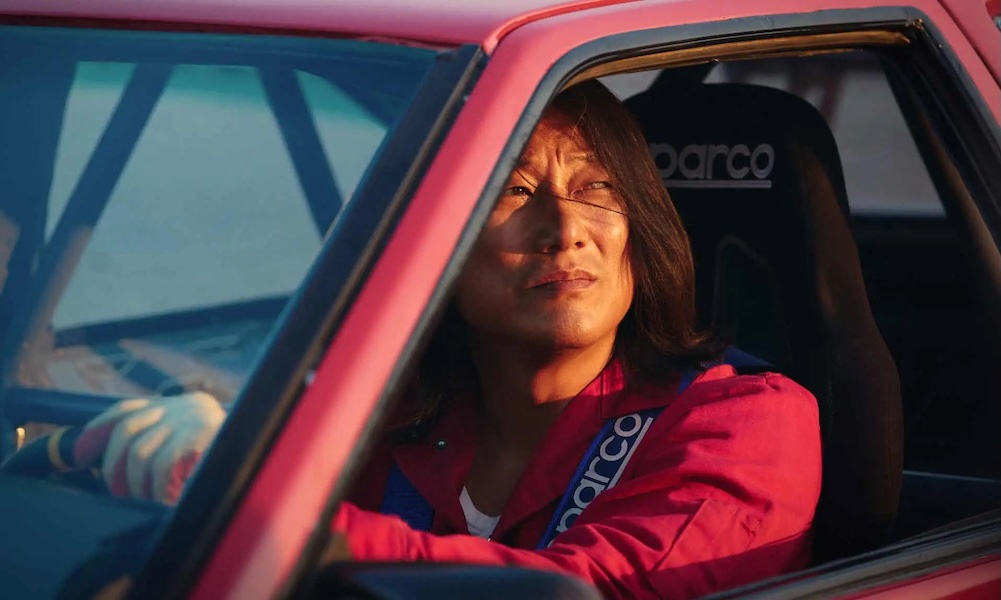
It isn’t just the car stuff that Kang knew from his experience on the “Fast and Furious” movies that people loved about them – and all of it is executed well here, but the comforts of certain cliches and an overriding belief in how a hobby can bring people together, which allows him and co-writers Ted Chung and Aaron Strongoni to build an engaging narrative around the barest of threads. The film’s title is meant to be taken literally and metaphorically as it unfolds in the widest possible aspect ratio where Tree can appear like a man looking for an oasis in the desert in his 40-year-old red Toyota Corolla named Lola, a car he’ll talk to more than people as a terrible introvert. You sometimes wonder why they need a racetrack in this version of Barstow when the streets are so empty you can ride around unregulated, but Tree needs a job, working as a janitor at the track who gets his big break when a Legends of Drifting time trial is held and an injury to Dusty puts him in the driver’s seat where he excels to everyone’s surprise but those watching off-screen.
Blind in his left eye because of “some condition I can’t even pronounce,” Tree fits the stoic and deeply wounded heroes that are a specialty of Kang’s and is intriguing as the bizarro version of his best known character, whose effortless cool made him a man of few words while Tree is bereft of them when he’s painfully shy — yet get either behind a wheel and their true nature comes out. Real-life drifting champ Adam LZ is on hand as the eventual adversary that Tree needs to conquer after qualifying for Legends of Drifting competition, aided in his efforts by the sage if reluctant Bennett who trains him as if a brusque Wilford Brimley were imparting the zen lessons of Mr. Miyagi. (Although the sports movie tropes are thick, the sight of a paintbrush being affixed to the back of Tree’s car to mark the distance of skidding towards a wall without actually damaging the vehicle is about as good a visual as it gets in terms of mastering a skill.) Of course, it can’t only be on the track where Tree faces challenges, being slowly lured out of his shell by the aforementioned Rosie in a strangely platonic relationship and paying down a debt to Lantana (Gregory Cruz), a local drug dealer he runs errands for, a largely obligatory storyline for which Kang at least as a director seems to have a similar lack of passion for except as a means to an end.
At the film’s current length, Kang’s obvious interests are more on display, spending plenty of time in the car simply looking at the open road in front and luxuriating in beautiful imagery out in the middle of nowhere to the point of indulgence, making the concessions to story stick out a bit more like a sore thumb and with a reduced runtime, they may be balanced out as equal parts of the story. The whole drug running element seems a bit out of character, particularly when Kang needs to double back to pay it off in implausible fashion after an obvious resolution to the rest of the film. However, you can understand why it was there in the first place when it creates one of the most rewarding parts of “Drifter” as well, with Bennett losing his daughter Amelia to drug use, putting a great distance between him and his own son and Tree as well, when he knows he runs drugs for Lantana. In what may be both the film’s most absurd and loveliest moment, Bennett takes the engine out of the car that he named after his daughter and places it into Tree’s, filmed as if it were a coronary transplant, and if that’s the kind of thing that brings a goofy grin to your face and maybe even a tear to your eye, Kang has made something special and in the end, it really is the heart that becomes the unstoppable engine.
“Drifter” does not yet have U.S. distribution.