



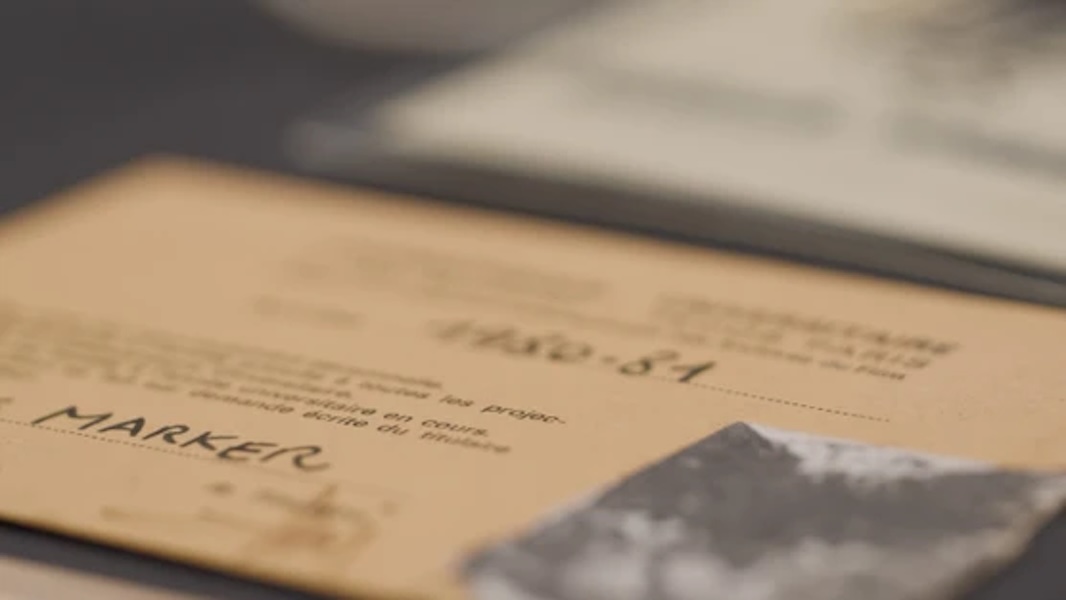

The wheels of the compactor shelves that hold Chris Marker’s archives at the Cinematheque Francais are seen as having a life of their own in “Nostalgia for the Future,” spinning without the aid of human hands as if what they hold inside is just bursting to get out. It’s an explosion that director Brecht Debackre is happy to facilitate in a tribute to the avant garde filmmaker, turning the fact that Marker never to be pinned down in terms of meaning or identity into a film that presents his images to construct at least one way to think of him while opening up the space to have plenty of others.
“Nostalgia for the Future” is best seen as a gateway drug rather than reference material as Debackre channels his own uncertainty about taking on Marker’s legacy in quizzical narration from Charlotte Rampling where as she puts it, “You don’t use the camera to capture the truth. You used it to ask questions.” With complete access to Marker’s voluminous archives, it is clever to frame the research as an adventure where every file holds its own mystery and each image becomes its own portal to another world when the filmmaker was driven to shake free depictions of the world from mass media and proffer a more independent lens, filming quotidian scenes of telephone banks in Japan or interviewing Fidel Castro in Cuba on the eve of revolution in the country. Shards of 1972’s “Three Cheers for the Whale” sit alongside 1981’s “Junkopia,” refreshing their meaning when seen in a new context and showing the breadth of experiences that Marker trained his lens on, elegantly expressing that the filmmaker himself may have had a different understanding of why he was drawn towards them himself towards the end of his life than when he first collected them.
Debackre turns the potentially scattershot quality of organizing all the clips into a strength when longtime Marker aficionados can make a meal out of even the briefest glimpses from his filmography and there are just enough biographical details, all tempered with acknowledgements of their questionable veracity, laced throughout the narration for those being introduced to Marker only now to hang onto the threads as it’s mentioned he parlayed disillusionment from World War II into an early career as a journalist and eventually a filmmaker that resisted labels of all types, including his own name, which changed quite a bit in his early years. The film also builds a compelling through line around how meaning is made in general what Marker’s ultimate wishes for his archive were when the filmmaker was so skeptical of any particular framing, even what he might impose on the work himself. Rumors persist of a letter outlining the organization of materials at the time of his death in 2012 that never manifests and given the filmmaker’s enigmatic spirit, there’s certainly the possibility he wanted to leave it unresolved, yet Debackre knows that nonetheless his legacy will be shaped by those who may have good intentions yet will impress some kind of definition on it one way or another that may not actually be there.
At a fleet 75 minutes, “Nostalgia for the Future” can still feel vaguely overextended as it speculates about ideas Marker had yet never wanted to firmly answer, particularly as it moves beyond his death, but nonetheless, Debackre does make a strong case for the ongoing relevance of the filmmaker’s work when as cagey as he could be about his intent, there was always some behind it in a world where increasingly as everyone is armed with camera phones, there’s more collection of images than ever with far less consideration and as the future holds the grim promise of greater surveillance and consciousness mediated by algorithms, Marker’s innate and perpetual curiosity, which can be viewed as resistance decades before anyone else could see it coming and now appears as if it needs to be held onto at all cost, deserves celebration and Debackre delivers a worthy one.
“Nostalgia for the Future” does not yet have U.S. distribution.