



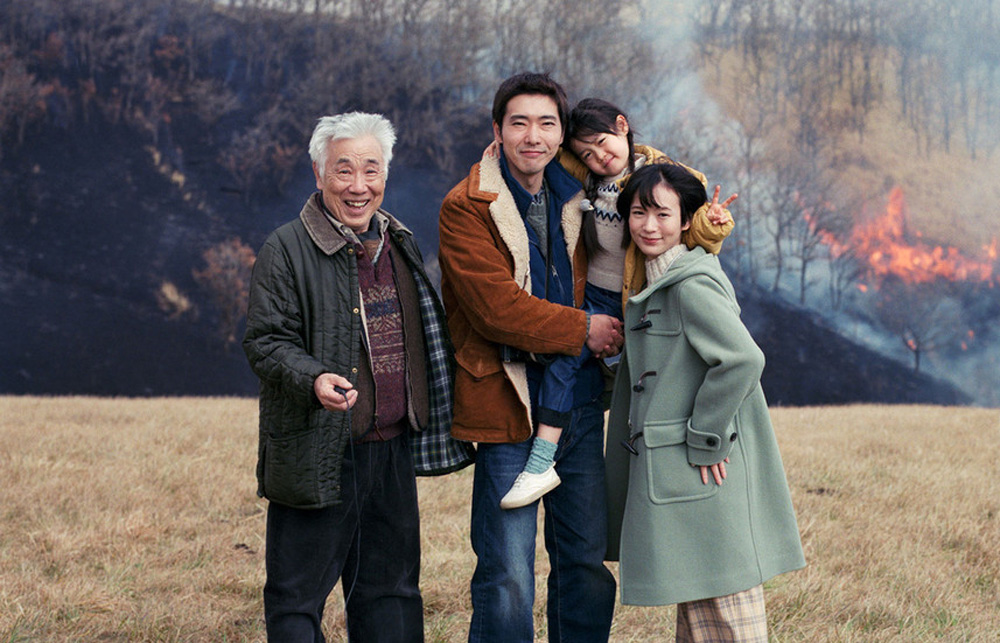

It can seem as if time stands still for Yuta (Tasuku Emoto) when he leaves by ferry to spend a month in the quiet prefecture of Oita in “Memorizu,” seen waving to his wife Yuki (Moeka Hoshi) and their young daughter Hana from the boat as if it’s the exact same scene he’ll return to and taking the image into his memory as if he’ll never forget it. Writer/director Miiku Sakanishi isn’t subtle about what he’s going after in his otherwise delicate debut feature where Yuta is headed to help his father-in-law Makoto (Issey Ogata) run his photo lab and portrait studio while he recovers from a leg injury, limiting his mobility, and while there aren’t a lot of customers looking to get their pictures developed in the era of iPhones, Yuta only needs to look at his to see that there has never been a greater desire to hold on to moments in some tangible form as the world constantly turns.
The sentiment may not exactly be original, but Sakanishi’s approach is when Yuta essentially finds himself in a situation as frozen as a photo, inevitably slightly restless when he comes from the hustle and bustle of Tokyo and while there’s affection between himself as Makoto, it isn’t as if they’re blood relatives. (It can irk when Makoto says over a dinner Yuta’s prepared, “I think we’ve had this before.”) Still, removed from his life in the city and the regular responsibilities to his wife and child, Yuta reconnects with the simpler pleasures of life, walking around Makoto’s dog Komigi in the mornings before work and spending much of his time in the shop going over the videos he’s amassed on his phone as he misses Yuki and Hana as well as occasionally joining Makoto sift through his archives where there’s photos that bring memories of his late wife Shiari as well as offer pictures of Yuki that Yuta is only seeing for the first time. The impact hits differently based on what form the images take, a fact crisply conveyed by Sakanishi’s own use of mixed media where the immediacy of cell phone videos stirs a different response than the slower savoring of old photos, creating a different feeling around the history being conveyed, and when Makoto’s job in the present requires him to stage photos for weddings and class pictures, the intriguing question is raised about how much memory now relies on a medium that is hardly a direct expression of the moment at hand, but rather unconsciously curated by a number of different elements.
The idea of reflection isn’t limited to thinking about the past when it’s revealed that Yuta had to miss the birth of Hana, who laughs now at the video expressing his regret that Yuki shows him while he’s away, and Sakanishi inspires thoughts about how images can create illusions – Yuta may not have been there for either Hana’s birth or in the current moment as he attends to other family matters, but he isn’t seen as an absent father and he is surrounded in a house that was vacated by Shiari long ago, yet her spirit quite clearly remains as pictures still hang on walls. That’s a primary form of tension in a film where little happens dramatically and with a very deliberate pace and next to no music to speak of, “Memorizu” takes patience to appreciate, yet the calm that washes over Yuta as he settles into Oita with its natural beauty undiluted by Yoichi Kamakari’s cinematography extends off the screen and the provocative consideration of memory that swirls around breathes as much fresh air into the proceedings as the shots of the open landscapes.
“Memorizu” does not yet have U.S. distribution.