



It’s a sad statement not just on the situation unfolding in the mountains of Argentina, but on the state of the world when an elder from the indigenous Chuschagasta community in “Nuestra Tierra” outlines the reasons why they usually decline any engagement from anyone outside of it regarding the rights to the land. “Dialogue means we’ll have to give up something,” he laments when plenty of bad actors have asserted to have ownership over acreage that the Chuschagastas needed no deed for after harvesting it for time eternal, assuming correctly that any challenge to their claims will be backed up by a justice system rooted in colonialism, and words and history itself will be twisted to make a case.
Although the legal proceedings covered in Lucrecia Martel’s stunning documentary are over a relatively small plot of land, it is natural to start considering any number of countries where governments have acted with such impunity, not having any legal standing but the confidence to believe there will be no retribution for their actions and it’s telling that the defense of a pair of ex-cops that planned to start a mining business with a third partner and ended up murdering Javier Chocobar, a member of the Chuschagastas during a confrontation in which they planned to take the land by force, largely rests on the idea that given what they were capable of with their police training, they showed restraint by not being more violent towards those that were protecting their ancestral territory.
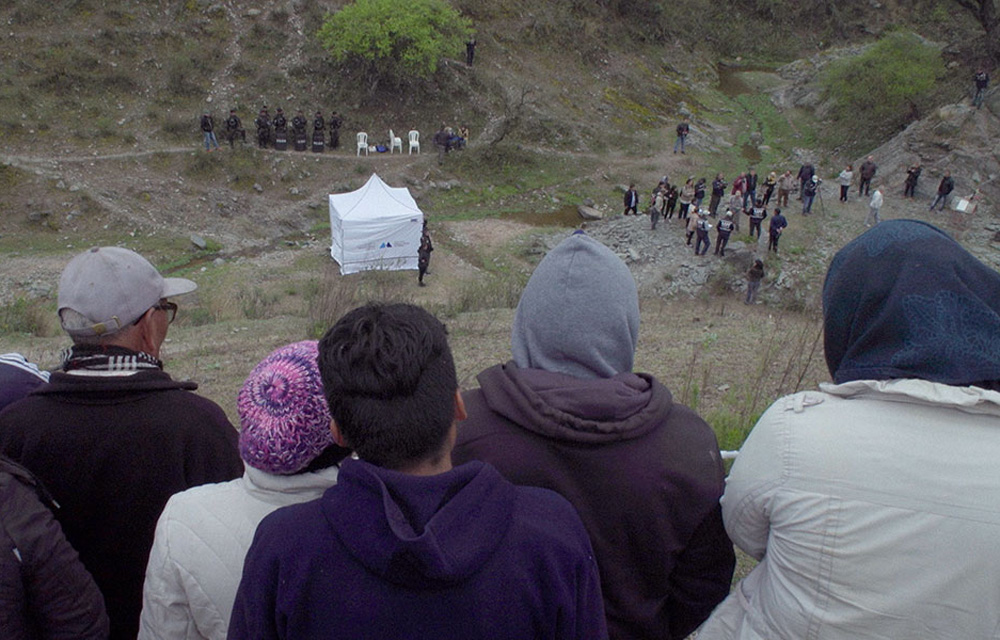
Martel has never made a documentary feature before and no one has made one quite like her as the wildly innovative director behind “The Headless Woman” and “Zama” trains her lens on the trial of the three men. For audiences abroad, the procedural elements of the court system in Argentina will likely be fascinating enough, a bit different than western tribunals when the court itself is physically arranged differently, with testimony given at the center of the room surrounded by lawyers and judges rather than someone taking the stand to speak and defendants have the right to challenge witnesses directly. Additionally, a centerpiece of the film becomes a field trip to the site of the incident where the defendants freely describe what occurred in considerably more charitable terms to them than video taken on the day by both themselves and the Chuschagastas, who saw long ago that a camera was a key to protecting themselves against threats to their property rights. However, from the second Martel employs the use of drones for coverage of some of those high altitude scenes, it’s clear besides Michael Bay in “Ambulance” no one has thought about their use quite as inventively as she has when the beautifully scenic shots they’re often deployed for are disrupted by the herky jerky pivots that are typically edited out. Their clever inclusion here speaks to how the Chuschagastas have been yanked around in their natural habitat, sometimes violently so as people have encroached on the territory with nothing more than arrogance to claim title to it.
The trial itself appears to be conducted fairly, but the injustice is that the Chuschagastas were pulled into court in the first place, subject to laws surely drafted without consideration to them, and Martel shrewdly structures the film to gradually shift the balance of who’s getting to tell the story and thus providing the frame for how this history will be relayed in the future, from the perspective of the three defendants and their lawyers to Javier’s wife and broader family who are fleshing out their personal experience in undeniable terms to assert their presence in others’ minds as much as the land that’s rightfully theirs. History itself is called into question when the Chuschagastas describe how little of they ever learned about themselves in school and reflect on paintings and textbooks in which their erasure was considered a foregone conclusion. It then becomes poignant as much as genuinely stirring how Martel makes still photos taken over the years within the community come alive with incredible sound design in addition to interviews rich in detail that sound as if it’s the first time anyone’s taken an interest in hearing what they have to say. When Javier’s wife looks over a table with all the photos laid out her family has collected from over the years, it seems as if she could be referring to either the pictures or the people in them when she remarks, “You see it like this, quite weathered, but here they are,” and after adding, “I don’t know what will happen to them after I die,” the fragility of an entire culture’s existence comes into focus as does an unimpeachable portrait of resilience.
“Nuestra Tierra” will screen again at the Toronto Film Festival on September 8th at the TIFF Lightbox at 12:30 pm and September 9th at 3:40 pm at the Scotiabank.