



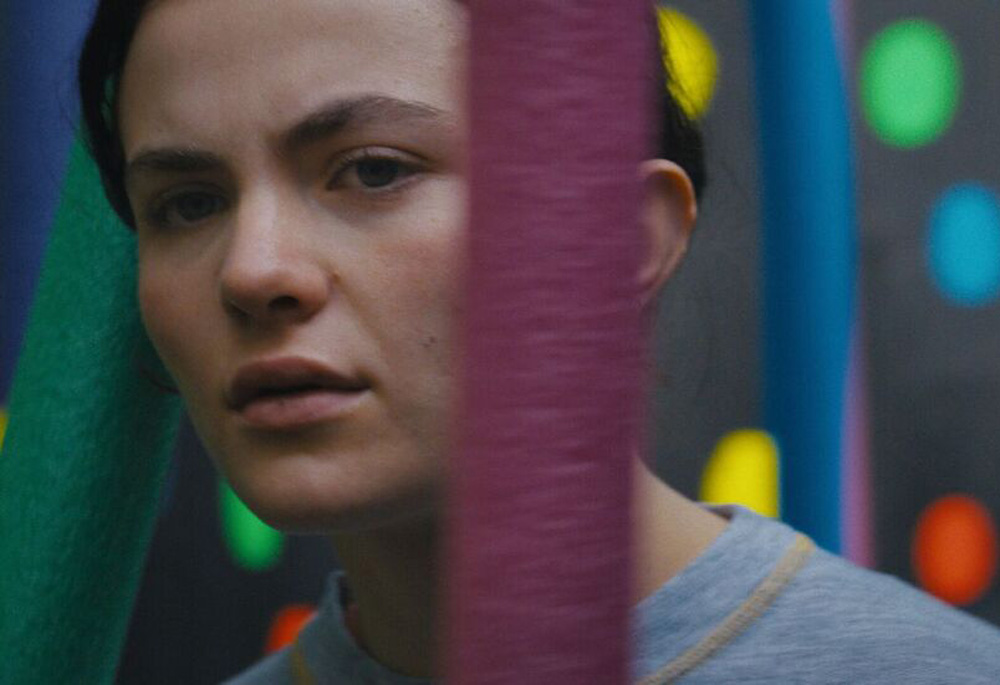

The haunted house that has provided a living to the Clark family takes on a profound second meaning in “Caity,” but Lindsay Calleran’s wonderful feature debut would be engaging to see it simply as it is. With Paul (Morgan Spector) at the helm and his 16-year-old daughter Caity (Chiara Aurelia) presiding over a ragtag crew of seasonal workers from their tight-knit community in upstate New York, the operation has irresistible charm as cauliflower is dyed to look like brains in a jar and prosthetics and lighting are tested to make it appear as if someone’s guts are spilling out along with an endless supply of maggots. The goal may be to induce jump scares, but the ultimate effect is pulling loved ones a little closer.
It has certainly done that for Paul and Caity, whose tempestuous relationship only reflects that they’ve reached the point of saying anything to each other knowing that it won’t hurt, free to blame one another about lax work habits or a deflated Jack O’Lantern with anger they can be assured will die down by the end of the conversation and more often than not, it’s just playful teasing, having a strong connection that seems to elude Caity’s mother Robin (Emily Schaffer) and definitely her older sister Dana (Olivia Rouyre), who won’t work at haunted house for reasons beyond feeling too grown up for it. It turns out that while Paul puts fear into people for fun, he has scared the bejeezus out of his family before, having nursed a drug and alcohol addiction for years that he’s seemingly recovered from, yet suspicions remain that he could fall off the wagon any day. While Dana is old enough to remember the really bad times and opts to stay away, Caity only knows the good version of her father, making it a bit of a tragedy in and of itself when she starts to be uncertain enough about his sobriety to start sniffing soda bottles in his truck to see if there’s actually liquor in them.
The writer/director locates the ability to make something singular as much aesthetically as narratively by staying true to the emotions, having Paul gradually recede into the background as it appears his addiction has come back to place a wedge between himself and the family, adding insult to injury when it comes during the haunted house’s busy season. Some individual scenes exquisitely articulate what Caity could assume but not entirely know at her age beyond Aurelia’s strong, intuitive turn, watching as the teen peers out the second-story corner bedroom of her house to see her dad blow up after having a rough conversation with her mother, only to find Dana’s boyfriend has been sleeping over, uncertain of exactly what’s being said when the windows are shut but having enough evidence to come to conclusions. But Calleran boldly takes things one step further when she’ll occasionally throw in a split-screen or a picture-in-picture that might seem wildly out of place in the kind of serious-minded drama that the film becomes, yet feels right at home in a film involving a funhouse, eventually working the visual language towards more poignant ends as it comes to resemble the glitches in the childhood memories Caity holds of her father filtered through home video, with the incursion of tracking coming across as a block of nostalgia to overcome to see what’s really going on.
In lesser hands, this kind of gambit could be terribly on the nose, but Calleran confidently employs the experimentation to deliver anything but the relapse drama you might expect from a simple synopsis, highlighting the magnetism of someone who has an addictive personality (portrayed with great charisma by Spector) where the highs convince one to overlook the lows and taking particular interest in the specific moment that Caity is in, not only having a different experience of Paul from everyone older than her in the family when she was too young to see him at his worst, but preoccupied with him as he’s increasingly absent, imperiling other relationships where she grows negligent such as with her best friend Petey (Michelle Mao) or could use a confidant as things turn towards the romantic with a trio of friends she makes around work (Christian Lees, Jonah Lees and Jordan Hull). (The fact that both liquor and casual drugs can help break the ice with people her own age become an especially fraught decision for Caity, given what her father is going through.) Things may be moving too fast for Caity to see them in the right light, but amidst the phantasmagorical swirl of orange, purple and green fluorescents, Calleran captures the moment precisely, showing how the past can perhaps obscure a future for its young protagonist, but conveyed with such clarity that it couldn’t look any brighter for its director.
“Caity” will screen again at Tribeca at the Village East on June 11th at 3:15 pm and June 12th at 5:45 pm.