



It wasn’t the utopia that the founders of Burning Man had envisioned in 2021 when the annual event where thousands descend on Nevada’s Black Rock Desert to set up a temporary city to last just a week. Like other cultural institutions, organizers faced an impossible choice as COVID made in-person gatherings irresponsible if not outright illegal, but still for a festival that brought together the masses with an independent streak, it was a subject of fierce debate, revealing the politics of attendees who had long put them to the side for a week where cash has no place and it took community to survive when basic amenities are stripped away in the middle of nowhere with nothing to lean on but one another. Charitably, it could be seen as confirmation that Jerry James, Michael Mikel and the late Larry Harvey had come up with something necessary outside the system for those that tired of the rat race that much of civilization now adheres to, but the silver lining was probably difficult to see for Marian Goodell, Burning Man’s CEO left in charge by her partner Harvey after his passing, as her leadership was threatened by big money donors to the organization that wanted the event to go on and any attempt to mount the event would be even more logistically challenging than it is in a normal year.
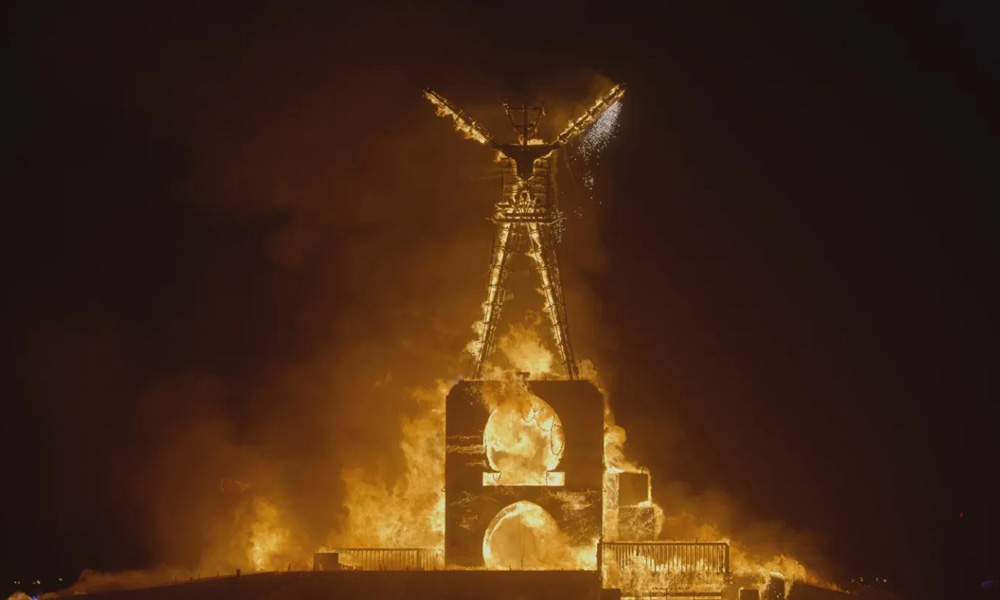
You could be assured to see something wild on the ground at Burning Man, which often resembles the post-apocalyptic landscape of “Mad Max” where clothing is optional and the event fulfills its promise annually with a giant stick man being set ablaze at its conclusion, but directors Jehane Noujaim and Vikram Gandhi find it more unexpectedly in the organization’s boardrooms in “The Man Will Burn,” remarkably having cameras around for a true fork-in-the- road moment. The four-episode series covers just about as many years as Burning Man is put in financial peril by having to absorb the losses of cancelling the event for two consecutive years and faces internal rebellion over its direction for the future when Goodell’s caution would appear to some to be at odds with an event that’s prided itself on having so few rules. Naturally, more than a few unruly Burners want to set up an event themselves without the organization to rival it dubbed “the Renegade Burn.”
The filmmakers gain full access to the Burning Man’s archive, detailing how a scrappy event for artists in California Bay Area became a behemoth and ultimately a playground for the wealthy who find a satisfaction there that they can’t even with their billions. However, even as they bear witness to Google founder Sergey Brin trudging around in the mud like everyone else when the festival is hit with torrential downpour in 2023, the two extend an interest in individual spiritual seeking from previous projects such as Noujaim’s previous HBO series “The Vow” on the Nxivm cult (with co-creator Karim Amer), and Gandhi’s breakout debut “Kumaré,” in which the director provocatively posed as a guru with a completely made-up religion, to an overall soul-searching for the organization that has tried to stay outside of the world its attendees seek refuge from but inevitably engage with it as economic pressures mount and more capitalistic instincts kick in. With series offering a chance to visit Black Rock to actually get out of the stifling heat this summer as it now streams on HBO Max, Noujaim, Gandhi and series producer Muriel Soenens graciously took the time to talk about how they managed an undertaking that could feel as if they were staging a Burning Man of their own with both a voluminous archive to dig into and filming in a desert where electricity was at a premium, but drama was never in short supply.
How did you team up on this?
Jehane Noujaim: Filmmaking is probably one of the most collaborative art projects that you can do and we knew that Burning Man operates 24 hours a day during the period of time that it operates, so we really wanted to pull a fantastic team together that could work simultaneously. It really began with Muriel. I had been working together with her on a number of projects and actually through a previous film, “The Great Hack,” I had worked quite hard to try to get the license to use the opening shot [of that film], which is the whistleblower [at Burning Man] hanging her whistle on the temple. It was one of the hardest pieces of footage I’ve ever tried had to get access to. It was practically impossible. It took eight months, but in the process, I met a lot of the people who ran the organization and ultimately we got the shots in the film and they felt good about it. So when they were thinking about talking to different independent filmmakers about doing something with their archive, it was beginning of COVID and I was one of the people that they contacted. We began talking about making a film and Vikram was put in touch with me through Dana, one of our initial investors and an old friend. We started talking about it. Initially, we thought [a movie] would be a terrible idea…
Muriel Soenens: But we hopped on the phone with them to try to gain a little bit more trust and a sense of where the story was at.
Jehane Noujaim: And it started as a potential archival project, which seemed like a great project to do in the middle of COVID when we didn’t know whether we would ever be able to be face-to-face with somebody and shoot again.
Muriel Soenens: As they were talking about their 35-year archive, which is just a documentary dream, they happened to mention that this was maybe not a great year to be filming because they were thinking about having to shut the whole thing down [due to the lockdown]. It was a huge deliberation and in the course of a couple sentences, they happened to mention that it was an incredibly divisive decision within the community of Burning Man, which to a documentary maker’s ears is the opening of the treasure box.
Jehane Noujaim: In other words, it allowed us to access all of the history [of Burning Man’s] ongoing questions and challenges, which is what is this place and what does it mean? Who does it belong to? Is it anarchic or has it lost its anarchic touch? So we knew we had to start convincing them to let us roll the cameras immediately, even if they shut down, which as you see in episode one, they were deep in debt and deliberating that.
Muriel Soenens: And didn’t they tell you, “There’s nothing to film”?
Jehane Noujaim: Yeah, they said, “We’re not going to have [the festival]. It’s probably not even going to happen,” so in we went.
The baton pass between episode one and episode two is really remarkable because you’re able to draw the parallel between 1996, this previously pivotal point in Burning Man history where they had to get organized to survive while risking their everything goes ethos, and when you start filming in 2021 when it’s a similar crossroads. Could you recognize that pretty early?
Vikram Gandhi: When we started shooting at the Renegade Burn, all the old school Burners were saying, “This is going to be like 1996” before Burning Man became a licensed organization, before the Burning Man Project was formed, when there were no rules, there would be free tickets. It was a conversation that was happening for people who knew and because it was really fresh in [our] minds, it made a lot of sense to cut back and forth because it was something that everyone was saying, “Is this going to turn out like ‘96 or will this be peaceful and without incident?”
Jehane Noujaim: I would add that the history of Burning Man lies very much under the skin for them. Whatever happened five years ago, 10 years ago is very close to their heart.
Was the idea in mind from the start to shoot over successive years?
Jehane Noujaim: It evolved. Initially, we didn’t know how many years. It was a verité film, so you follow your characters, so we really were not sure when we started how long it would be. The organization said that they would give us access for three years, but in the back of our minds, we felt that if we’re in the middle of a story three years down the line, we’re going to have to talk our way into another year or two.
Muriel Soenens: Every burn offers a drama. We could have been filming for probably 10 years, had it not been for budget and reality.
I imagine. You have a wide array of characters, including some like Ray and Lindsay, who are only going to Burning Man for the first time. How did you locate needles in a haystack like that?
Muriel Soenens: We did a lot of online research, we have intrepid researchers and producers and we have regular meetings about the casting. So you start scrolling through and you do deep, deep dives into a world and a lot of people are searching for something and then you’re there searching for something. Then somehow you follow [each other]. These two people happen to have been very public about their search for something that would reset their lives. Ray, in the sense, that he actually went online and started talking about his life and said, “Where would I find someone like me who’s such a mixture of things?” It’s unusual someone came up on some Reddit Substack and said, “You should probably check out Burning Man.” And Lindsay actually discovered it through VR and then found it to be something that moved her in VR, so it was very unusual.
Jehane Noujaim: But we followed a number of characters, and as we all experience, you can lose a character. We had to follow them in the playa [at Burning Man] and you can [literally] just lose them and not see them for the rest of the festival. So it really required a lot of trust building from our team with the characters, explaining what we were trying to do. And they had to believe in the process as well because they had to be willing to be followed around, many times, in situations that they probably didn’t necessarily want a camera around.
Muriel Soenens: In a funny way, it was mixing the most modern of technologies to find characters through the internet and networks that are only available in the past couple of years, and then going back to old school filmmaking, pre-telephone even, where you have to follow them into the desert with the hopes of finding them as if you were in the 1950s. So it’s quite a mix.
Vikram Gandhi: There were definitely people who didn’t whose story didn’t work out – some because we lost them, but others because to track an internal experience and know how it’s all going to come through. We met a lot of people and these two [Ray and Lindsay] stood out as the strongest among [the Burning Man] virgins.
It was interesting to hear just now Muriel describe the spiritual quest of Burning Man, and one of the exciting parts to me was seeing the directors of “Kumare” and “The Vow” team up when they’re both about people searching for something. Did it feel like you could continue your own exploration of the issues that raises in this?
Vikram Gandhi: I’ll be honest, I was excited that the director of “Kumaré” and the director of “The Vow” were working together too. [laughs] A lot of the essence of what I was looking for in my first movie, there’s a lot of Burning Man in it when it comes to the combination of like spiritual searching and humor and pranks and the social experiment, so it’s definitely in my DNA as a filmmaker and it made sense.
Jehane Noujaim: Yeah, all my films look at power dynamics. You see “The Square” was a community of people coming together, trying to figure out what was next for the country and trying to reimagine a different future for Egypt and with “The Vow,” It came up a number of times where members of the Burning Man board were like, “Oh my goodness, what are these people going to come out with?” And there’s a joke in the Burning Man community that if it’s a cult, it’s the kind of cult where you wash your own brain. There isn’t this leader [because] the first signal of a cult is that you cannot disagree, and if you disagree with something, then you’re basically asked to leave. But what we found in Burning Man and what was beautiful about it was that so many people have such strong disagreements, yet what they are united on is this idea that this temporary city in a desert should keep being should keep happening every year and that they should do everything that they can to make it happen, even though they disagree on how it should happen. There are many different people who think different things.
And of course, I was excited to be working with the director of “Kumaré” and it didn’t turn out this way but initially, when we were talking about how to pull a story like this together — and I’ve never made a film like this — but at one point, I thought, “Well, do we need some kind of on screen character like Vikram [in “Kumaré”] to be able to really walk us through. We didn’t end up going that way, but having that as a possibility was interesting. It was a very early thing that we talked about, but then it we we decided to do it differently.
Vikram Gandhi: Yeah, one of the things about Burning Man is that it’s not really about one person, so it always made sense to make sure that we could find this cross-section of people. It makes storytelling harder, but it’s in the ethos to try to try to tell as many stories of people as we can and obviously we’ve done a lot of work and trying to weave them together over the course of four episodes. It was definitely a complicated process of figuring out the way in.
Muriel Soenens: Then of course the challenge of making something that’s so iconic for people who are stars [within the Burning Man community], they’re rock stars, and making a film for people who know them as well as people who should discover them, whether they like them or not, it was an incredibly unique thing, as well as the proselytized, the beloved, intrepid 30-year-old Burners. It’s hard.
“The Man Will Burn” is now airing on HBO and streaming on HBO Max.