


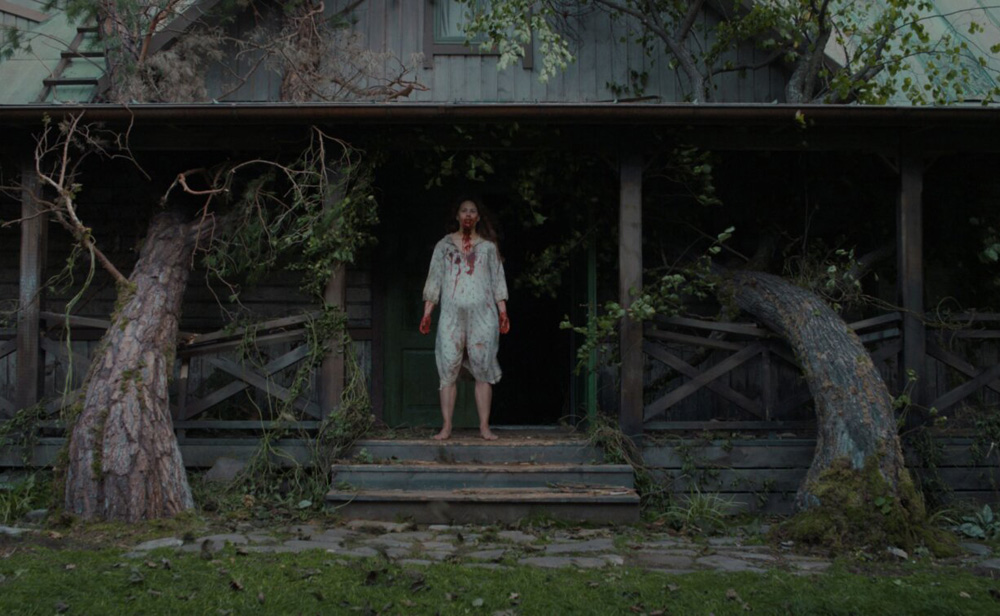

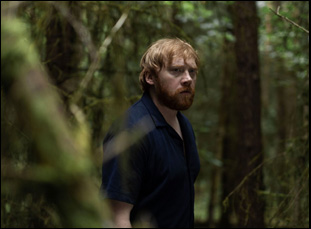
Saga (Seidi Haarla) would seem to be possessed by forces beyond her control as she returns to the forest in Finland where her grandmother once resided in “Nightborn,” bringing along her husband Jon (Rupert Grint), who immediately promises that they won’t be returning to his native England even if work beckons when his new bride clearly wants to set down roots. It is a sign of desire both for him and the life that she wants that Saga coos into his ear, “Make me a mother” amidst the trees as they’re taking a tour of the enchanted property, and the requisite lovemaking does lead to a baby, one of three if Saga’s ultimate stated aspirations comes to pass, yet the delivery isn’t exactly a bundle of joy, noted by one of the nurses to be an extraordinarily hairy child amongst other unusual features, taking the new parents quite a long time to name Kuura – and even then they don’t always know what to call it.
To go by her memorable debut “Hatching,” director Hanna Bergholm is wary of plotting out the perfect life, either in terms of the future or in comparison to what others have when a daughter’s anger towards her mother who had dreams of being a mommy blogger manifested itself into an uncontrollable winged creature that threatened to push the rest of the family out of the nest. In her ferocious follow-up, it is the mother herself who may have a monster growing inside her as postpartum depression sets in and she has trouble warming to her child despite her best efforts, complaining of being sucked dry in a variety of ways when it isn’t only milk that young Kuura is drawing from her, but her energy and even blood. A paranoia develops when no one else seems to share her concerns and the rotunda that she and Jon have turned into a nursery starts to look like a vicious cycle in which she can never get a fresh start. As painful as it is for Saga, Bergholm also finds the dark humor in it when the child develops into a product of its toxic surroundings and the parents are reduced to crawling around to get a grip on what’s happening to them when the ground seems to be crumbling beneath them.
Haarla, who previously made audiences fall in love Juho Kuosmanen’s “Compartment Number 6,” becomes someone that it’s impossible to shake once more as the downtrodden mom, and Bergholm builds on her strong central performance to show how warped the world around her becomes when Saga becomes disillusioned with it, demonstrating again what a gifted stylist she is when everything from the walls of the house to the clothes reflect her horror. After premiering earlier this year at Berlinale followed by a celebrated box at Fantasia Fest just last week where the film picked up the Cheval Noir Award for best feature, “Nightborn” is now streaming on Shudder and the director graciously took the time to talk about turning her own anxieties about being a parent into a waking nightmare for others, her extensive work with practical effects to pull off the strange creature Kuura and how she collaborated with the metal gods Eicca Toppinen and Max Cavalera to really rock the cradle.
 How did this come about?
This really started from my own experience as a parent. When I got my child, the baby was crying a lot and I was confused with all these feelings that I had that felt forbidden, like the rage towards the child or all this confusion, and I really felt that I want to make a story about this forbidden side of motherhood, or the painful side. Then I started to talk with many women and with men who have children about their experiences and I collected this story from them. I started to think about the physical side of being a mother, like how your body might transform very quickly and and how you then deal with that and how it affects your relationship with yourself and with your child.
As with “Hatching,” you keep the film contained to the present moment, but reflect past ideas of conformity and domesticity in the design of the house and the costumes as well as Saga’s ideas about how many children she wants, while the film is clearly of this moment. What was it like to think about generational changes in ideas about motherhood?
First of all, I really wanted to make this story where you can see all the close family members like Saga’s mother and sister and John’s parents and how they all affect to each other because we are only affected by the people that are close to us — we see ourselves in them or we want to be like them or we don’t want to be like them and we might say something and mean well, but we end up misunderstanding each other. So I wanted to talk about that. But I always like to tell the story by using all the elements of storytelling like the costumes and the props and I really wanted to tell this story from Saga’s point of view and show with her dresses how she tries to portray some kind of ideal that she has in her mind.
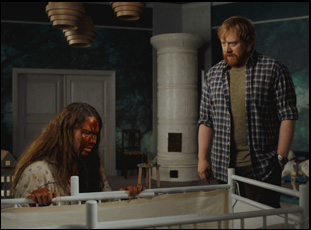
After childbirth, she doesn’t basically fit into her clothes anymore and she has decorated the nursery to portray her ideal of this perfect parent-child relationship, but the nursery is so over-the-top lovely with all these porcelain dolls that it feels even impossible for a child to play there. it was a production designer’s idea that it would be a round shape because I was describing that the baby and Saga live in kind of a bubble, so the nursery is this huge, round shape and then it was fun to imagine all the most lovely things you can possibly imagine and put them all there. There is a ceiling with stars painted on it and a lamp, which is a castle on clouds, and with all this, I wanted to show her dreams versus the reality.
The nursery almost feels like a Roman Colosseum because of that circular shape and I’ve heard Rupert Grint describe filming this almost like shooting a musical with how involved the choreography was. What was it like to figure out the blocking?
It was really when we started the process, so Rupert Grint came to Helsinki for ten days of rehearsals before we started filming and we had very famous Finnish choreographer Tero Saarinen, because we have a dance-like moment in the film and there’s a fight thing going on, so we really started the rehearsals by them getting physically close and getting to know each other. Rupert and Seidi actually said later on that it really helped them to get brave enough to really be close because they are very close to each other in this film and it’s very physical roles that they have, [and I could] realize how well they understood the characters. It was really them really owning the characters and in the rehearsals, they were getting deeper into their parts and being comfortable enough to portray them.
 I don’t want to spoil the movie magic too much, but it’s wild to see that there are at least nine different children listed in the credits to play this one baby – and I know there’s some puppetry in there too. What was it like creating a consistent performance from the baby?
Yeah, it is because we have a baby who does all kinds of things in this film and I wanted this baby to have a very specific way of moving because baby movements are usually quite cute. I wanted this way of moving to be a bit special, so that’s one reason why I wanted to use this animatronic puppet and we had a wonderful team making them and puppeteering them. They had been working on all the “Star Wars” and “Jurassic World” films, making these creatures. Since there was also this creature in “Hatching,” one of the [ways] to have this physicality that I wanted was that [the baby wasn’t going to be this] CG character, it’s really there. That’s why I wanted to use a puppet. And there were some really bizarre looking moments [on set] with them being around Seidi and Rupert and moving the baby with rods, but I did learn a lot from making “Hatching,” and I had an understanding of how these SFX work.
Then in different moments, we had real babies and of course with real babies you never know what kind of mood they are in and what they will do. So there were many challenges, but it was fun and really carefully preplanned because with the puppets or with the real babies you can only shoot certain things. The baby is quite hidden, so it needs to be figured out beforehand how do we hide the baby in every shot, so it’s just what we want to show. It was very carefully storyboarded.
Was there anything you thought might’ve been near impossible going into this that you were excited to pull off?
There are things happening in the house that were a huge puzzle for all the team in the shoot to figure out how to do. It continued all the way in the post-production in sound and in music and then we had the VFX work as well, but I always enjoy making things where all the team can really do their best efforts.
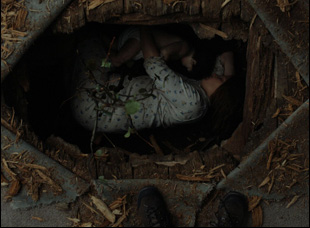 The score is a really interesting part of this. What was it like to put music on the film?
It was cool because when I started to think about this story, I listened to the band called Apocalyptica, a Finnish band who plays metal music with cellos. I’m very much a heavy metal fan and I wanted to work with Eicca Toppinen [one of the their members] and for him to compose this metal solo music for this film. I was describing to him like this baby cry [where] it sounds like heavy metal roaring, and I also want these tree sounds to sound a bit like human heavy metal roaring. I was telling [both] him and the sound designer Micke Nyström that the heavy metal artist I admire the most is Max Cavalera from Sepultura and Eika said, “Yeah, I know him,” so then we got him also into this film, growling, so his voice is hidden in there as well.
Everything in the film blends so well, including the humor and the horror. What’s it been like to share with audiences so far?
It has been so fun because the world premiere was in Berlin main competition, which is usually an art house audience, and you can see this as an art house drama film if you like, and now I screened at Fantasia and it was avery genre audience, but they actually reacted exactly the same way. It seems like if you’re a drama fan, you can watch it and if you’re a horror fan, you can watch it. If you have children, you can watch it. If you don’t, you can watch it. So it’s made for everyone.
“Nightborn” will start streaming on Shudder on July 31st.