


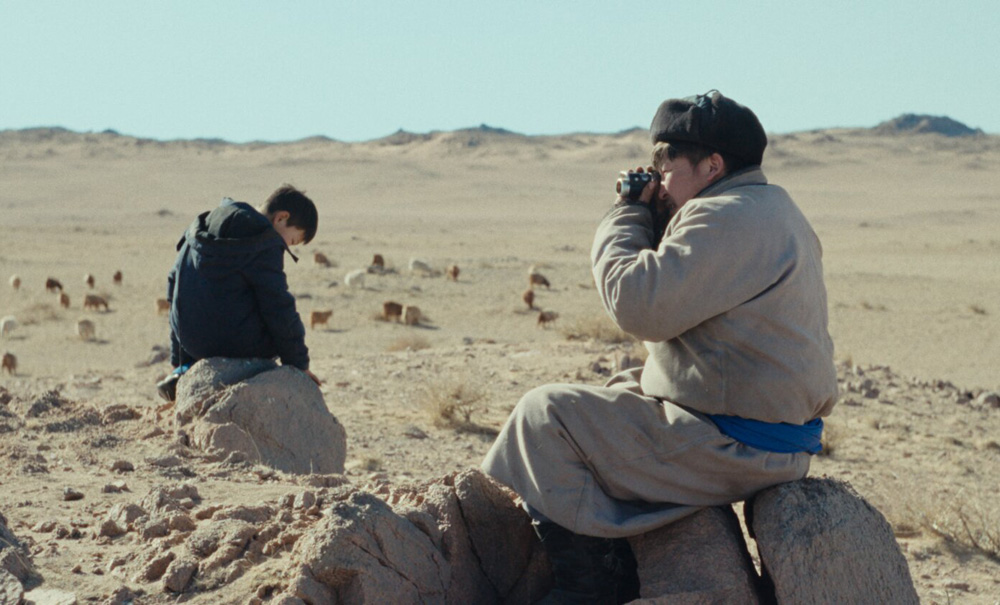

“It’s terrible when you wake up from a nightmare,” one of the kids gathered in small house says to the others in “The Wolves Always Come at Night” as they pass around a flashlight to hold just under their face, telling spooky stories. They are in the middle of the Gobi desert and any tales they share seem to have at least a century or two of history behind them, remaining only in circulation because of a moments like this throughout time where details may unconsciously be sharpened or sanded off by the last person to hear it and still entertaining when there may not be too many other diversions.
Gabrielle Brady’s second feature would seem to join a grand tradition in this regard when she brilliantly engineered a way to capture the lives of a Mongolian shepherding community that could easily vanish when a sand storm devastates the area and leads a couple (Davaasuren Dagvasuren and Otgonzaya Dashzeveg) to relocate to more urban surroundings. When the unforgiving landscape can erase any trace of life that once existed as dust covers past civilizations, Brady keeps a cultural history intact with some cinematic sleight of hand as she watches Davaa and Zaya rebuild their lives without being entirely able to let go of their past, which drifts in and out of their consciousness and supplied with real glimpses of the community they had to abandon.
The director, who previously helmed the marvelous “Island of Hungry Ghosts,” where a nonfiction approach felt touched with magic in making a lovely comparison of the plight of those seeking asylum in Australia to the migration patterns of the continent’s indigenous land crabs, uses cinema to become a time machine for Davaa and Zaya when filming commenced when the real-life couple was setting up their new home, but the production could allow them an opportunity to travel back to the life they once knew as they played out scenes that led them to the present situation. Shot in the widest frame possible with cinematographer Michael Latham’s exquisite compositions, “The Wolves Always Come at Night” is related with the gusto of a grand legend even when it’s resolutely contemporary and the liminal space that the filmmaker creates for both her subjects and an audience as it expresses the feeling of living in uncertainty in a number of different respects seems genuinely innovative.
After premiering last fall at the Toronto Film Festival en route to stops at BFI London and Mumbai as well as True/False and San Francisco, the film was selected by Brady’s home country of Australia as its official Oscar entry for Best International Feature and recently, the director graciously took the time to talk about how she was able to forge a unique alliance between an Australian and Mongolian crew to make the film, finding the sweet spot between drama and documentary to be able to tell such a story and braving fierce headwinds, often times literally.
 How did this all come about?
It had been percolating for a while. I lived there [in Mongolia] in 2008. I was very young then, I had just turned 20, but had this very influential experience spending almost 18 months there and I spent a lot of time going back and revisiting friends and colleagues and somewhere along that track, the idea started percolating. I did the first real research trip when I was pregnant with my daughter, who’s now six, so I’ve got a physical aging of that research process.
How did Dava and Zaya enter the mix?
It didn’t start with them, but that was the moment we knew that we had a movie. The exchange with them was very potent on both sides and within a few minutes, they were interviewing us in a way at the same time that we were interviewing them. We started shooting the next day because they were moving all their earthly possessions from the countryside to the city, so those scenes in the film was the first day we knew each other. And of course then we had a much longer period of filming.
What was it like to meet them at that point in their lives, after they had lost everything and then figure out a way to recreate those events and involve them in that process for the purposes of the film?
It was pretty clear early on that we couldn’t and didn’t want to be in the face of a family who had just had this loss for a number of reasons. It’s a really painful experience, so it just felt like there wouldn’t really be permission. So we always knew that we wouldn’t show that in that way, and when I met Dava and Zaya, Dava [said] “we can start filming, but I don’t want this filmed” and actually it was Zaya, who was more adamant, [saying] “You have to show who we were as it was, or people won’t know why we are who we are now. They won’t understand the gravity of the loss unless they’ve seen who we were.”
That was an invitation to film in retrospect, as I like to call it, because it wasn’t a reconstruction, but more like a relocation. There was an ease to it for Dava and Zaya because their families still live there and they go back seasonally anyway to help with the animals. So it wasn’t a stretch for them to go back. but when we went there, we set up our own gear and we lived with them in this spring and of course within that there were some of these key moments that were more constructed to help with the the narrative flow, but a lot of what was happening was just happening in the spring — the movements of birth and death and conversations and precarity and uncertainty and storm. These were just all unfolding events.
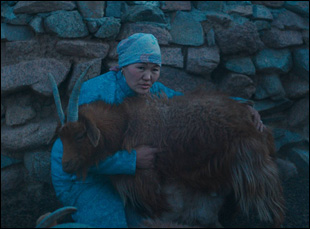 It seemed like you were already moving in this direction of a hybrid documentary/narrative when you made “Island of Hungry Ghosts” since that didn’t feel like nonfiction at all. How did you approach this?
It was an evolution, really. Both on “Ghosts” and on “Wolves,” it was like a double whammy. On one side, the film itself needed it. In “Island of the Hungry Ghosts,” we had to film in retrospect— after the event, because of the legal situations that people were facing, it was so sensitive — and here we were [on “Wolves”] filming after Dava and Zaya had lost their animals because of when we met them and not wanting to be part of such a painful experience with a camera in someone’s face. But then, there was my own fascination with this kind of filming. I love working with non-professional actors. I come from a theatre background. I think performance is an incredible way to kind of translate experience onto screen, so I think both films needed it and gave us a lot more space for the cinematic approach as well.
What was it like as a cultural collaboration when you’ve got both Australians and Mongolians working on it as part of the crew?
A lot of the crew building was with our producer Ariunaa [Tserenpil], a very prolific producer in Mongolia. Her husband’s also a very prolific director, so she’s worked on so many productions over so many decades and the crew that we built within Mongolia was so curated with her eye. We’ve known each other a long time, so she really was bringing people together that she felt were perfect for the story, the way I work, and for Dava and Zaya [feel comfortable]. Then the other people I worked with were long-term collaborators like Michael Latham, the [director of photography], and Aaron Couples, the composer and we’ll also work together on the next film, so there were threads of this continuum.
Was there much of a foundation for a story beyond what Dava and Zaya shared? Or did you let it really unfold?
It’s a bit of both, and this is the interesting thing with documentaries. Of course, there’s a film treatment written and when you look back on that, it’s completely different in a way. At the same time, there’s an essence to it that stays the same. Because it was evolving with Daba and Zaya, it became its own beast and the best way to describe it was that we would initiate environments for real life to unfold and emerge, so a lot of the scenes are actually observational. Yet we might put a light or choose a time of day to amplify a certain feeling, always tending to the visual and sonoric language to bring cinema. That’s our job, I feel, is the translation between someone’s experience and what we see on screen. But nothing was scripted so in that way, it was very much a documentary.
When that’s the case, was there anything you might not have expected but could get excited about?
Two moments come to mind — one that’s more drastic, which is the storm itself. In a way, the whole movement of the film, there’s a before and an after and the whole structural approach is built on this cataclysmic event. The very first interview question I had was how did you reconstruct the storm and we didn’t reconstruct a storm. We didn’t have the budget. So it was very improvised, almost like a film troupe or a bit like how Cassavetes was working with his actors. We’d be here for these days and whatever occurs in this time we’ll respond to. And this is what nature brought us was this once-in-some-decades sandstorm that wiped out everything. So that was a huge surprise, but at the same time, part of the very texture of how we were working.
The other scene that comes to mind is a moment where Dava is telling his uncle that they’re leaving. And so we’d discussed that scene beforehand when Dava was one of the co-writers of the film, and he [said in reality] they actually just left. They didn’t have a conversation. But then he shared that actually there was a conversation that they needed to have that never happened, so in the film we see this conversation that didn’t happen the first time around. Yet it was the real conversation [Dava wanted to have]. It was what couldn’t be said the first time. So it struck me that the film, in a way, was also rewriting narrative for the protagonists as well and this felt like a really powerful movement that the film initiated.
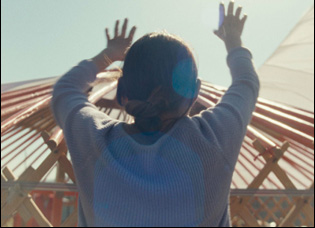 Given the process that you have for this film, I imagine there’s tons of footage. Was it easy to find something to hold on to structurally in order to build around?
There wasn’t a sense that it would be as linear as it is, but in a way, it needed to be because of the event and the before and the after. If we had a more clear traditional narrative, we could err into these moments of magic realism and blur this in-between space, the limbo that Dava and Zaya and all nomadic families in these districts are feeling. We wanted to amplify that limbo. It’s almost like a mother without a child being a herder without animals. There’s an absence. So people are really in this in-between space and the narrative structure allowed for these other explorations. But there was a lot of material because it was a documentary. We were finding the story as we went and there were other participants and collaborators that couldn’t make the final film that would be great short films, if there was time. There were a lot more layers in the film originally, but in the end, it felt like stripping back and creating more containment for just Dava and Zaya’s story. It told us everything we needed to know, so it got pared back.
The sound design is part of what makes this so immersive. What was it like to work on?
Sound for this film was so incredibly important that we had this guiding light that the wind was our narrator in a way. It was both present and omnipresent, always either in waiting or completely encompassing. For me, the most powerful force that cinema has that other art forms don’t is that you can transcend space and time. You can bring somebody into a world, no matter [whether it’s] documentary or fiction, so it’s always about creating a feeling that someone could almost feel as though they’re there. It was challenging. Of course, we didn’t have enough time to capture all the sounds that we wanted to. I also worked with an amazing sound designer as well and we really played with Foley and not just any old Foley, to get the sound of horses. He had real horse hooves and we were really kind of film nerds, obsessed [with getting it right].
What’s this been like getting this out into the world and seeing it connect with audiences?
It’s been so fascinating to have presented the film in Mongolia, and then to see so many crossovers in other places like in Iceland. There were a lot of nomadic herders that came to watch the film and felt that their story was being witnessed. Also in India, there was a man who came to talk with me afterwards and he was just weeping. He had a similar story with his cows and he described getting laughed at, but to see something that hasn’t been taken [presented] in a whole image on screen was moving There was also a young man who was climate activist and he was super angry about the film, that there were no facts and figures [included], and then next to him was this man who was weeping, saying he’d never seen anything so visceral that it’s broken his heart. It’s always fascinating to get a range of different experiences, [especially] at that same screening.
What’s it like to represent Australia at the Oscars?
The very exciting part is that for whatever these award seasons and ceremonies mean to different people, they bring a lot of attention around the film, so it gives it new eyes on it and it’s another wave for the film. That’s always really exciting for me. I’m also really honored that Australia would recognize a film like this that wasn’t on the shores of Australia, yet was made with a big Australian team. That really means a lot to us and also for the Mongolian team, honouring Dava and Zaya’s story. It helps for the whole team and we’re just really excited.
“The Wolves Always Come at Night” does not yet have U.S. distribution.