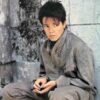
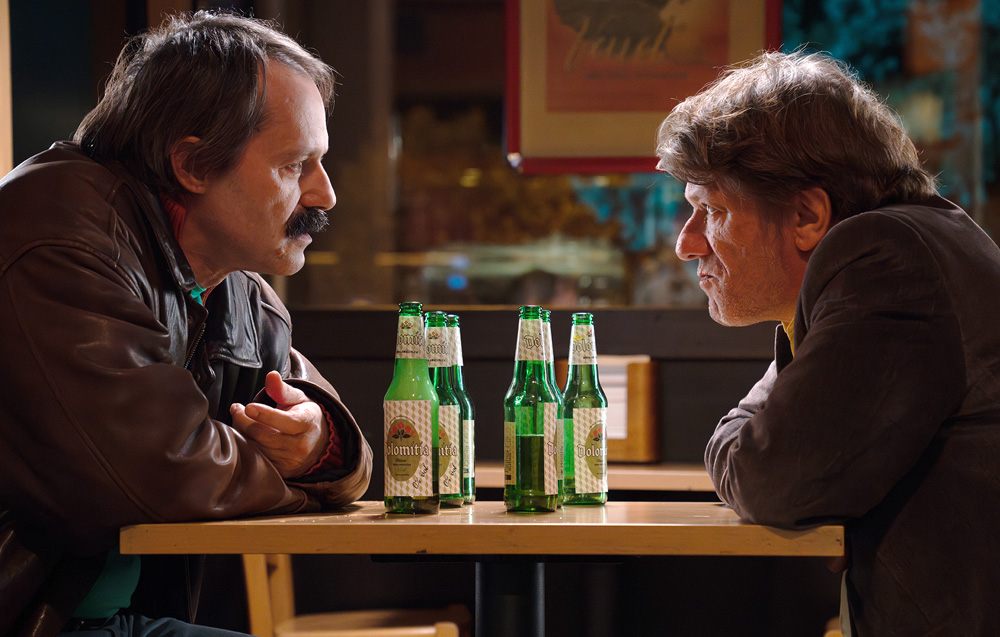

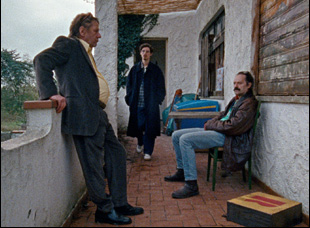
The ritual of insisting on a nightcap while putting off the inevitable end of the evening by searching for somewhere to sit down becomes a potent reflection of where Carlobianchi (Sergio Romano) and Doriano (Pierpaolo Capovilla) find themselves in “The Last One for the Road,” two middle-aged men in an Italian factory town that’s glory days have passed and threatens to take them down with it. Over drinks, they’re always happy to talk about the moment it all changed around 2008 when the economic crisis claimed the main employer, becoming the stuff of urban legend now as they fancifully recall how the boss once flew in on a helicopter to give a retiring employee a gold watch when caring so much about their fate and yet ended up leaving so many out of work and scrambling around for sustenance and rather than hunt for a new job, Carlobianchi and Doriano have decided to hit the road on a tip that their other friend Genio, who long since decamped for Argentina, might’ve hidden some money before he left.
The two are content to talk amongst each other about the old days, but they find someone new to listen in Francesco Sossai’s frisky comedy, which in itself feels as if it’s a fresh observer before even coming across Giulio (Filippo Scotti), a young architecture student they meet upon seeing the alcohol flowing around a college graduation they stumble into. Sossai, a native of the Dolomites where the perspective from seeing the cities from afar disabused him of the glamorous view of Italy that most filmmakers have been attracted to over the years, quite literally taking the road less traveled in his debut feature where filming on celluloid adds a layer of grit to the grungy world of late night dive bars and other sketchy detours that Carlobianchi and Doriano inhabit, particularly when the former refuses to turn to Google Maps for the directions. Grabbing an enchanting sense of melancholy from the air in a country where the natural beauty can’t be refuted, but for many it’s difficult to be able to be comfortable enough to actually enjoy it, the film distinctively carries the breeziness usually associated with road movies, sitting comfortably besides classics such as “Il Sorpasso,” while being well aware that history can be crushing if it’s repeated without question.
“The Last One for the Road” proved intoxicating for audiences upon its premiere around this time a year ago at the Cannes Film Festival and ed to Carlobianchi, Doriano and Giulio finding their way well beyond Italy with stops at the Toronto Film Festival, New York and Vienna, among others. Now the film is arriving in U.S. theaters for a good long run and Sossai graciously took the time to talk about how despite putting years of his life into the film by getting well-acquainted with the area where his lead characters would travel, he isn’t one to plan things out too much and how he was able to conjure such an acute feeling while keeping things loose.
 How did this come about?
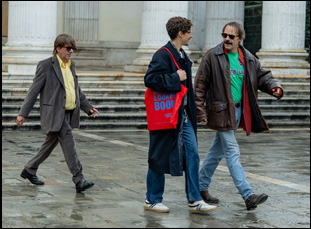
I’ve been wanting to make a film about the current Italian landscape for a long time because I felt there was a big void, especially for people outside of Italy. There’s always a picturesque portrayal of Italy and I wanted to show that Italy has changed a lot and it’s a lot of different than what people think it is. At the same time, I’m very fascinated with this idea that the meaningful experiences of life that stay with you for all your life are very few and more mundane. For me, one of them was this weekend I had with a friend in Venice where we met an architecture student and we spent the time sharing things about our lives, drinking and going to parties and then walking around looking at beautiful architecture. So I thought “Wow, after 10 years, this feeling is still with me. Maybe maybe I can explore it. Maybe there is something inside this feeling,” and that’s how I started to develop this idea of the film.
Is it true you actually spent time picking up scraps of dialogue from around the location where this was set?
Road movies are very beautiful because you start with a map and you know that the people are going to go from here to there on the map, but it’s a very loose and free structure. At the same time, I was going around and tuning myself in the themes of the film and doing that, it makes me become like an antenna to dialogue and situations I was observing, so I write down a lot of what I hear around, knowing it’s going to find its place in the movie After a lot of years of writing down scenes, my co-writer and I close ourselves in a place for two weeks, draw an actual map of the film, which was similar to the one [the characters] draw at the bar towards the end of the film. We had all this material and all these scenes, and we started to compose it, [saying] this scene is going to come right after [this one] and so on.
 How did the 2008 financial crisis become a dividing line for the film?
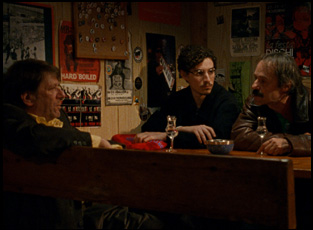
2008, especially in the industrial area of northern Italy, was a landmark in the lives of people because when the economic crisis arrived, it was the end of a dream of economic development from the north. The north used to be very poor until the Second World War and during the ’50s and ’60s and ’70s, this area had this huge economic growth, but 2008 was the end of that idea. I know a lot of people that grew up in the ’70s and ’80s and 2008 changed their life completely and their way of ever looking at the horizon. But what struck me is that they stayed the same age of the date of the trauma. They look and act like young people and they go on as if the world didn’t change and for me, [it seems like] a lost generation because they never realized what happened and they go on. So my two main characters are part of that generation that I observed for a lot of years.
At the same time, it was interesting that this young architecture student doesn’t even know what 2008 crisis is, so when they tell him, it’s like, “What is 2008? And they have to explain it to him and that has a lot to do with trauma. For some people, it is traumatic. For other people it’s not and maybe when you see that for other people it’s not, you’re a bit relieved somehow and I wanted them to feel a bit relieved about that because he has another perspective on that.
How did you find your central trio of actors?
We don’t write thinking about actors because you get disappointed if you don’t get him or her and when you write with an actor in mind, you write what you already know he or she can do. You never get surprised. So for us, characters don’t have a physical connotation, but we want to know how they structure dialogue, how they talk, how they react to things, how they talk about things, and how they’re restless in their speech, so that’s what we develop. Then when we’re done with the script, I look for these voices. I go around and when I hear something that interested me vocally, I turn around and usually that’s the actor for my film. that’s how I did it.
It was a different process for each of the three [actors], but for instance, Pierpaolo Capovilla, the one playing Doriano, is a very, very famous Italian singer. He’s a cult figure from a hugely influential band in Italian music of post-punk music from 2000-2010. So when I finished the script, his voice that I knew very well from the records entered the script and I couldn’t divide it from him anymore, so I ask him to play it. But with the three of them, I don’t do open casting calls or see a lot of actors [for the roles]. It’s like falling in love and if I fall in love, we can shoot.
 Once you see the actors together and they have a certain dynamic, does it change your ideas?
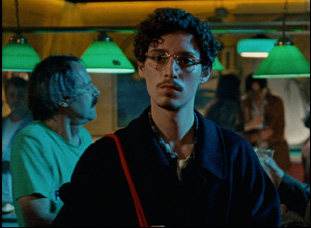
Yeah, that’s the beautiful part about casting. I don’t change dialogue a lot, but every actor brings something new to the character and I want to be able to get surprised by that. What I tell them every time is there is this Robert Bresson sentence that I really like, “I don’t want the actor to show me what they know they have, but I want us together to reveal something they don’t know they have inside them.” That’s the process I want with them. I don’t want them to give me what they already know about them or to show something they know. But I want us together to find something they don’t know they had inside them.
From what I understand, there isn’t a lot of shotlisting – you’ll get on set and figure out how you want to frame shots, but there’s a great split diopter shot of a shrimp cocktail that suggests some things were planned ahead of time. What was it like figuring out how to get the right visual feel?
I rarely storyboard, except for maybe when you have a more complicated scene or you have to be super fast and I try to have an idea of what I’m shooting. Otherwise, I like to come on set early and try to look at it with new eyes because when you prepare a film you go hundreds of times to the same place and you talk with the electrician and the cinematographer and the set dresser and so on and you grow tired of the spaces. You have seen them a lot. So having a safety net of a storyboard, it activates my imagination again when I come on set. For instance, there is this scene when they meet Julia, this university student who is celebrating her degree, for the first time. In the script, I wrote that she was dressed like an Egyptian queen, so the costume designer and makeup [designer] made this beautiful wig. But when I came on set, I realized we were under this church that had very heavy columns and she was looking like Cleopatra, so I thought this reminds me about those films from the ’60s about Cleopatra, those historical blockbusters, and I said “Okay, why don’t we shoot it like this today?” I’m very lucky because I have a cinematographer [Massimilliano Kuveiller] who knows cinema very well and knows how to react to my impulses.
Then with the split diopter scene, I said “Max, how can we put them in relation?” Doriano drank a lot that night, is now hungry, and it was something very fat and juicy and sweet and sour to eat, so he finds the shrimp cocktail and [I asked Max] how can we be from in the space of the bar from opposite ends, but be together, so we came up with the idea of the split diopter. [Max] is very fast at doing things and we have a lot of fun because when you set up the shot and you see like the shrimp cocktail and Doriano, it looks like a Mario Bava giallo film from the ’60s, but instead of the phone call [in front] and the murder [behind], it’s this funny thing. It’s very loose, how we work, and we try to have fun.
 The music also is a great part of this and there’s a lot of live musicians besides a frisky soundtrack. How much do you think about it early on in the process?
These are all bands from my home region and on one level, I wanted to have music from the area to give a real authenticity to the film and all the music was written into the script already years before shooting. But I wanted to create a strange effect, which is for the live music to feel a bit diegetic, so for instance, when they sing [live], it resonates a lot to what’s happening in the scene in that moment — their lyrics are a counterpoint to what’s happening in the film, and this is something that maybe you usually do with the soundtrack, but I said to achieve this effect, we have to record it like a very good live record. I hired some re-recording mixers that specifically work with live music and at the same time, with the original soundtrack, I worked to have a bit of a lo-fi approach. For instance, a couple of tracks were recorded on the microphone on [my music supervisor] Krano’s computer in the toilet at his place, so we have all the reverb of the toilet because I wanted the original soundtrack to feel more diegetic. You have to have the feeling that he’s there with you and he’s half drunk and he’s playing the guitar, maybe sitting in the car or in the other room, just outside the frame.
That subconscious feeling is really there in the finished film. What’s it been like getting the film out into the world?
I had beautiful festival screenings — of course, the first one in Cannes in Un Certain Regard was an absolute blast. It was a dream coming true and then I had a lot of nice screenings all around the world — being in the main slate of the New York Film Festival was incredible. What’s very interesting to me is that the film has a universal aspect. It’s not only a regional Italian film — and I’m happy that it did exceptionally good at the Italian box office — but it says something to a lot of different audiences. That means something for Italian cinema that people are hungry to see the real Italy in maybe this off-center [film], not set in Rome or Naples, a new Italy and the contemporary Italy, not the picturesque Italy anymore.
“The Last One for the Road” opens on May 1st in New York at Film at Lincoln Center and IFC Center and May 8th in Los Angeles at Laemmle Royal, May 15th in Cleveland at the Cleveland Cinematheque, Santa Fe at the Center for Contemporary Arts and Burlington, VT at Partizanfilm, May 16th in Albuquerque, NM at Guild Cinema, and May 23rd in Tallahassee at the Challenger IMAX Dome.