



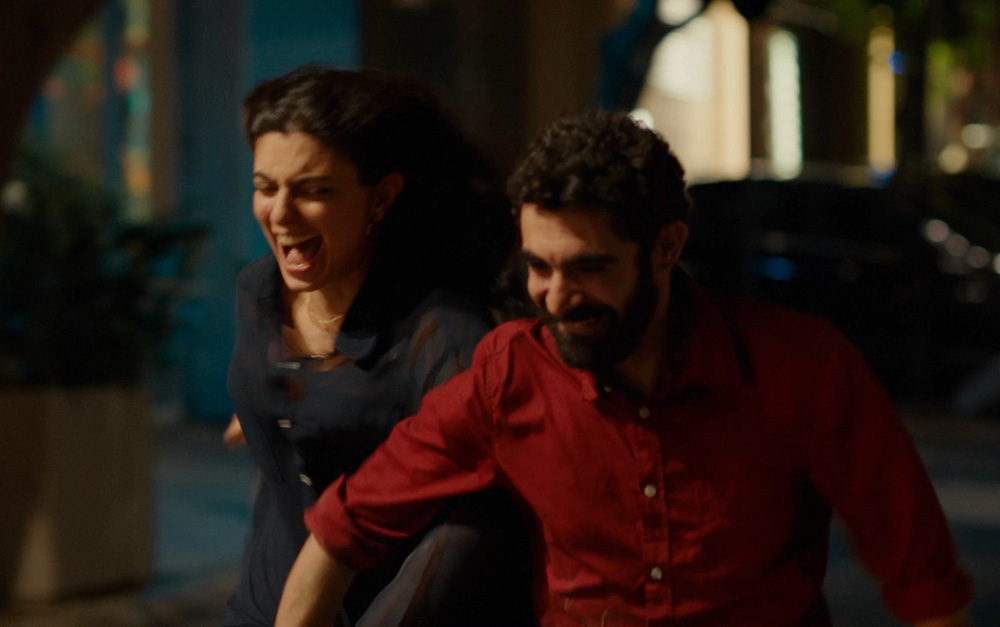

“I hate that we’re still living the same stories that our parents did,” Yasmina (Mounia Akl) says as she’s contemplating the possibilities of having a child with Nino (Hasan Akil) in “A Sad and Beautiful World,” an admission delivered in such a way that writer/director Cyril Aris makes sure history isn’t repeating itself at least in the way it’s shared, even as their shared home of Lebanon appears caught in a vicious cycle. Far from the somber realism that one might expect of a drama from the Middle East about generational trauma, Yasmina can be heard speaking as part of a dreamy montage that might be more expected of a quirky American indie at Sundance, with the ultimate tragedy of the circumstances leavened by offbeat digressions and the occasional burst of autotune in the score. This surely won’t be welcome by some who have a natural allergy to such twee playfulness, but as Yasmina describes her concern isn’t as much a commitment to a life with Nino as it is to living the same place that ultimately destroyed her parents’ marriage with the stress that living in such uncertainty – a point that doesn’t need to be driven home too hard with Nino when his parents died by stray bullets on the streets while driving at night – changing up the narrative serves a real purpose beyond adding a certain freshness in Aris’ disarming dramatic feature debut.
Aris previously directed a documentary about the turbulent making of star Akl’s own directorial effort “Costa Brava Lebanon” that began production before the 2020 port explosion and somehow continued after against all odds (“Dancing on the Edge of a Volcano”), and the agony and ecstasy of being born in the country is vividly expressed in the very first frames of the film where Yasmina and Nino are delivered moments apart in the same hospital by a tireless crew that manages to remain calm as the building itself is being rocked by bombs from outside. That the screams from Yasmina and Nino’s mothers pushing out their children rises to the same level sonically at first seems like a subversion, but then turns into a challenge to the warfare when any new beginning will require their newborns to hold onto the innocence of that moment rather than succumb to the constant feeling of being under attack. From that moment on, it always seems as if Yasmina and Nino are outrunning something, giving way to a briskly paced romance where they cross paths for a time in elementary school until they are brought together as adults by a literal collision when Nino thoughtlessly drives his car into her mother’s office during a particularly stressful day and he invites both back to eat at Chez Nino, the restaurant he inherited from his parents.
Aris credits their connection to the stars in perverse way when it’s the papers of an astrology-obsessed elder that rain down on the dashboard of Nino’s car to cause the accident and throughout the love story that starts to develop, Aris is conjuring his own brand of whimsy, not quite removed entirely from the real world, but just fantastical enough for a credible conflict to develop between the couple. While Nino’s sees his homeland with rose-colored glasses, insisting on holding onto his restaurant as a foundation for a future, Yasmina believes he has his head in the clouds, frustrated by her own work as a consultant on the country’s economy and while much of the film’s energy comes from how Aris staged elaborate tracking shots with cinematographer Joe Saade to keep up with the characters that approach everything with passion, the director’s partnership with editor Nat Sanders seems to pay similar dividends when infusing the same kind of frisson in the relationship with its dual perspectives that one has seen in his collaborations with Daniel Destin Cretton and Barry Jenkins. The film risks being overwhelming in ways it doesn’t intend when operating with such maximalism and a frequent allusion to an island that Yasmina dreams of can feel like an exclamation point that the story doesn’t entirely need, but feeling as if it’s all too much might be the right emotion to come away with when there can be as much anger as love towards a place that holds so much history, personal and otherwise. True to its title, “A Sad and Beautiful World” evokes a variety of different responses, but admirably asserts that joy be part of any movement towards change and offers plenty of it itself.
“A Sad and Beautiful World” will screen again at the Venice Film Festival as part of the Giornate Degli Autori sidebar on September 2nd at 4:30 pm at the Cinema Rossini e Cinema Candiani and September 6th at 11:30 am at Sala Perla.