



To spend time at the Laemmle Royal in Los Angeles this week – or to watch online at AAM.tv, where the celebration will be simulcast online for anyone out of town – will be to enjoy a tale of perseverance as Quentin Lee takes the stage each night to introduce one of his works as his production company Margin Films has its 30th anniversary. Although it’s without a doubt that Lee wouldn’t have survived in the industry this long without belief in himself, it had to be hard to imagine that the company he created would last beyond his scrappy second feature “Shopping for Fangs,” co-directed with UCLA classmate Justin Lin, initiating it simply as a practical matter to indemnify the production. (As he notes when I pull out my cherished long-out-of-print DVD copy from the long-defunct indie label Vanguard, he can’t even remember if any money ever exchanged hands for the rights, adding “You live and you learn.”)
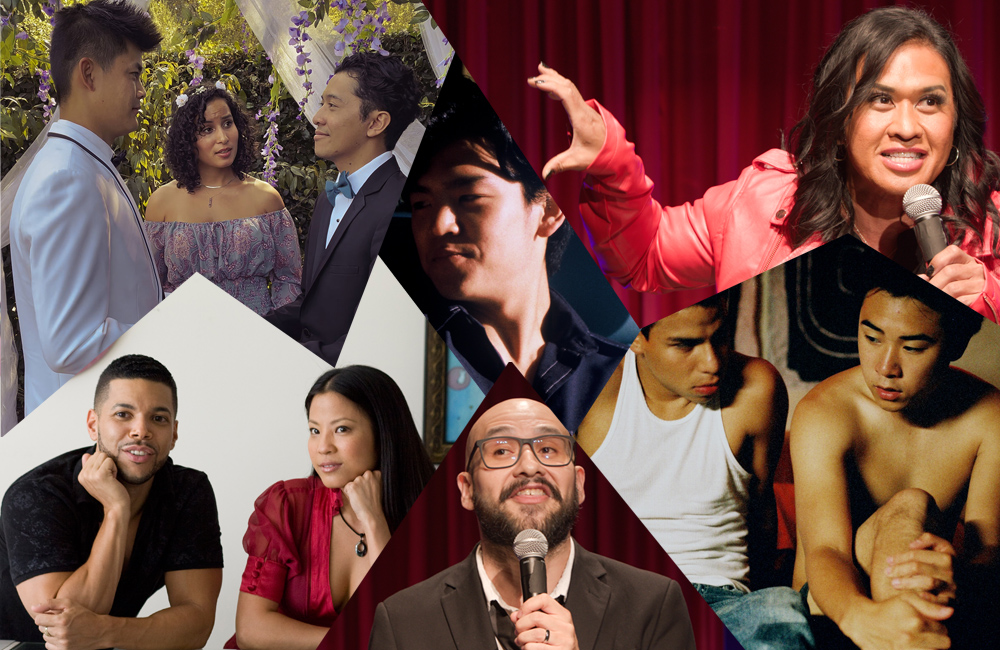
The stories that Lee is bound to tell after screenings of “Fangs” (May 1st) and “The People I’ve Slept With” (May 3rd), among others, are sure to be worth the price of admission themselves during the series he’s dubbed CinemAsianAmerica when he’s protected his independence at all costs. But buying himself freedom by working as resourcefully as possible has yielded a truly distinctive filmography, building an unpredictable career off the early notoriety of the beguiling horror comedy “Fangs” with the irreverent hostage drama “Ethan Mao” (May 2nd) in which a Thanksgiving dinner threatens to become a crime scene as a man disowned by his family for his sexuality returns home, “The Unbidden” (May 4th) for which the director assembled an all-star cast including Tamlyn Tomita and Elizabeth Sung for an inspired twist on the ghost story, and the refreshing coming-of-age comedy “The Last Summer of Nathan Lee” (May 6th). As much as he’s become a pioneering voice simply by expressing his own identity as a proud Queer Asian American, he’s often extended to spotlight to other marginalized communities, particularly when literally giving over the stage on stand-up specials he’s directed such as “Rez Comedy” and “Comedy InvAsian,” both of which will have their own showcases on May 5th and May 7th, respectively, and the platform Lee’s built with Margin Films has removed gatekeepers from the equation, both in terms of green lighting films and eventually getting them out to the world.
Naturally when Lee has worn so many hats, the celebration of Margin Films is multifaceted and in addition to the screening series, he’s publishing a book of photos from the sets of all his films from over the years. Like so much else over the years, much of the planning for Margin’s birthday party has fallen on the filmmaker’s shoulders, so it was particularly a special privilege to get to speak to him on the eve of this milestone, honoring his desire to create movies that would reflect everyone with a retrospective that all could see no matter where they are this next week and the lessons he could only pick up from experience.
How did this retrospective come about?
[The anniversary was] just was happening and I was thinking, “Should I do something? Should I not do something?” I started Margin Films to make my first feature film “Shopping for Fangs,” just because I really needed an entity to make this film and at that point, I wasn’t even an American resident. I was just an international student [at the time] But I decided that we should do something for the 30th, so we put together a collection of my films from Shopping for Fangs all the way up till [my latest film] “Last Summer of Nathan Lee,” and then the closing night is a sneak preview of three of “Comedy InvAsians” episodes, which is a stand-up comedy TV series that I created back in 2018 and it’s three stand-up comics, each doing a 30-minute set and it’s going on its third season. So it’s very exciting.Not every filmmaker could do this for any number of reasons, but particularly when it’s so rare to be able to hold onto the rights to your work. Was that always important to you?
I think it’s always been a dream for a filmmaker to be able to own the negative. That’s a story I heard about even before I went to film school, like Francis Coppola always wanted to own his negative. The only reason I went to UCLA versus USC is because at USC you don’t own your films. USC owns all the students’ films, so even if you go to festivals, you can’t really distribute it. So I decided to go to UCLA because even even though I had to raise money outside of [school], I I get to own my films and I started with that tradition. And it’s interesting because the one film that I don’t have access to, “White Frog,” I don’t own or wasn’t involved in producing and when I was putting the series together, I reached out to the producers [and asked], “Do you think that I can screen ‘White Frog’? You don’t have to do anything. I even have the DCP at home.” And there was radio silence. So I think that if you could as a filmmaker control the rights of your films, you should.
Not only are you putting on this great retrospective, but there’s an accompanying book of photos to boot. What was that like to put together?
Yeah, my first internship in Hollywood was handling publicity at Columbia TriStar TV publicity, so I understood how important it is to have an international marketing campaign. Even on “Shopping for Fangs,” I kept saying we need to have some photos to mount this international marketing campaign, so I was mostly the person shooting photographs and over the years, I just had this whole collection, and now you shoot everything digital and in color, but back then, it was slides and then black-and-white photography was just an industry standard. I was working at Strand Releasing very early on — I was actually their first intern ever. I was the first intern for a lot of people. [laughs] And I just remember somebody complaining, “Oh my god” — it was on “The Living End” – “There’s not one usable photo. I don’t know what happened.” So as I was making “Shopping,” I didn’t do that much, but since I was able to have enough materials to be able to sell the movie, I realized that’s really important and having done all those, I just thought, “Oh let’s put it together as a book.”
Was is it interesting to think about these movies in context?
It’s fantastic and I’m really excited that Justin [Lin]’s also doing the Q & A with me on opening night. Shooting “Shopping for Fangs” was probably the roughest thing ever in my life because I don’t know why we thought we could do that. And I would say, “Hey Justin, we can co-direct. Like when I’m directing, you can be the [assistant director] including getting craft services and when you’re directing, I will be your AD and I’ll get your craft services.” So that’s what we did, and I just remember shooting in this tiny studio apartment because I shot so many films in Koreatown and I I moved in there in 1993, and the rent was for $450 a month. It was a big studio, so I kept shooting all my films there and because it was this one bedroom with a futon, every time we’d shoot one corner of the room and they pushed all the things onto my futon and everything to one side of the room and then we’d shoot this other corner.
The one really interesting lesson I learned from “Shopping for Fangs” was that you’ve got to put up signs when you’re shooting because in Westwood, we were at this supermarket called Breadsticks and we were shooting a robbery scene and [the cast] was rehearsing with a [prop] gun and stuff like that and the AC came and said, “Quentin, you’d better put up some signs because some people looked through the window and said they’re anxious or worried.” And I said, “That’s fine, nothing’s going to happen.” But as soon as I get out of Breadsticks, [someone] was like, “Freeze!” And there are four police cars, like, “Don’t move. What’s going on in there?” And I said, “We’re just shooting a student film. I have a permit.” And they didn’t want to go by permit. They said, “Can you just put up some signs?”
Unbelievable. That seems like as good a segueway as any to ask what led to you interest in stand-up comedy in addition to your more traditional narrative films?
We started started off in 2018 and Koji [Steven Sakai] and I worked on “The People I’ve Slept and then I said Koji said, “We know so many Asian American comics, but there’s never any outlet for them.” So I thought why don’t we just create a TV series? We just put all these Asian American comics we know into a TV series and the first season was six one-hour specials and it was sold to Hulu as an exclusive. Since then, I just kept doing a lot of comedy and one thing I really do like about stand-up is that I like to present art in a very organic way and stand-up comedy is so organic that I’m more like a documentarian. There’s so much organic unity to the art pieces because when you develop a movie like “Shopping for Fangs” and and “The People I’ve Slept With,” there’s constantly so much in development, but something’s so raw and so exciting about doing stand-up comedy because you really shoot it. You don’t even know what the script is. They come and [the comics] bring the writing and they just perform it and you shoot it and then I’m the one trying to craft it into something entertaining and fun for the audience, so I like that too besides making narrative feature film.
It seems like no matter what you’ve done, you’ve managed to platform diverse voices and creating the sense that no culture is monolithic. Has that been an attraction to all the things you’ve done?
Yeah, absolutely. I directed a a viral black lesbian short film called “Secrets and Toys” that’s actually on YouTube and the reason I got that job was because I think Cheryl Dunye dropped out, but the writer and star Delilah came up came to me and said, “Quentin, would you be interested?” We were both at Outfest together, and I said, “Of course I want to direct a Black lesbian love story. Why wouldn’t !?!” When I was going to school, I was always studying a lot about post-colonial theory and very much wanting, like Gayatri Spivak was saying, to be the subalternity of voice, so I follow that precept because I feel like I’m the subalternity as a queer Asian male and I was never given these the storytelling outlets, so once I tried to do that, I wanted to do it for other marginalized people.
Have you kept in touch with a lot of former cast and crew over the years or will this be a real reunion this week?
I have, but Justin was just texting me last night, like “Quentin, we’d better invite all the cast of ‘Shopping for Fangs’ and it’s been 30 years, so I went on Facebook and then I know some people only have e-mails, but it’s going to be a really fun reunion. Sadly, Clint Jung, who played the husband passed away, but it’s a celebration of their work and my work and the idea we are all in this together.
CinemAsianAmerica will run from May 1st through 7th at the Laemmle Royal in Los Angeles with each movie playing three times a day at 1:30 pm, 4:30 pm and 7:30 pm with special Q & As after the 7:30 pm screening and available to stream anywhere via AAM.tv.