
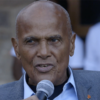


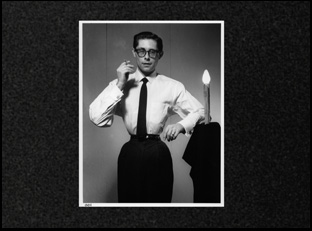
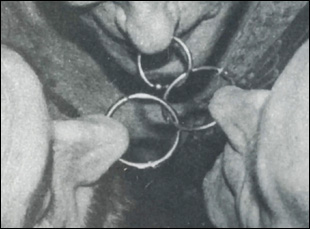
Fakir Musafar can be heard recalling in “A Body to Live In” when he first felt he had power over his physical form, affixing clothespins to his skin as a young man, a habit that would catch on as he promoted a practice that came to be known as Modern Primitive where he would test the limits of the human body as a way of liberating the mind from corporeal form. It seems that the best way director Angelo Madsen could honor the pioneering provocateur is not to adhere to the traditional form of a biography, but to capture his spirit in building a memory of the person not bound to any obvious shape when Musafar documented all he would put his body through, including piercings, cinching his waist with corsets and laying on a bed of nails, with pictures where he captured the freedom he felt from transcending the limitations of his own skin or what society thought was acceptable in the pictures he took of himself.
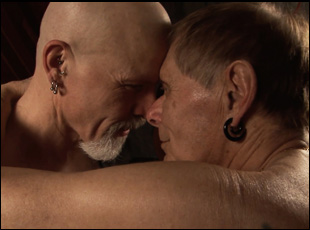
After Madsen documented his own journey as a trans masculine man and the tragic death of his niece in his previous feature “North By Current,” “A Body to Live In” is no less intimate despite the filmmaker no longer having access to his main subject, who passed away in 2018 from cancer. However, his voice reverberates with the poetry he wrote in his youth, under his given name Harold Loomis, and through the interviews he gave throughout the years as he rose to prominence with the Modern Primitive movement, fascinating outsiders with lurid tastes that would make him a regular on daytime talk shows of the 1980s but appealing to so many out there who never felt at home in their bodies. Born on a Native American reservation but brought up with his mother’s hope to become a minister, he would end up proselytizing, yet from a place where people could create their identity for themselves separate from their superficial appearance and while Musafar is a primary voice in the film, Madsen keenly structures it around the community he built, allowing each to have the space to describe the profound experiences they had creating their own standards of beauty in a community they could call their own.
When Musafar was born in 1930, “A Body to Live In” covers nearly a century in which the underground movement Musafar led slowly found its way into mainstream American culture and observes how he changed over the years, having to adjust to a role in the spotlight that could be as confining and narrow as the ideas around gender, sexuality and the body he would publicly take issue with, yet showing not only how resilient he proved the human body to be, but the spaces he created for people to find themselves and take comfort in amidst the AIDS crisis and the subsequent public antagonization of the gay community that made up much of his own. The full-on sensory experience that Madsen creates from the swirl of archival material and tender recollection from friends seems attuned to what Musafar had hoped to achieve in one of the group rituals he’d perform and with the film starting a nationwide theatrical run, kicking off in Los Angeles with a special screening this evening at the Los Feliz 3 and a subsequent weeklong run at the Lumiere Cinema at the Music Hall before heading east, Madsen graciously took the time to talk about being able to bring Musafar back to life so vividly, finding the emotional quality in the materials used to capture his work, and reaching a point with his own work where he’s found others to help shoulder the load.
 How did this come about?
I tend to work with things that are of particular interest to me in my life and Fakir was a friend of mine and had passed away in 2018. The last time I’d seen him was in 2017 when he came to see one of my films. I met him in 2003 through a friend and we didn’t really become friends right away, but a little later I got involved with some of the BLW stuff and seeing what that was about. I got to know him a lot better there and I was really interested in his philosophies, but also in his artwork, which were very interesting to me as a budding artist. The photographs were phenomenal. I met him right around the time his monograph came out in 2003 and I got the book, [which] was just so, so gorgeous. The images were just breathtaking. They were beyond what I had seen in the fetish sheet magazines and [I thought] “Oh, this work is legit. This is amazing.”
So fast forward a bunch. We’re talking about my film in 2017 and it was a film that was a very DIY narrative feature about this middle school lunch lady and her sci-fi interdimensional trans romance in a wormhole. He really loved the film and it was very sweet to me because the film is very unique and campy, a little bit outside of some of my other body of work. Fakir just loved it and [said] “feels like my life’s work, this exploration between other worlds and love that is interdimensional, both with a body and without a body and has no gender.” At that point, I really started thinking if we could collaborate on something and what that might look like for us. That same year is when he got sick with cancer and passed away the next and in the mix of that same time, I had a prompt from another artist friend of mine to make a film using just still images. I couldn’t respond to the prompt because I didn’t have time to work on it, but that idea of making a film of all still images stuck in my mind very strongly. I wanted to revisit this when I had time, and the concept would be to make a film using audio interviews from him and just still images — his old beautiful black and white photographs — and that would be the whole film. Obviously, once I started doing research that exploded my face and there was no way to contain what I would find to just a film with still images.
At one point, you register regret in an interview that you didn’t actually conduct any interviews with him, but you really are able to get his voice in the film. Did you know there was enough archival out there to fill that out?
Yeah, definitely. I feel like the regret about not getting to talk to him is that he was very well-rehearsed when he spoke about what it was he did. Partially that was because he had to be, because he was constantly deflecting from people trying to get telling him it’s crazy, right? Especially in the 1950s and ‘60s, so he had his line down, his shtick, and he never deviated from it. Oftentimes if he’s in an interview with someone from the press, he says the exact same thing, so a lot of interviews he says the same thing over and over again and you’re sifting through these interviews looking for micro deviations from what he said before, like where does he does he deviate ever so slightly from a story [I’d heard] so many times and if I had the chance to talk to him, knowing him, I would have been able to poke holes in all these stories and really dig out other channels of information.
That said, I also don’t know if the film could have been made if he was alive because we probably would have would have fought each other for content control. I’m sure he would have wanted the film to look the way he wanted it to look. He’s an artist too. So in some ways, it is what it is. We always sacrifice something by not having the person be around to be able to tribute, but it was auspicious and lovely that his world was so well-documented, both by him and his loved ones and somewhat by the media.
It also seems like a hard balance to strike where you’re balancing Fakir’s individual story against the community he helped create and each person within it get their own time in the sun. What was it like to structure?
It was really hard. It sounds silly to say it because it’s chronological and chronology feels like the most straightforward thing you could do, but in other ways the thematic positioning of things was just really, really difficult, especially because so many of these things are happening at the same time or with subtle overlaps. It’s a real edge to walk to deviate a lot from someone’s biography when they’ve occupied the first 25 minutes of something. It’s a move that people are are either going to like it or not. But for me the structure of the film really follows my own structure of interests, so I don’t get into the nitty-gritty details of Fakir’s personal life, his other relationships, his time working at a the time at IBM. I’m not so interested in these other areas of his life [in terms of the film], not that those are not interesting because they actually are really, really fascinating, especially certain work he did in the tech world. He worked for this German company that was the first to invent the handheld audio recorder.
He did the engineering for those chips that go in the handheld audio recorder from 1955 and I just find that so fascinating that he was someone who was constantly documenting himself and then he actually did the engineering for this other tool that also documents. There’s a lot of those micro connections in his world, which I don’t get to get into at all because I start privileging the community and the philosophy, [which] are also core interests of mine and are slightly less idiosyncratic than the chips from those recorders. But I try to create a portrait that is thorough, but also it can’t ever really be comprehensive because how could something like that ever really be comprehensive? It was an edge to walk and I spent about 13 months straight editing, which is the longest edit I’ve ever done. It was also the most challenging edit I’ve ever done.
But it’s strange as hell because the structure was essentially the same from the first cut in February 2023 to the fine cut in February 2024. That 13 months was all micro edits of varying styles. But I mean essentially the structure stayed chronological. And then 13 months of like micro edits, moving seconds [up] and back and like one clip of a conversation to another part of a conversation. There’s always lots of micro editing in a film, but I don’t know that I’ve ever done it to that level and for that long. Had the film come out a month or two earlier, it would not have been ready, so it was a really hard one for me.
 It paid off. You also find a way for the materials you use to express emotion — it was so moving when Fakir’s longtime partner Cleo is talking about her lover Mark contracting HIV that you’ve got the flickers of color there. What was it like to use the nature of the archival material in an emotional way?
I adore those moments for visual experimentation and when I get to have them, it brings me a lot of joy to be able to have this visual language be more expansive. That footage of the flashing lights is actually very close-up footage of someone in a black box studio doing the ball dance, so someone has steel balls sewn on them and they’re dancing, moving around [with] the camera tracing them, and all you see is the streaks [of light] and the studio is blown up in light, so the balls are reflecting everything. That’s just a person’s body swaying with those balls on and [the camera is] so close that it becomes abstraction.
[Cleo’s] talking about doing the ball dance and I think people don’t know what they’re looking at, but their body or their hearts do, and people are seeing there’s some coalescence or conversation happening wherein their interiority is filling in the gaps. I like leaving those small gaps for people to fill, [where] the viewer is going to find something there and not quite understand why it feels so effective, but there’s formal frameworks going on behind the scenes that are making that happen or [I’m] creating the environment for that to unfold.There are ways in the edit where I just would file away certain footage I would find in a certain folder and [think] I don’t know what this is for right now, but it’s going to be good. I was able to find a lot of stuff like that. There were these performances that they did at the old Ornette Coleman Jazz Fest [that had a] super fascinating history because Ornette Coleman came and hung out with them afterwards and [said], “Wow, I really like what you guys are doing.” Fakir performs with a few other artists and friends and Cleo was there, Idexa Stern was there. who is not in “A Body to Live In,” but is in another installation piece that I’ve made and there’s a multi-screen live feed projection, which we hardly do anymore with suspension format performance that is not multimedia. Suspension performance is pretty straightforward and stylized, and this was crazy. It was an overlay split screen, like chroma green, with all kinds of other images going on at the same time that was a live feed mix by an artist. That wasn’t me doing overlays. That’s an actual mix of the performance and I actually used that clip as a a way to think about lots of other things I was doing in the film with layering and inversion because I wanted to have some stylistic cohesion between the photographs and then the work like that.
I didn’t realize you also did the score for this as well until seeing your credit at the end and it seems so much a part of the fabric of the film. Is that something you’re thinking about relatively early on or do you wait until you have a cut?
With “North by Current,” Julian Baker sent me her stem files, basically her mixes, but then she sent me recordings of each track separately and then allowed me to take her stems and I cut [the film] with the stems, so it wasn’t like I sent her the film and was like, “Here, do this.” It was like, “Here’s a an outline of things I want, things that might be good in certain places and you go do what you do” and she went to the studio for three weeks and came back, sent me all these recordings, and then gave me free rein. So I really prefer working with music pretty early in the edit, usually bringing it in while I’m starting to navigate a rough cut – not during the assembly stage, but absolutely during the rough cut and I start seeing what feels good. Sometimes the joy of that is that the music gets to create the rhythm for the piece, which is a much more organic, natural way for me to to create rhythm than with images alone.
 What’s it been like to see get this start to get out into the world?
It’s really fun. I’ve been making films for 15 years, and this is my fourth feature film, yet still I’m kind of underground and that’s okay. I make films pretty DIY, and they’re not about things that mainstream people are often interested in. But it is really fun to get to feel like I’m like upping my game a little bit. I get to have a publicist. I get to have a distributor. Those are things I don’t often get. “North By Current” was distributed, but it wasn’t like a collaboration with a distributor, like Altered Innocence is booking it in theaters and we’ve got these amazing t-shirts coming out. Historically, those are all things I’ve done myself, and I like [the] poster [I made] quite a bit. I think it’s very good. But I love the poster that Frank and Sam and Altered Innocence made because it’s just something I would never have made myself and that’s really exciting to see people gravitate around the work and support it. I’m very insular in my process and I speak fine about it in public situations, but my process actually is very insular and very internal, and I’m not talking about it a lot, so now with this film to get to have a little more support around it is really, really exciting.
“A Body to Live In” will have a special screening in Los Angeles at the Los Feliz 3 on February 27th with the director in person for a post-screening Q & A, preceding a weeklong run from February 28th through March 5th at the Lumiere Music Hall. It opens in New York on March 6th at the Anthology Film Archives, March 23rd at the SPACE Gallery in Portland, Maine, March 28th at the Roxie Theatre in San Francisco and May 1st through 3rd at the Northwest Film Forum in Seattle.