



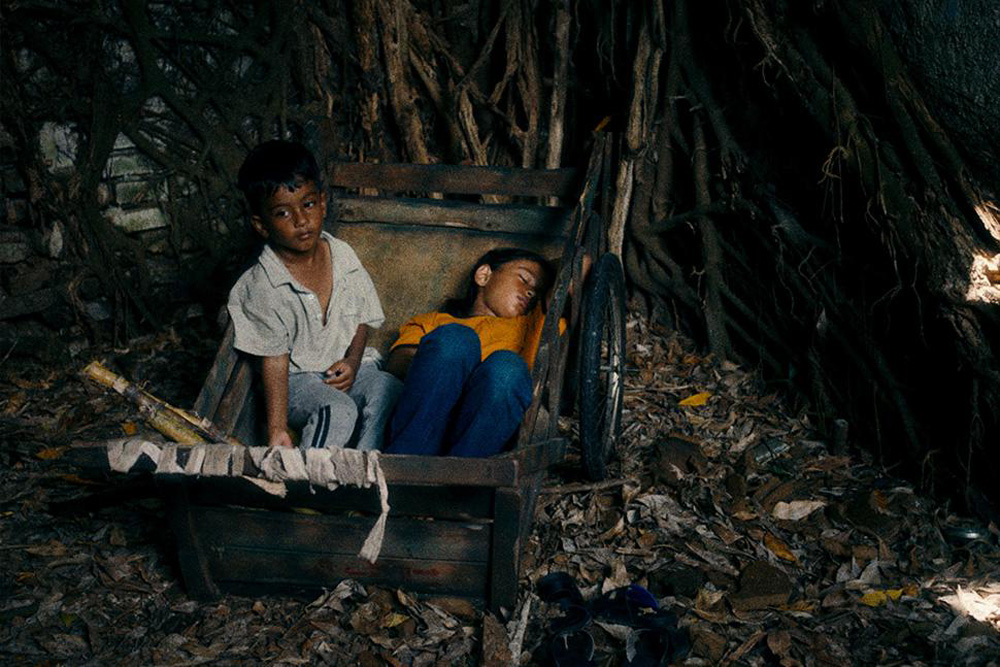

Not long after the nine-year-old Somira (Shomira Rias Uddin Muhammad) and her younger brother Shafi (Shofik Rias Uddin) are introduced in “Lost Land” playing hide and seek, they disappear into the background of Akio Fujimoto‘s harrowing third feature despite being the story’s central characters. They are hardly alone in attempting to escape their native Myanmar as part of the persecuted Rohingya community, and presented at first within their family home where their father has to consider his own survival as his brother in Malaysia tells him to pack lightly for the journey, it actually can be felt how easily they can get be overlooked, quickly becoming just a number as they are ushered onto the back of a truck where they become part of a dozen and subsequently load onto a ship where there are at least 50 others. Things happen in a hurry when all of that is packed into just the first day of their planned migration and it’s a stroke of brilliance on Fujimoto’s part that they seem to disappear as any consideration of them as humans does, even by those closest to them as all are overwhelmed by the thought of simply staying alive as the boat is rocked by torrential downpour and the threat looms of being caught by international authorities patrolling the water, and it may take a catastrophe to bring the children back to the center of the frame, but they become impossible to ignore upon their return.
Reminiscent of other indelible migration tales of recent memory such as “Sin Nombre” and “Mediterranea” that impress with their immediacy, “Lost Land” also shares their ability to stand out from one another as an exacting level of detail giving way to a propulsive cinematic experience. Cinematographer Yoshio Kitagawa observes Somira and Shafi’s travels from an eye-level view to precisely capture all the obstacles that the most vulnerable have to overcome, from being on a ship where the crew speaks another language to the preparation of food served in bags that a child might wince at eating when they think they actually have a choice in the matter. While the film consciously loses track of the kids after they’ve gotten on board, it takes on their perspective as it roams with curiosity around the deck to observe other refugees speak to what they hope will be their new lives abroad or practice keeping their culture alive with songs from the old country or praying towards the sun as their Islamic faith dictates. The journey is arduous enough before an encounter with the Coast Guard splits up the family, with Somira and Shafi breaking off to continue on foot with others who begin to peel off one by one as they all face one dangerous situation after another trudging through Thailand.
The 28-day trek is intense throughout, but Fujimoto impressively expresses how the characters all process their experience as they size up their surroundings throughout and make choices about how to proceed that are true to them without the time to think about it. A break in the action that allows for Somira and Shafi to play in an abandoned building is one precious stolen moment of a few in the film where someone affords themselves a chance to be back in the life they knew, which proves as critical to keeping up their energy as anything else on the run and between the history they have and ingenuity they show, the kids start to assert a humanity that it appears the world wants to deny them. It may take a lot to establish such a presence in a world so currently consumed with various humanitarian tragedies, but “Lost Land” rises to the occasion.
“Hara Watan (Lost Land)” will screen again at the Venice Film Festival on September 2nd at the PalaBiennale.