



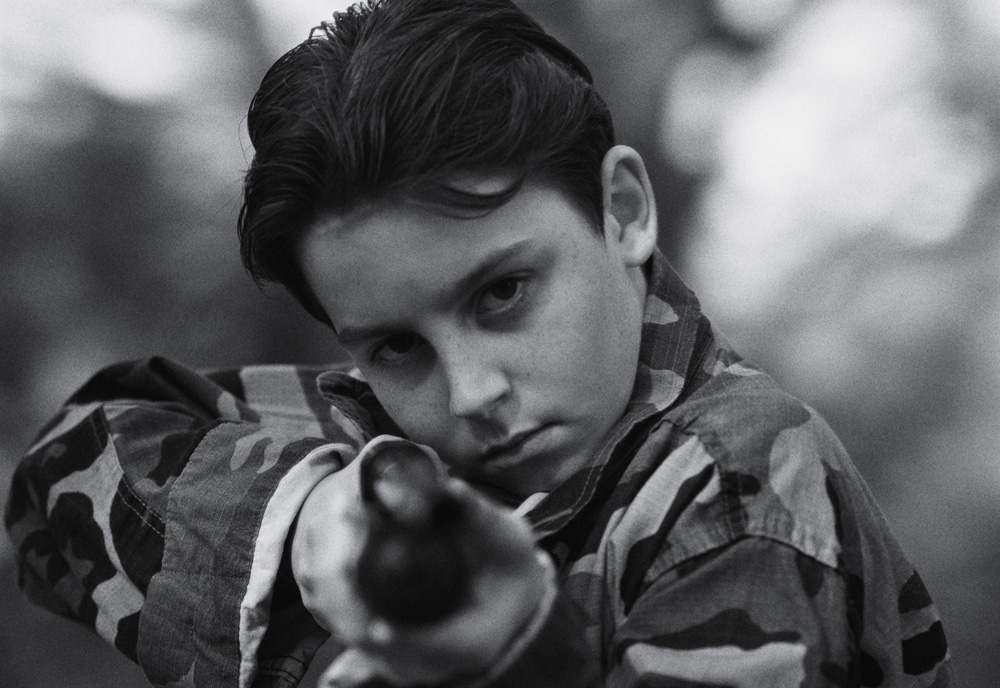

If Todd Wiseman Jr. needed any proof that he was onto something with “The School Duel,” all he needed to see was how his young cast handled the prop guns that were handed as part of the shoot.
“The elephant in the room is when you give a bunch of teenagers machine guns, they think it’s cool – and it is,” says Wiseman Jr., who notes that with the heavy subject matter of his debut feature, blowing off some steam was always welcome. “I grew up playing paintball and these kids grew up playing Airsoft and to them, it’s a game and to have that moment on set where you’re like, ‘Well, these kids are having a lot of fun doing something that’s really serious and really dark.’ But that made it just so clear to me that we live in a culture that I’m a part of and that glorifies and indoctrinates people in a way that makes this seem really cool.”
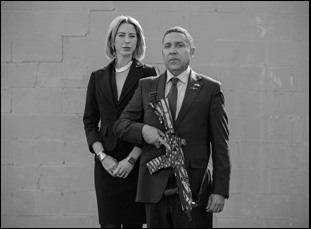
Just as the realization on set sent shivers down Wiseman Jr.’s spine, “The School Duel” offers a similar shock to the system, a bleak dystopian drama with shards of black humor set in the near future where Florida has gone rogue (more than usual) and gun control has been prohibited by its governor Anthony Romero (Oscar Nunez), creating a survival of the fittest atmosphere from the womb. As if being shot at school wasn’t more than a likelihood than it ever should be in the first place, a modern education involves participation in a statewide tournament where those with the best aim and ability to dodge bullets are pitted against one another as a proving ground for military service in the National Legion and as the 13-year-old Samuel Miller (Kue Lawrence) tells his mother after accepting an invitation, “It’s just violence, not like sex of anything.”
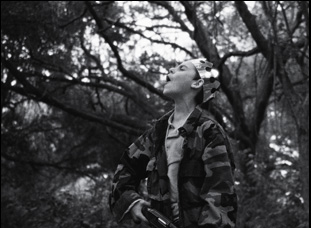
He may be right that there may be little to worry about – at least by that point when there is simply little left of the teens resembling average kids, walking around with clenched fists and a constant vigilance that blinkers out any future besides the soldiers the state would like them to be and Wiseman Jr., filming in a stark black-and-white, outlines a vicious cycle with a look at just one generation when it’s unlikely Samuel will have any better fate than his father who is away at war and with the duel having a dual purpose as entertainment as much as recruitment for the powers that be when cheerleaders are brought out on the sidelines of the battlefield as if they were at a football game, it suggests the rot has spread to the culture as a whole. Still, as dispiriting as “The School Duel” could be, it’s too arresting to prevent look away as the filmmaker engages in battle as fiercely as his young protagonists do, though he sees it as a fight for their soul.
After making a splash last fall at its premiere abroad at the Deauville Film Festival, the film is hitting home in more ways than one as it rolls into theaters across the U.S. starting this week and Wiseman Jr. graciously spoke about telling a story about such a tough subject with the urgency and sensitivity required, why the casting of his young star Lawrence seems particularly meant to be and extending the film’s reach.
 How did this come about?
It came about because I’m just like every other person in this country who’s disgusted when another school shooting happens and then nothing happens as a result. But if you look back at my shorts, you’ll see I’m interested in this type of thing. [“The School Duel” has] a very extreme premise, but the message is rather nuanced and [I thought] instead of doing nothing or doubling down on the wrong thing, why don’t we try a little bit of moderation and a little bit of gun control? I am actually somebody who comes from that community — I come from a world of guns. I own guns. I’m a hunter. I’m somebody who I thought could come at the debate without a blunt object and use this really insane premise to say, “Hey, rather than going crazy, why don’t we just try to come together a little bit?” That’s the overarching reason.
When you make something like “Army of God” before this, tackling terrorism, were you battle tested as far as pushing something pretty incendiary on its face into production?
“The Exit Room” with Christopher Abbott is also a little in that world and then “Six Stars” with Milo [Machado-Graner], the kid from “Anatomy of a Fall.” Part of the reason we did [“The School Duel”] in black and white was to mute the violence and make it so that it’s not something kids would necessarily be drawn to, but to have that artful raw take like you see in “La Haine” and “400 Blows.” My DP Kyle Deitz and I looked at a lot of war photography and we tried to think about composition. I wanted the violence to not be visceral, but more like the shark you don’t see. It’s also a sad and muted world that Sammy is living in and the actors on set didn’t show up to make a satire necessarily, maybe outside of Oscar Nunez. They showed up to make a drama, something that was going to resonate and have an impact. It just so happened to have that lens on it and we shot it in order because I wanted everyone to get to we worked our way up to the duel. Our young star Kue Lawrence was literally growing up on set over the course of just a 19 day shoot.
Kue is so poised in this, but what sold you on him to to carry this film?
It’s still a bit of a sad story, actually, but I was in prep for the movie while my youngest sister was sick and she passed away from cancer. But we were together in a hospital room, watching auditions and she and her best friend were just clicking through along with me and we saw Kue and she instantly was like, “That’s your kid.” It was one of those really powerful auditions where we all knew the second we saw him that it was going to be him.
 From what I understand, you actually spoke to child psychologists, which may have been more about aesthetics, but what it was like to tell a story like this responsibly as far as involving kids?
I spoke to a lot of people, including folks from the Sandy Hook Foundation, and child psychologists who tried to mitigate the fallout from the “13 Reasons Why” spike and a bunch of other [shows] because I basically didn’t want to do something that was inflammatory or inspirational. That is obviously part of the reason we shot it in black and white, just to be sensitive. I have never had a family member or a child killed in a school shooting and I didn’t want to make something that was going to disrespect them. I wanted to make something that spoke to the general public about the absurdity of how we as the United States approach this and the lack of responsibility that anyone takes to slow or solve this problem. I just read a Wall Street Journal article this week about this drone company who wants drones in every school/ They’re going to fly around and flash in the eyes of school shooters as they’re shooting. Like, what the fuck is that about? We are not addressing the the issues at hand, which is how does a mentally unstable kid get an AR-15? That is the problem.
One of the most interesting ideas is this translucent phone that Sammy has – not only is it a striking image all its own that infers that you’re in the near-future, but you can see how the media he consumes on it affects him without being too heavy handed. What was it like to figure out?
Obviously there’s the cheat of being able to see the actor as he’s watching, but also I’m a little bit of a nerd and I did a lot of uh research around volumetric capture where people are looking at what’s not just a 2D image anymore. You can now capture the back of somebody, so if you look closely at that, you’re seeing the backs of the people that he’s watching as if they were captured. I was trying to make this [reflect the] slight future where small technological advances could have taken place, but it still felt really grounded in the present. But obviously the cinema trick is we get to watch Sammy react.
 It’s also too subtle to detect consciously, but is it true the score is laced with gunfire?
It’s totally insane. Trevor Gureckis, the composer, is amazing. He’s one of M. Night Shyamalan’s guys and what he did was take actual recordings of guns — the sounds of loading and firing and slowed it down and broke it into musical elements and created the score entirely from those. There’s going to be an album released alongside the movie on Lakeshore Records, and it’s wild.
The premiere for this film happened abroad at Deauville. Has it been interesting to see the film play internationally in comparison to the U.S.?
Well I’m a celebrity in France. [laughs] And here apparently I hate America, which is just the most untrue thing anyone can say about me. I love our country and the fact that you can course correct and can have patriotic people say, “Hey, we’re doing something that’s wrong and we need to fix it.” We premiered it domestically at the Miami Film Festival and it was received well there and in France, Canada and everywhere else [we’ve played], it’s like the outside looking in. There’s no doubt it plays better overseas because this is an issue we don’t like to talk about here in this way.
“The School Duel” opens on April 24th in New York at the Alamo Drafthouse Lower Manhattan with a special screening on April 24th at the Alamo Drafthouse Brooklyn with a director Q & A, May 1st at the Lumiere Cinema at the Music Hall and San Diego at the Digital Gym Cinema, May 3rd in Philadelphia at PhilaMOCA, May 5th in New Orleans at Zeitgeist and May 8th at the Alamo Drafthouse South Lamar and Tampa at the Sun-Ray Cinema.