


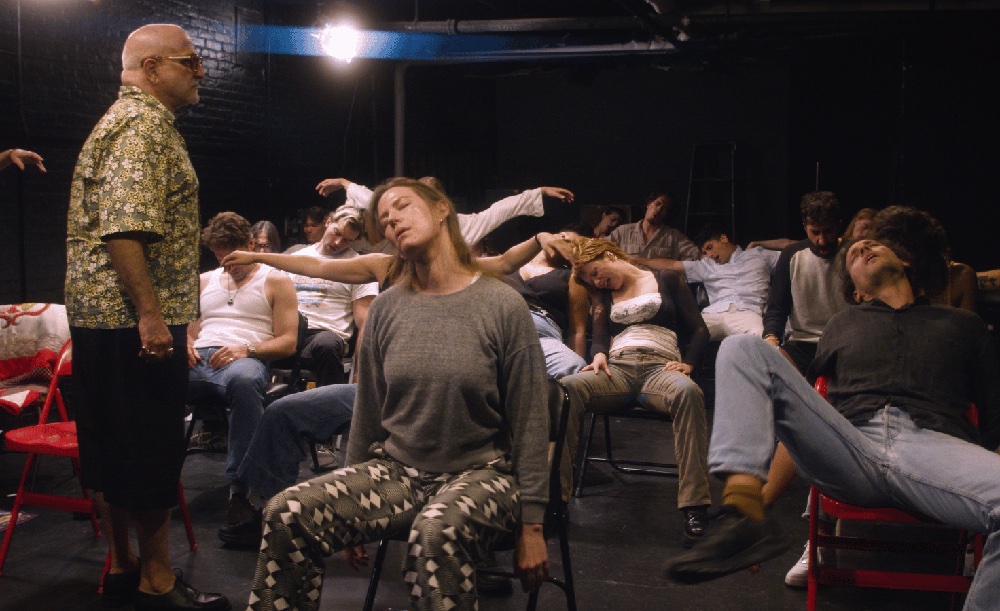

No one can figure out exactly what Charlie Birns wants in “The Whole World is a Lie,” the director himself included as he reenters a method acting class that he took nearly a decade prior and hopes to conjure the magical experience he had to share with others. He’s allowed back in reluctantly by the teacher Tony Greco, not out of any particular affection for Birns and surely not because he wants any additional attention brought to the class, but because it seems as if he sees Birns as the project that he’s working on rather than a documentary and by agreeing to let him film, he can hopefully figure some things out about himself as an actor, though Greco’s other students who are in a vulnerable spot can’t exactly be thrilled to appear on camera before their time and aren’t satisfied with Birns’ explanations when pressed. Neither is Birns’ father who frequently laments that his son is wasting both his time and energy in his thirties.
It is often said that art can be therapy and Birns ultimately shows how messy that idea can actually be in his second feature, having to pull in other people to work out his own issues and wondering how much he actually is doing something for others as he intended when it seems like the film is actually for his own edification. The filmmaker never directly admits to his folly, nor really should he when the film curls around to eventually what his goals seem to be in an intriguing way, but as “The Whole World is a Lie” fumbles about reflecting the director’s own search for purpose, it can be frustrating before the amusing consciousness sets in that while in the moment, he seems to have no idea what he’s doing, he has full control over the edit done in retrospect after gaining some hard-earned perspective.
“The Whole World is a Lie” refrains from the satirical tone that most take with this kind of meta documentary, making it a tough sit when what humor there is is served up extremely dry. A disclaimer that says “some events have been condensed and rearranged” is among a few admissions that what you’re seeing is the product of some after-the-fact chicanery – during the film itself, Birns can be seen asking his mother for another take of opening the door, which surely isn’t the only scene that was staged for effect. Still, it is quite funny when Birns’ father talks about waste that surely months’ worth, if not years’, of interviews with spiritual advisers is condensed into a montage where it’s only the director’s voice is heard in voiceover, thus proving his dad might’ve been right, and he makes a point of listing how long his fellow students in Greco’s class have been at his knee, with some there as long as 21 years, seemingly on a search of their own to get in touch with some deeper truth.
Greco doesn’t ask to be a god, but by inference Birns treats him like one when the initial conception for the documentary involves consulting the aforementioned religious scholars and devotees about the path to enlightenment, putting Greco in league with them and the teacher is neither questioned nor willing to lower his booming voice during acting exercises where he’s questioning the motivations of the actors, an approach assumed to have value based on the fact that no less than Philip Seymour Hoffman was said to be a student. However, none of them holds the power over Birns in the way that his dad does, giving the film its title with a watchword that wasn’t honed over time by any great philosopher but picked up on the streets, adding to the notion that rather than looking for wisdom, it may be better that it finds you.
That isn’t the only thing that it starts to look as if it was passed on from father to son that Birns really has to dig into to get a better understanding of himself and when it takes the kind of intense interrogation that Greco grills his students, what the director got out of the class starts to reveal itself. Yet Birns also demonstrates the futility of extending a personal epiphany more broadly when no one else can understand what’s going on and he struggles to articulate it himself at least as he’s in the thick of it, still stumbling onto something rewarding when depicting the fact that his process isn’t replicable can save others from thinking there’s one right way forward, yielding a film that also is refreshingly one of a kind.
“The Whole World is a Lie” does not yet have U.S. distribution.