

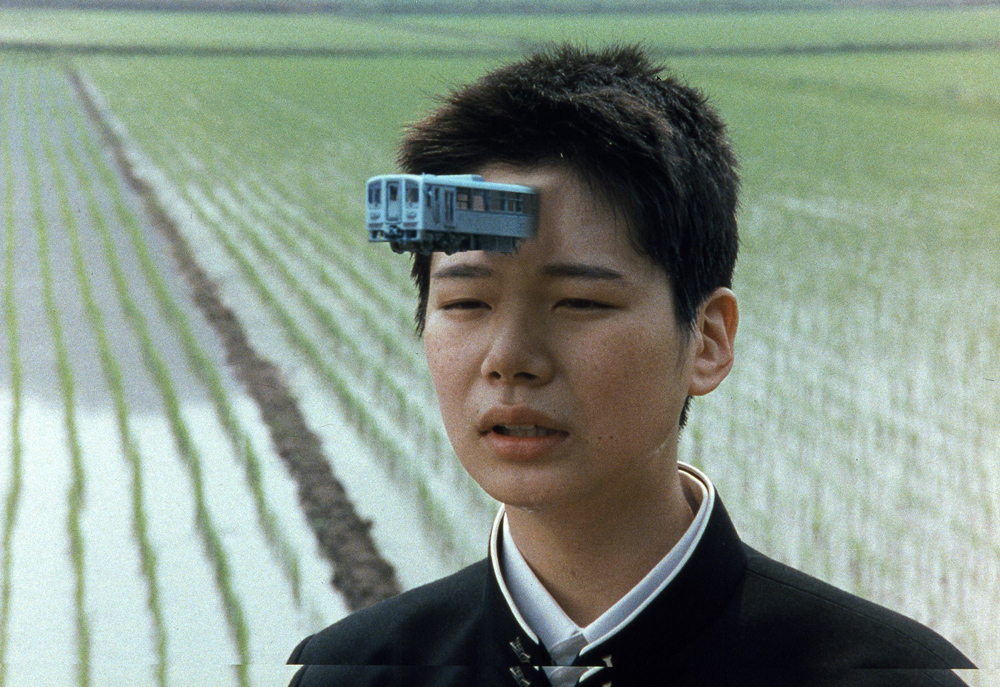

In a way, it could be said of “The Taste of Tea” started with “Kill Bill” for director Katsuhito Ishii, a surprising connective tissue when the former was far more likely to draw tears than blood. The director has said the experience of working with Quentin Tarantino to animate the memorable sequence charting the origin of the crime boss O-Ren, played by Lucy Liu, after the “Pulp Fiction” director caught Ishii’s film “Shark Skin Man and Peach Hip Girl” at the Hawaii Film Festival, allowed him to productively vent all the anger he had, leaving him without a single mean bone in his body. All that remained was his boundless creativity, which could help explain the enduring pull of his 2004 film that keeps its grip on anyone that saw it with its unforgettably surreal imagery yet continues to elude any description, very much fostering the same warm feelings of family and home that could be found in the films of Yasujirō Ozu, Hiroshi Shimizu or later Yoji Yamada but with something slightly more mischievous afoot.
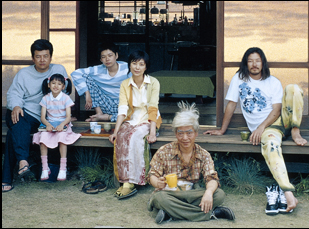
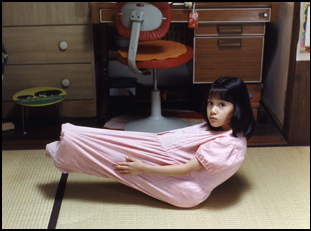
Not much would seem to be going on in the relatively quiet home of the family at the center of “The Taste of Tea,” living on the outskirts of town where it takes a bike ride down long and windy roads to get anywhere, but it’s the small things that are made to feel big in such an humble existence, starting with Sachiko (Maya Banno), a young girl who often can be found quite literally sitting in the shadow of her larger self, wondering whether there should be more going on in her life. If you didn’t know all in the family had artistic pursuits, the fact that Ishii makes their imaginations a tactile part of their lives certainly clues you in as the family matriarch Yoshiko (Satomi Tezuka) is an animator and her brother Ayano (Tadanobu Asano), who hangs around the house with the same amount of motivation as the eccentric grandfather Akira (Tatsuya Gashuin), actually is a music producer while the teenage Hajime applies his creativity to getting a girl he likes at school to acknowledge him. You would think that it’s a good thing that having a hypnotherapist in the house in father Nobuo, played by Tomokazu Miura, but even he has no control over the house.
While losing track of time may not be seen within the family as a positive that has to intensely think about themselves and their surroundings for entertainment, “The Taste of Tea” has all the charm of a lazy Sunday afternoon as it dips in and out of the family’s lives with modest obstacles that seem insurmountable with the way they’ve been built up in each of the characters’ heads and when Ishii’s has such an enormous imagination, the seemingly trivial travails can seem epic. After the director convened a shoot less with the idea that he’d be making his masterpiece than just gathering friends for a bit of fun, he can be pleased two decades later to find that the film continues to give so much joy to others and was recently restored and now revived in theaters with a theatrical run starting in New York this week from Film Movement. On the eve of its engagement at the Metrograph, Ishii spoke about his unconventional approach to live-action filmmaking from his roots as an animator, how a family really did come together for the film and what it’s like to revisit all these years later.
 You’ve said in the past about this film that you wanted to make something from the perspective of the audience rather than as a filmmaker. What precipitated that shift?
Yeah, the prior two films that I had made were very commercial and I’m very proud of those works, but I also see them as being quite calculated. Like you could understand where the emotional beats are meant to land and I could not forget the experience of making an independent film as my first film with just my friends. That story had to do with a young woman in university who was going up into the mountain to try to find some marijuana, and there she meets this suicidal boy. It was an experience that I couldn’t forget and I wanted to create, make a commercial film that had almost the feeling of working on an independent film.
With “The Taste of Tea,” I started storyboarding and I never wrote a script. So everything was based on these drawings that I had collected over time. I think that also contributes to me making a work that feels like it stands up to repeat viewings. My favorite scene is the scene where Tomoko Nakajima and Tadanobu Asano finally meet and they are sharing this bashful conversation with one another. I even worked on the music for that scene, so I really think that I wanted to make a film that I could watch over and over again and find new things about.
Clearly, that proves true now. When the idea came for the story, did you think of the family holistically or as individual characters that shared a home at first?
I thought of each individual character. Initially, I had started to collect stories about this idea of a grandfather trying to make his granddaughter laugh and I was drawing these storyboard ideas for all these little jokes that he could make. But then that became so fun that I thought about, “Okay, what does the rest of this family look like?” That’s when I started to expand this idea of the family. I knew that I wanted to cast Tadanobu Asano, so [I thought], “Where does he fit into the family and what can I do with him?” I also knew that in order to make the best use of his abilities, it was best to try to make his scene partners be amateurs, so I cast my friends who are total non-actors to be a character where they would have to fight with Asano. I knew that the more Asano had to struggle in his scenes, the funnier they would become. So it’s really just a mix-and-match approach to making the film.
 When you’ve worked in animation as well, are the practical limitations of what you can do in live-action filmmaking something you can embrace as a creative challenge or do they become frustrating when you could just draw something in the animation?
Typically I work on commercials to make my living and commercials you can shoot without a script. You start with the storyboard and you start with these drawings and you’re able to make it. And that process actually really suits my style of storytelling. But the problem is that when I’m working from storyboards, that means that the producer then has to write a script based on the storyboards and the drawings that I have provided. And once that translation happens, the script really doesn’t make any sense. Of course, if I’m writing the script, like for instance, for something like [the 2000 comedy] “Party 7,” it can make sense and and the opposite translation works very well. But I think it just suits my working style to work from drawings from the beginning.
Is it true you actually drew a location for the family home and asked your locations manager to match it?
I had actually drawn a map of where I wanted the film to take place and we were able to find a location that really matched the landscape. It happened to be in Tochiki, and I think this is what they mean when they say there’s an angel of cinema. It really felt like all of these miracles had to happen in order for me to find this place that exactly matched what I had drawn up.
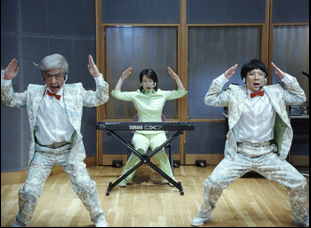 The music is such a great part of the film and eventually the grandfather gets to have quite a memorable performance of “Mountain Song.” Was it always in mind to have Ayano work in the music industry so you could have that aspect of the film or did it work the other way around?
I was really making up a lot of songs just through humming them, but I knew that song needed to end up in the film, so it was a bit of reverse engineering where I [thought], if it could be the characters that are writing the song, then that can make it, so it was very forced, but I put it in there.
What’s it like to revisit the film now all these years later, especially when you cast so many of your friends at the time?
It’s definitely something that lets me enjoy the film because I just think, “Oh my god, they’re all so young.” But I’m just very glad that I made that film and for so many people from various countries to be able to see this work and then give me their thoughts and and feedback around it just makes me very happy. I’m really glad that I made the choices that I made back then.
“The Taste of Tea” opens in New York on May 8th at the Metrograph and will screen at the Boston Japanese Film Festival on May 16th and open at the Gene Siskel Film Center in Chicago on June 26th and the UW Cinematheque in Madison, Wisconsin on July 22nd.