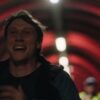





After a marathon session cracking the story for “Headcase,” it was probably the only time in Spencer Zimmerman’s life that he welcomed a splitting headache the next morning, only rather than experience it personally he knew he’d be leaving it all the page.
“We threw together a pitch in a single night,” Zimmerman recalls of the quick turnaround he and co-writer Pat Moonie pulled off after learning of a contest where they could execute a killer idea they had. “It was literally three or four hours of just hanging out and blasting out this idea and we submitted it, thinking nothing would come of it.”
Instead, Zimmerman finds himself on the precipice of making his debut feature after “Headcase” has already generated enough excitement ahead of the premiere of the initial short at Fantasia Fest in Montreal this weekend to begin development on a longer-form version. You can see why from the dark comedy why there’s interest in what the rest of a body might look like when you only get to see the head of Brad (Moonie), a hapless pedestrian who has the bad luck of crossing paths with Karen (Siobhan Connors), a would-be wellness influencer trying to set up for the perfect shot underneath an overpass who ends up gruesomely hitting him with her car. The blow should be deadly, but to both their surprise, it is not as Brad continues to talk through the situation even as the rest of his corpse lies elsewhere and Karen scrambles to determine what her responsibility is to Brad and how she can avoid arrest.
It’s peculiar for Karen to want to evade the spotlight when her main desire is to attract attention to her TikTok and Zimmerman and Moonie have put together a sharp satire revolving around a central character who wants to help others on their “mental health journeys” but finds herself on a most lonely path herself and her only company – Brad’s severed head – only makes her feel more isolated. Beyond having Moonie and Connors’ snappy rapport to sell the situation, “Headcase” also clearly benefits from the know-how Zimmerman gained from being a part of the Vancouver-based production company Oddfellows, which has helped shepherd such films as Osgood Perkins’ “The Monkey” and Sean Byrne’s “Dangerous Animals” to the screen in recent months, and while the film may run just over 15 minutes, it is clearly a big screen experience with a bold opening title sequence and striking visuals throughout. On the eve of its unveiling at Fantasia, Zimmerman graciously took the time to talk about how “Headcase” came together in a whirlwind, the film’s savvy use of practical effects and how a small role ended up playing a surprisingly larger one in the overall feeling of the film.
How did this come about?
It was a crazy, crazy ride that all started when my co-conspirator Pat came to me and [said], “Hey, I’ve got this crazy project.” He didn’t come with the script. He just came with the general pitch and [said] “Would you wanna do it?” And I [said], “I do, but I feel I got way too much going on right now.” And he [agreed] we shouldn’t do it, but both of us couldn’t get the idea out of our heads, so we decided, we have to go full tilt with this and we submitted [a pitch] to this film production program in Vancouver, Crazy 8s, just to see what would happen. Then before you knew it, we got into the next round, so we [thought], “Okay, I guess we have to get serious about it now.” We went to the next rounds of pitches and it just kept going well for us, so it was like, we absolutely have to make this movie now. We can’t turn away from it. The universe was drawing us into it.
When you had a relationship with Pat and Siobhan before, did you have an idea for what their dynamic could be in regards to this story?
Yeah, that was from the very beginning. We wanted to make something that they could both be in because Siobhan had been in a few other projects that I had done and she was fantastic to work with every time. She’s one of those actors that you can just throw anything at and she can just nail it, and Pat, I had been meaning to work with on a different project about a year or so prior and it just didn’t work out, so this was a perfect opportunity for all of us to do this together. They’re a real-life couple, so they’re very much this dynamic duo and they’re so, so talented and incredibly fun to hang out with. So we wrote the roles knowing who would be who, but that actually freed us up in a really awesome way because you didn’t have to write something and wonder “Can this person pull this off?” or “Are we pushing this too far?” Especially for Karen, it was super helpful to have Siobhan there and we knew we can do whatever and she’s here and she’s going to go for it to make it happen. She probably would have anyways, but because she was also a producer, there’s was an extra level of commitment to the project.
You also have this background in VFX, which I understand is used sparingly in comparison to what you could pull off practically. Did it help you figure this out?
Yeah, when we were pitching it, that was always something people had questions about — how are you pulling this head thing off? For me, I knew we were always going to do it mostly practically, because the effects wouldn’t have to be that crazy and we were going to use Pat’s real head for most of it and we’d have to do some stitching to make it look real, but that was something that I was always confident I could do. And I was a VFX artist for a long time, so I just knew no matter what, we would be able to pull this off. Logistically, it was a crazy shoot. We had to shoot the film on a really, really compressed timeline in three days and then it was edited completely in five days after that, so we had two-and-a-half days to do the actual editing and another two-and-a-half days to do the sound and the color and the visual effects. We had started the edit the moment we started shooting so that we could squeeze as much time out of that as possible and we could step into the editing period with a full cut of the movie ready to go. That gave us a huge advantage in getting it out in time.
There’s a great visual language to it with this fixed camera that can pivot. It seems like that could’ve saved time when it could lead to a minimal amount of set-ups, but it also really creates a great style – did those go hand-in-hand for you immediately?
Yeah, I love when the camera can be part of the joke. That shot where [Karen’s] crying and it’s really close on her face after she’s killed Brad, and then as you zoom out, you realize, “Oh, she’s actually making a video,” and then she kneels down, and you realize, “Oh, the head’s right there” – those moments of visual comedy are the things that I really, really love about filmmaking [where] performance and blocking and camera and sound can all like work together to make a really cool moment. I’m always trying to find ways of using the camera in an interesting way and I feel like more often than not, it involves one specific interesting placement rather than a bunch of different angles.
That bridge you film under is incredible visually. How did that location come to mind?
Initially, it was just supposed to happen in a forest, but when we started scouting, we [thought], “This feels super boring. This sucks.” And my cinematographer Gareth [said], “Dude, we have to do it on an overpass. I know the perfect overpass.” And it was this overpass where the SkyTrain and the highway and like a regular train pass by and it’s crazy, but it was impossible to film there. There was no way we were going to be able to get all of our equipment and people there, so that started like this crazy search for an overpass that would work for us. We spent two or three days just on Google Images, going through like every possible bridge and overpass in the lower mainland, [thinking], “Where can we shoot this? It has to have this gravity to realize like what’s going on [in the scene].” So we found this overpass in Maple Ridge. It’s the Golden Years Bridge that we’re shooting under, and when we got there, a lot of the overpasses have these really grassy areas [around them], or it can feel dry or industrial, but this place had this specific mossy texture that reminded us both so much of the movie “Stalker.” We got there and we [thought], “This has to be the space. We cannot shoot this anywhere else. We absolutely have to make this work.” And credit to our amazing location manager Brooke, we got to shoot there. That one shot where [Karen’s] underneath the bridge and the sun is striking at just the right time? It all worked out.
That might’ve been it, but was there anything that happened that took this in a direction you didn’t expect but could get excited about?
There’s always so much stuff coming at you that you’re always just doing like whack-a-mole of problem solving, trying to figure out how to get through it. One specific case where something just came up and it actually ended up really helping the story was we had this character of one of the police officers at the end of the movie, and there’s the one police officer that breaks in [to Karen’s house] and [says], “Freeze, freeze, freeze.” But the other ones are all basically extras, and I don’t know how this happened, but when we were casting the movie, the lines for the first police officer ended up going to everybody, so they all thought they were getting [to be] the main police officer. It was the night before that people found out that they weren’t actually getting that role, so there was a bit of a panic like, “Oh, I’m not going to do this if I don’t have lines.”
So the cop at the end who’s outside the door holding back all of the reporters, she [said], “Oh, I’m not gonna do it if I don’t have good lines.” And I [thought], “Fair enough. You’re coming out to do this movie as a volunteer, essentially,” so in the moment, I worked out these lines for her to do and created this role, so this extra moment got built out of this situation that I think actually really helped the movie. It gave like this extra beat there to reinforce how crazy the media was at the end, so as stressed out as I was in the moment, I’m happy that happened because it added this important moment for the movie.
You also have a role for Gigi Saul Guerrero, a great horror director in her own right, as someone that Karen goes to see for a job interview. How did that happen?
We knew that we wanted somebody to be like pretty formidable for the role of Julie because you wanted to meet her and just be like, “Oh, I know who that is,” and you could know the stakes behind this moment a little bit more. She’s not just some random person. And Gigi’s name initially came up from our casting director, but I had met her before in social settings because she had gone to Capilano University [in Vancouver] and so had I. And we’d known a lot of people in the same circle, so it was just a really great pairing, “Oh, Gigi would be fantastic for this.” And it worked out that she could come and do it and she did such a great job. I’m so happy she’s in the movie. It was another one of those serendipitous moments that she was able to do it on the day we had to shoot that scene.
What’s it like getting to this point with the movie and having it ready to share with audiences?
It’s such a treat. It’s such a rare thing to be able to make a movie like this that turns out exactly the way you were hoping for with all of your dear friends and collaborators. And to be able to take it to Fantasia, which feels like the perfect festival for it and premiere it in front of people who I know are going to understand it and hopefully embrace it warmly, and with so much of our cast and crew are coming to the screening itself, it feels amazing. I’m so happy and proud of our crew for putting their all into this movie and I’m so, so proud that we get to have a moment together and celebrate it.
“Headcase” will screen at Fantasia Fest as part of the Influencers shorts program on July 26th at 6:15 pm at Auditorium des diplomes de la SGWU.