

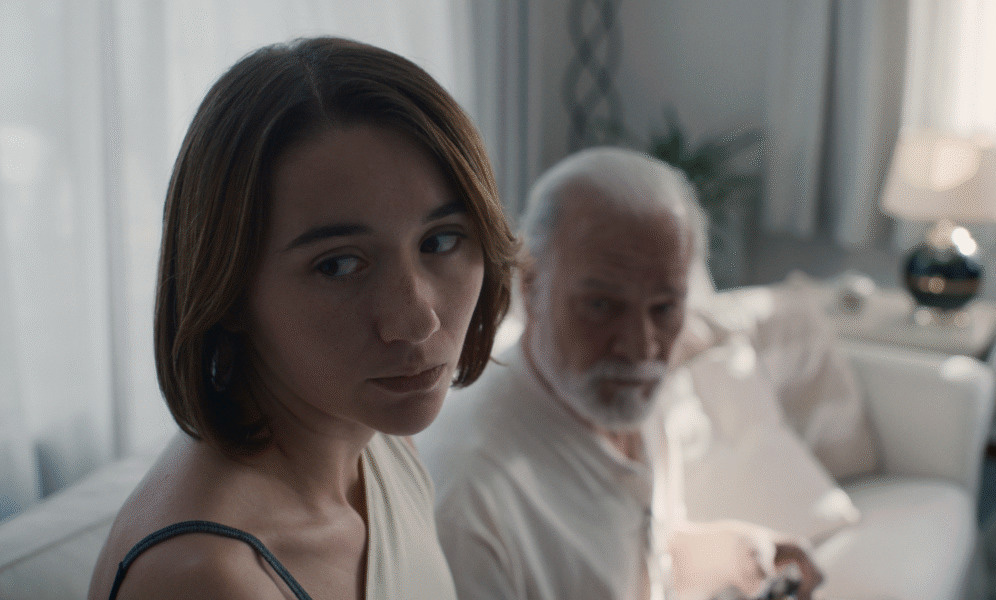

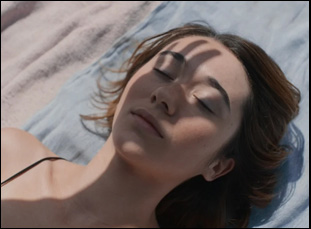
Lucia Aleñar Iglesias was looking for a very particular kind of light to enter the house of the grieving family at the center of “Forastera,” with the teenage Cata (Zoe Stein) and her slightly younger sister Eva (Martina Garcia) unexpectedly thrust into the position of caring for their grandfather Tomeu (Lluís Homar) over a summer their mother Pepa (Núria Prims) has sent them to spend in Mallorca, a time that was meant to be enjoyed for all the freedom that can be felt by the sea but suddenly looks a lot different after their beloved grandmother Catalina passes away. The sun continues to beam down when the world doesn’t change upon her death, but it can feel a little harsher to Cata at times when it doesn’t dim, being sure of what to make of it when it seems as if everything’s become a little darker yet somehow the light may also reflect her grandmother’s ongoing presence inside the house.
“I wanted to introduce this light in a very casual, more poetic way than perhaps a genre-driven way,” says Iglesias, who reinvents the ghost story in her beguiling debut feature. “It was more of an emotional compass for for the character, a way to kind of externalize what everybody is going through and the emotional journey of our main character.”
If the young Cata was expecting a vacation in the drama, at least she gets an out-of-body experience as she reluctantly takes on the responsibility of becoming a pillar to both her grandfather, who simply doesn’t know what to do with himself after Catalina’s death, and her sister, who is too young to entirely comprehend it, until her mother eventually returns from Madrid. It’s a role she is said to appear poised to play when so many relatives and friends will mention how much she looks like her grandmother, a compliment she doesn’t know how to take when she is taking strides towards becoming her own person out of her mother’s watchful eye for the first time and doesn’t exactly know how she can shoulder all that her namesake did, and this is what haunts her more, even though she starts to suspect that Catalina’s spirit has never left the house.
Iglesias, who was able to see Stein actually grow up in front of her eyes after first starring in her 2020 short of the same name, fashions a unique coming-of-age story as she sees Cata wondering what path to take as she starts following in her grandmother’s footsteps, whether she likes it or not, as she tries charting out her own direction, and clearly draws on her star’s own navigation of the same time in life to express the same stirring as the calm but constantly shifting sea right outside where she stays for the summer. Both the entrancing story and the rapturous locale make for an irresistible drama and following a premiere last fall at the Toronto Film Festival, “Forastera” is beginning its theatrical run in the U.S. and the director generously took time to talk about returning to her native Spain for the tale of adolescence, making the film a sensual experience and being playful with a subject that normally involves reserve.
 How did this come about?
It’s been a seven-year process of making this film and while it’s not autobiographical, it did begin with an experience I had after I lost my grandmother. This was many years ago and I kept getting these photographs of my grandmother when she was much younger sent by family members of mine, comparing me to this version of her and this projection. While it was a very moving gesture and beautiful, it was also very unsettling and I became very curious about this feeling of how we project our loved ones onto places, onto objects and onto other people and how that absence creates a lot of presence.
As I was thinking about this, it was very interesting because at any time I kept talking about what I was writing, I realized that it wasn’t an isolated experience. Many other people I knew had these ghostly encounters or projections having to do with losing a loved one, so I thought it was a very interesting context to play and to place a coming-of-age story in — to put a teenager in in this situation, sensing a comparison or a projection and actually being very curious about it in that moment in your teenage life where you’re looking for clues as to who you should be or what kind of hat you should try on. I was very interested in exploring that idea of identity through grief.
You had previously worked with Zoe Stein on your short. What was it like having that kind of foundation already moving to a feature?
Yeah, I feel very lucky to have been able to work with her on multiple projects. When you’re making your first feature, everything is so new and scary and to have someone leading the project that you already know and you’re comfortable with for me was a gift. Beyond that, for both of us to get to explore one character through multiple iterations and to give ourselves that time to revisit the idea and transform it too, because she’s playing a similar version in the short, we [could] rewrite and recreate and explore these same themes. It’s really cool.
When you give such a sense of place in Mallorca, was there anything that was really important for you to get across?
I was really interested in creating a world for the film. We certainly borrowed a lot from the place, but I really wanted to look at the world of this film through the eyes of a foreigner. The title of the film directly translates to “foreigner,” but on this island in Mallorca, the locals use it to refer to other Spaniards who come and and visit, so I wanted to really build a world through those eyes, through someone who has this very casual relationship with a place who maybe only spends a month or two there a year and isn’t completely rooted and [moving away] from these busy beaches or resorts to these sleepy towns, it was important for me to portray [all of that] but through that lens of someone who’s passing by who is not entirely involved.
The house itself holds so much memory. What was it like to find the right central location?
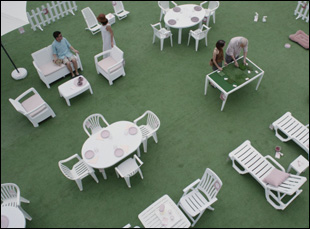
It was a process. We took quite a while to settle on it and I was very lucky to have the production designer and cinematographer be very involved in the scouting as well. I always wanted to have the sea as a backdrop, this idea of the waves not just to to hear it but to be able to see it. I didn’t know I would find a house like this though with the glass terrace or the railing. That was never written into the script. We just walked into it and [we thought], “Well, we can’t let this go.” It’s so impactful and it’s such a interesting place to put these characters. We spent quite a bit of time designing the interiors of the house as well, to make it seem both somewhat familiar and also off-kilter. It’s very a carefully curated color palette. Everything is matching. It has this timeless feeling, but also this postcard-like feeling where it doesn’t feel completely real. The characters are playing pretend, so I thought let’s play around with the world seeming a little bit strange and too good to be true.
 The dress that Catalina gets passed down from her grandmother really stands out in that environment – it’s got bright red dots. What went into selecting that?
We had to do a few iterations of it because we landed on the idea of it incorporating a kind of optical illusion in the prep process, a month or two before shooting. We didn’t want it to actually distort the image we were creating, so it took our costume designer Pau Aulí a few tries, [saying] “Okay, how big are these spots?” And “What can we get away with here that doesn’t actually distort the images?” I was very interested in creating a silhouette. It’s not even a dress, if I’m being honest. It’s like a pantsuit, and I wanted to create something that gave her a sense of power or an armor of sorts and for it to feel very unlike her costumes as a teenager. That really took us to a a different time, um, but also feels playful and not just old. I think that’s something that she’s attracted to, like there’s a story here. There’s a lot to to get from this dress and a curiosity about who who wore it.
The elasticity of time also becomes a really interesting element of the film and obviously that’s something you’re deciding in the edit to a degree as far as the rhythm, but when it seems like the camera is really patient, how much were you thinking about that up front?
We definitely thought about it and I followed my instinct with it, but in the story, this character is freezing time a little bit or or creating an alternate reality for herself, so it was interesting to do the same thing with the the camera and the way we were going to approach the scenes and create these very long shots, [very] wide that allows the viewer to wander in the scene. It does stretch time a little bit, and I think summer hours do that to us. This idea of being in a summer vacation very much feels like time stops, but so does grief. Everybody deals with it in a particular way and we were very interested in creating that [sense that] we’re not quite sure how much time has gone by here, and that’s okay.
Anything happen that changed your ideas of what this was?
One thing that really surprised me in in a beautiful way incorporating music into it and working with Anna von Hausswolff and Filip [Leyman], the musicians, later in the post-production process. While I always wanted to have a score in the film, I was really surprised in a positive way by what they brought to the story and this nostalgic quality that’s not heavy, but a little mysterious that I think really adds to it.
 The sound in general is a really evocative part of this. What was it like to work on the mix?
It was very exciting and I was not expecting how creative the sound design process actually was. I got to work with a team of women who brought so many ideas and added so much texture to the film. There’s so many details in the soundscape that are not just there by mistake. They’re real choices that they were making and we figured out how to weave in. There’s one particular example, whenever our protagonist Cata is in this game with her grandfather, they include this sound of an airplane going by, which is part of any soundscape, if you’re near an airport or a busy city where there’s a lot of travel, but it’s these weird details that if you only include them in [a specific context], you’re adding texture and creating meaning and and clueing the audience in to things that perhaps they’re not even aware is happening. It was a really cool part of the process.
What’s it been like sharing this with audiences so far?
It’s really special. To talk to people about how they’re how the film is reaching them is always surprising. Everybody walks in with a different idea and perspective and it’s really cool to connect with with a story like this and to share it is really special. I feel very grateful.
“Forastera” opens on May 29th in New York at Film Forum and Santa Barbara at the SBIFF Film Center, June 5th in Hudson, New York at Time and Space Limited and June 26th in Houston at the River Oaks Theatre.