




There are reminders everywhere that there’s always a border to cross in “Blue Heron,” from its arresting opening shot of a family settling into a new house on Vancouver Island from inside a moving truck to a scene that may not seem unusual on the surface as the film’s unnamed parents (Iringó Réti and Ádám Tompa) talk before their bedtime until the slightly strange realization that the camera is positioned outside their window like a voyeur. Ironically, nothing seems entirely off-limits for writer/director Sophy Romvari, who continues to show no fear in diving into tortured domestic situations, as she previously did her much beloved autobiographical short “Still Processing” where unearthing a box of pictures opened up the grief of losing two older brothers, yet she is able to illustrate boundaries of perception that the film’s characters may not recognize for themselves to breathtaking effect.
It’s not entirely clear whether the family’s move is fully prompted by the behavior of their eldest son Jeremy (Edik Beddoes), but “Blue Heron” begins with the hope of a fresh start as murmurs persist about the teenager who can’t help but stand out when he’s nearly a decade older than his next oldest sibling and his sandy-colored hair is markedly different than his two younger brothers Henry (Liam Serg) and Felix (Preston Drabble) and his younger sister Sasha (Eyul Guven). Their parents will hide their concerns in their native Hungarian so that their English-speaking kids won’t be able to understand, yet Jeremy’s troubles at school and erratic behavior can hardly be ignored and with a father glued to his computer for much of the day at work and his mother having three much younger kids to look after, Jeremy at once consumes so much of their energy and yet hardly gets the attention he needs.
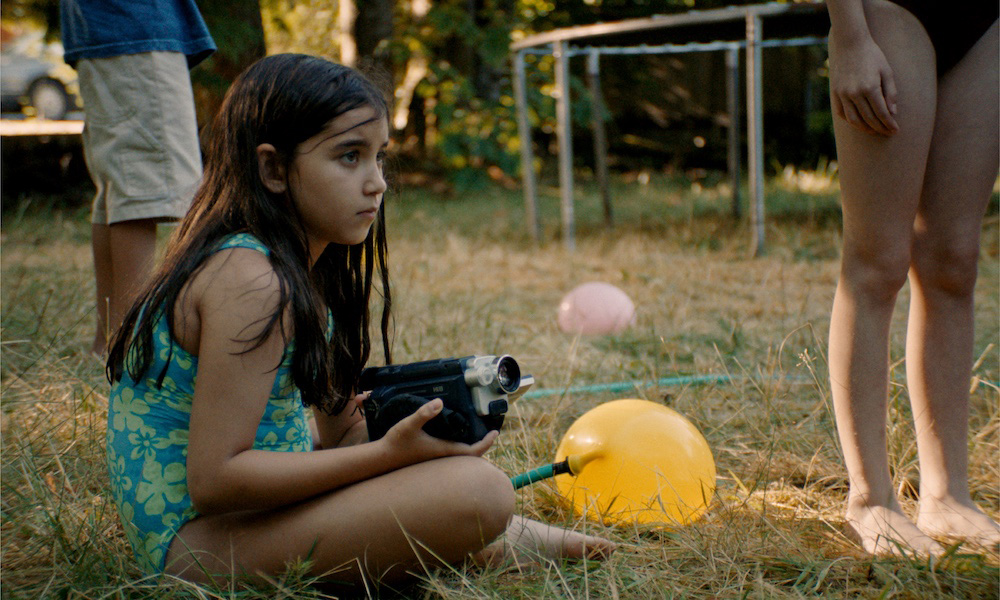
Jeremy’s constant perch on the outer edge of the periphery to note his status as an outcast and a constantly looming threat to the sanctity of the family runs the risk of presenting him as the monster that Romvari works so hard to avoid, but by taking him largely out of the action, the filmmaker shrewdly eludes showing the obvious effects of his outbursts and instead hones in on the psychic toll it takes on everyone within his family to care for someone so deeply without being properly equipped in any way to care for them. Ultimately, the film gravitates towards the point of view of Sasha, who quite literally doesn’t have the vocabulary yet to articulate the sense that something’s not entirely right despite her parents’ best efforts to present the change of scenery as positive and exciting, but clearly knows more than her age would suggest.
Given that Jeremy becomes a casualty of a rigid approach to his behavioral issues as it’s unlikely there was the medical terminology available for a proper diagnosis in the ‘90s when the film is initially set and even more of a reach that his middle class family would be able to afford anything more than general treatment, “Blue Heron” becomes unexpectedly moving when Romvari begins to break free of any expectations of what the narrative should be as Sasha tries to drill down how the situation could’ve been handled better. It actually sends a chill down the spine with how elegantly Romvari conveys that Sasha’s lack of a proper expression for her discontent carries over all the way into her twenties (played by Amy Zimmer) as the film leaps ahead to find that she has become a filmmaker and uses her position behind the camera to begin to investigate what the family may have overlooked when it came to Jeremy, convening a meeting with social workers and therapists to discuss his condition and contemplates a visit home. Although the former sequence comes across as nonfiction with educated guesses about Jeremy’s condition having the eerie authenticity of coming from real trained professionals, the latter bends towards the surreal when Sasha’s thoughts of the past are suddenly infected with the knowledge she has now, allowing her to walk back down memory lane to see the family dynamics anew.
The breakthrough that Sasha has seems like a larger one for cinema itself with how inventively Romvari stages it, and “Blue Heron” is reminiscent in many ways of the exhilarating early work of her Canadian compatriot Atom Egoyan in films such as “Family Viewing” and “Calendar” where film could close gaps of time, space and loved ones when both operate at a remove from a cultural heritage they clearly cherish (in Egoyan’s case, Armenia, and in Romvari’s, Hungary) and a home video can offer details vivid enough to step inside years apart from its making. When Romvari’s admiration for what a film can achieve on that front is clear, the fact she’s made something that would seem to welcome a return time and again with a fresh set of eyes comes across as the ultimate achievement.
“Blue Heron” will screen again at the Locarno Film Festival on August 9th at 3 pm at the L’Altra Sala and August 10th at 11 am at PalaCinema 2 and 3.