



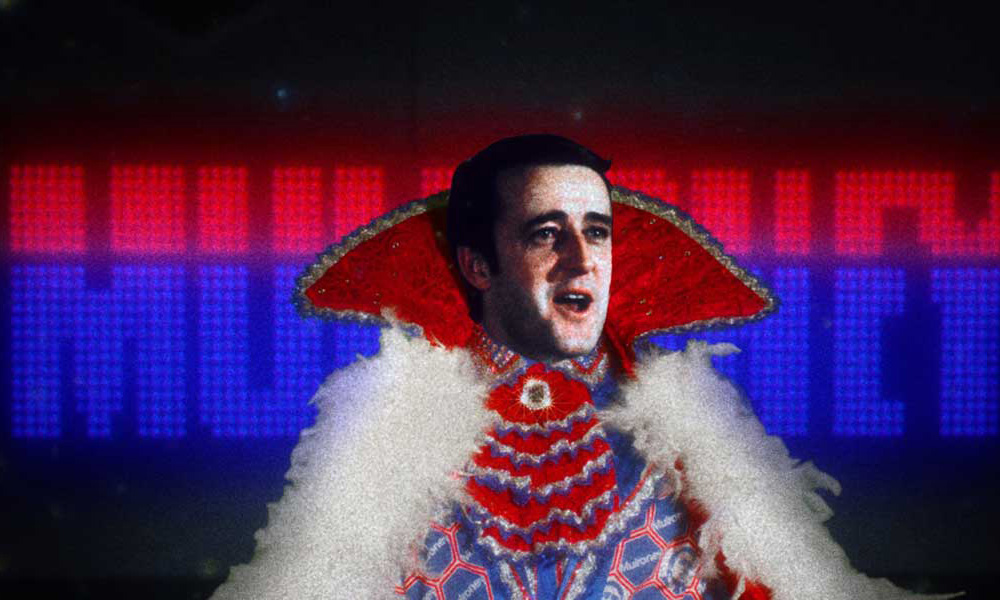

It’s especially nice to see the enduring power of public media in “Ladies and Gentlemen, Brian Mulroney” when the former prime minister of Canada is so quick to dismiss it, captured for posterity in an interview when he complains that government funding is going to “third-rate films that wouldn’t be shown in a basement” while tax breaks aren’t afforded to entrepreneurs. Mulroney presents himself as similarly salt of the earth, though there’s the sneaking suspicion that as he tells tales of learning his work ethic from his father who toiled away at a paper mill, he was a little more privileged than he lets on, shaping his worldview towards small government, and while he is the kind of politician made to be forgotten, a milquetoast man of the people who doesn’t want anyone to notice the ways he could enrich himself by holding office, the National Film Board of Canada logo at the start of Matthew Rankin’s gloriously unhinged, all-archival look at a key moment in Canadian politics appears to stand particularly tall to warn against history repeating itself when it’s been key to keeping a record.
Obviously appealing to Rankin’s home country first, “Ladies and Gentlemen, Brian Mulroney” can be enjoyed abroad when there aren’t many nations now that don’t have a Mulroney in their midst, bankrolled by businessmen interested in lax regulation and preaching national pride while being beholden to a small few. Though it was a cheeky programming choice by the team at TIFF to play it in the Midnight Madness section, the film may not be quite as gruesome as that might portend. Still, it is merciless when giving the former PM an introduction in a vampire’s cape, rising from a slim white coffin-like Ferrari, looking for any stolen moment to draw blood and Rankin cleverly pitches the story as if it were playing out on a VHS tape comprised of various episodes of different TV shows, complete with era-appropriate ads and interstitials from the 1970s and early 1980s as Mulroney himself cultivated a narrative that could capture the public’s imagination. (Galen Johnson’s graphic design work on the film is truly incredible as is the chameleonic score from Christophe Lamarche-Ledoux.) The treatment may be unconventional, but appropriate for a politician made for the television era such as Mulroney, compared at one point to Robert Redford and apt to speak in broad platitudes that effectively cover up the lack of detail behind them.
Mulroney had to bide his time in the Progressive Conservative Party, in which he had little internal support, and failed to secure a nomination to succeed John Diefenbaker, the standard bearer for the party as the only one to be elected as Prime Minister in 1957. Instead, he lurked in the shadows to keep the pressure on Joe Clark, who secured the party’s mantle as a more respectable policy wonk, yet had considerable less charisma and would never win over Quebec with his limited French. The film reminds of the great Albert Brooks line about William Hurt’s naive news anchor in “Broadcast News” that the devil isn’t likely to turn up with red horns and a pointy tail, and while Clark fumbles publicly time and again, Mulroney offers public support by claiming the two are friends when asked or helping with fundraising, but will undermine him with national speaking tours about what direction he thought the country should be moving in or add some cutting remark to words of encouragement otherwise. If he’s a monster in the making, Rankin isn’t shy about making him look like one in 16mm animation, lurching around a museum of famous Canadians at one point where he can literally pick their brains for guidance.
All the effort that’s put into raising the profile of Mulroney could seem like overkill if the ridiculous level of scrutiny didn’t become the point when so many like him can evade it as they make their way into government. Although there was clearly a stronger media contingent then than there is today to ask pressing questions as the film culls what seems like hundreds of interviews to present Mulroney and Clark in their own words, the lure of a catchphrase – Mulroney’s became “The Devil made him to do it,” during his 1984 run against John Turner, who got caught up in a scandal over appointments – still proves to be stronger than substantive reporting and the exaggerated style ironically unmasks what’s really being said and while trafficking in the same outrageous bids for attention that politicians do, “Ladies and Gentlemen, Brian Mulroney” provocatively provides an honest accounting of politics as the blood sport it really is to those that participate in it and the players capable of wreaking havoc on the public under a nice suit and tie.
“Ladies and Gentlemen, Brian Mulroney” will screen again at the Toronto Film Festival on September 19th at 9:45 am.