
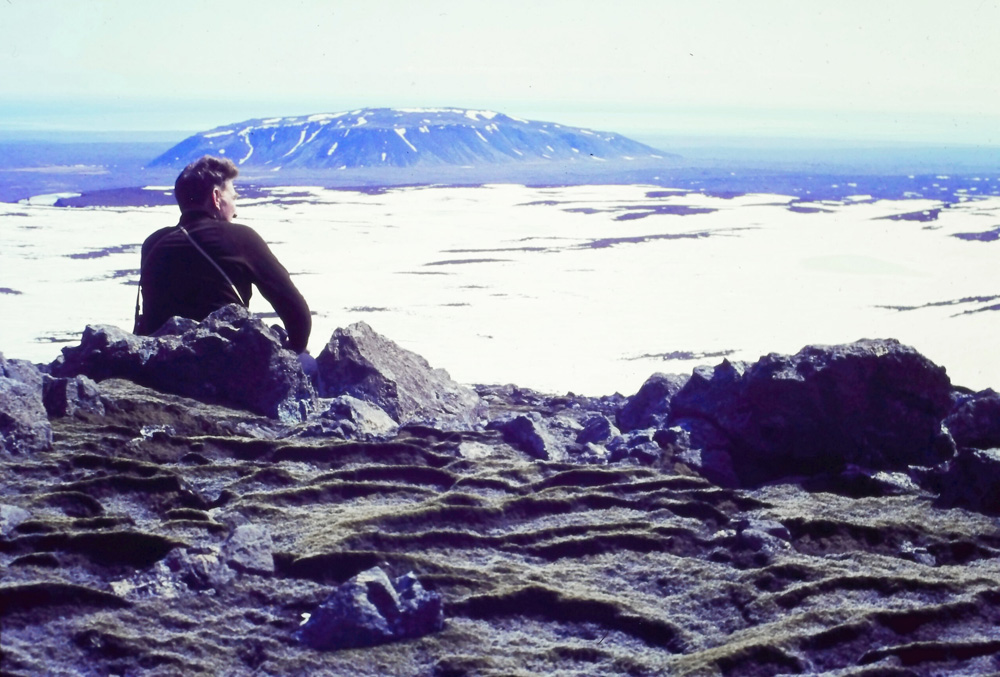

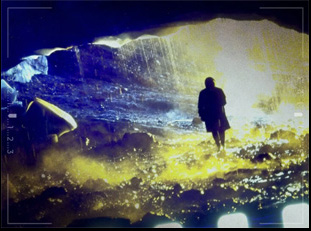
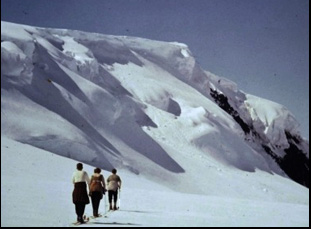
It’s telling that before a reel of film starts to unspool in “Time and Water” from the archives of Andri Snær Magnason, there is the sound of ice being chipped away at against a black screen as the introductory credits roll, with the process of excavation seemingly no different for an explorer of nature than someone rifling through the ephemera of family memories that has collected in their attic. They have long been intertwined in the life of Magnason, who is the descendant of a pair of glaciologists Hulda and Árni, both well-known in their native Iceland for when they scaled the daunting Vatnajökull glacier together and the former was the first female to fly a plane in the country, filming their adventures for posterity, and their grandson has kept up the spirit of their work as a celebrated author, penning nonfiction about the environment with such books as “Dreamland” while continuing to write children’s books and forays into science fiction.
The connection between the natural world and the human experience, however, becomes even more explicit in Sara Dosa’s magnificent documentary that finds Magnason faced with two impending losses, first as Okjökull, a glacier northeast of Reykjavik loses its designation as such given how much it has eroded, and the writer is tasked with writing a eulogy for a commemorative plaque to be installed in its place. The second is more intimate for Magnason as Hulda and Árni, still together after 70 years, are nearing their final days on this plain and as the latter’s memories have already started to wane with age, their grandson appears to be in a race against time to hold onto what he can in both a historical sense when they have information that could be so valuable to the generations to come and even a physical sense as well when they reverence that they hold for nature, seemingly lost over the years as the earth has been taken for granted, could be key to preserving what’s left.
“Time and Water” could’ve been interpreted as a tragedy when everything seems to be slipping through Magnason’s fingers like sand in an hourglass, particularly when his grandparents once told him of their own work extracting samples from the glaciers to see how much history they hold on their own that “to hold an ice core is to hold the earth’s memories in your hand.” Yet Dosa, who over the course of four films has shown an unparalleled ability to acknowledge dire situations while finding the humanity in them to still suggest there’s hope, sees Magnason’s efforts not as desperate or exasperated, but in the same intrepid spirit that carried Hulda and Árni up mountains that were thought to be insurmountable. As such, Magnason’s dive into both his own personal history and that of Iceland as a whole feels much more like a sprint, practically exploding off the screen as he makes connections between the place he was raised and how it shaped him and generations of his family.
For those who have been following Dosa, it is a special delight when the Hulda and Árni can be heard talking about the elves that were the “unseen” stars of the director’s second feature “The Seer and the Unseen,” which channeled the belief in the local legend of a diminutive secondary population living in Iceland into activism to protect the land that they shared with their human counterparts, and realize that she has been on a quest every bit as arduous and ultimately rewarding with the accumulating power of her films, tying together science, culture and the capacity for human ingenuity and passion that has brought the usually abstract concepts all within reach of one another and to an audience. One of the best working filmmakers today, it truly was an honor to get to talk to Dosa about how she cracked the code on adapting Magnason’s 2019 book “Of Time and Water” to the screen, going deeper with a team that worked together so well on the Oscar-nominated “Fire of Love” and playing the long game.
How’d this all come together?
I read an article in the Guardian just before COVID hit that was entitled, “How Do You Say Goodbye to a Glacier” that Andri had written and that just struck me as such a profound question to ask. I felt like it articulated this feeling that so many people, including myself, are experiencing right now, witnessing these paradigmatic changes in our landscapes and our relationship to home. Andri is a writer whose work has meant a lot to me through the years. I got to know him on my film “The Seer and the Unseen,” which he consulted on. And since then I’ve hungrily read all of his books, so I was primed to be really excited to read this article and I reached out to him about maybe turning that article into a film. But then COVID hit and he ended up finishing the book he was working on called “On Time and Water,” and I instead worked on “Fire of Love” because it was an archival film and it didn’t need any new production. But when we surfaced out of the pandemic, we each had finished these two different projects, and the time was right for him to then share his family archives with me after I had just done an archival project and for me to read his book.
This has all that archival woven in so elegantly – was it helpful to have arrived at this after making “Fire of Love”?
There was a lot in terms of the process of making “Fire of Love” that we took into the making of “Time and Water,” especially the dance between narration and archival editing. There was also a lot of themes in “Fire of Love” that couldn’t quite find a home or are just sprinkled throughout that we got to explore much more deeply in “Time and Water,” so I think of the films as kind of siblings. I’m really grateful for the experience of “Fire of Love,” and of course the further bonding with my amazing team, many of whom worked on “Time and Water” as well.
When the crux of the idea came from the glacier, was Andri’s family immediately part of that package?
The first real inspiration for me was that idea of the funeral for the glacier that was in the 2019 article that I read, so that was always going to be a North Star for the way the story unfolded. Then, of course, there’s many other things that we were contending with when you’re met with such an incredible trove of archives — not just personal archives, but historical Icelandic archives — and the new shooting that we did. We were always guided by the fact that we wanted to follow Andri in grappling with this journey of how how do you write a eulogy for a glacier, but also that’s not the most active plot, so we had to figure out different structural shapes that could make the film feel like it was flowing in a way that spoke to the themes of both time and and water as well as the cycles and the rímur — the folk music that that we talk about in the film — as well.
What was it like to find out there were actual hymns like that you could use from the national archives as part of Andri’s work there?
Andri’s work in the archive was definitely a catalytic moment for us in the edit room and the discovery of the rímur a big part of Andri’s own book, “Time and Water.” Once we started to listen to them, we were so captivated and haunted by them. They have this haunting and beautiful feel that’s ghostly and almost of the earth all at once. So there was something in terms of the feel that felt really right for us. But we were really inspired by this idea that this was an art form passed down through the generations that was nearly lost, but then refound and now through our film is transmitted out into the future once again. That became a structuring device actually for us — how to find cycles, echoes, and rhymes within the film itself, using one phrase earlier in the film, coming back to it later, and planting the seed of another idea here, coming back to it. We were really trying to work with the structure of the rímur itself, the repetition, as a guide for our own storytelling.
I’ve heard you’ve been a big fan of Dan Deacon for a long time, but this was your first time working with him. What was it like putting the score on this?
Dan’s amazing. He has this incredible ability to communicate the majesty and the power of a landscape such as Iceland through music and translate things in this way that it becomes magical and not too emotional to where you feel like the music is telling you what to think, but instead he’s able to guide you into connecting with your own emotions. He’s such a talented musician that brings such energy and and a joy and multifacetedness into the music he writes. He also really worked with the rímur to make sure that there were some melodies of the rímur inside his original score, so he was really thinking about the film on a very deep level, doing things in step with the themes and the ultimate message that we wanted to impart to audiences.
In general, the sound in this film is incredible, particularly when you’ve got this crackling of the ice bubbles in the glacier that really come alive. What was it like building that from capturing it on the ground to mixing it right?
Yeah, I really love working with sound, as do my editors Erin Casper, Jocelyne Chaput and Mark Harrison and as we were really talking about the character of glaciers, it was so important that the glaciers felt visceral and alive because feeling the life of a glacier is essential to understanding and thus mourning the death of a glacier. Sound can do that in such interesting ways. We worked with an incredible sound team, led by our sound designer and re-recording mixer Björn Viktorsson, and we also had a glacial sound advisor, a scholar named Konstantine Vlasis, who has really helped tell us about what he calls “the sonic life of glaciers,” so getting to work with people whose expertise is so deep really helped us to shape the character of glaciers in a way where I really hope you can feel not just their aliveness, but also a kinship. We’re not trying to anthropomorphize glaciers, but we’re trying to show that even this abiotic landscape has a life force to it and that the flow is being so radically interrupted.
 I’ve always been amazed at how your films feel like explosions, not in a sonic sense, but you have a core story that you want to tell and you tell just enough of it in every direction that it it works perfectly. But listening to the stories about Hulda, for just one example, I was thinking, you could have made a movie about her. Was it difficult to contain this one?
Yeah, it was very challenging to figure out what the narrative shape would be because we were met with so much richness of story and such incredible characters in Andri’s family, Andri himself, Andri’s writings, the history of Iceland, the science of glaciers and the enormity of the climate crisis. There was really a lot for us to contend with. But working with my incredible team, we realized that to actually create a literal container — being the time capsule framework for the film — would allow us to have a more unconventional structure that perhaps could feel more like a flow because there is this very firm, literal capsule around the film. So having that speculative framework applied gave us some structural freedom, and that epistolary voice of Andri narrating to future descendants who he will never meet helped too to guide this flow of the film and allowed us to move around a bit. But it was really challenging. Sometimes we would have too much science and the film would slow down and [an audience would be] unable to take in what came next, and the same thing would happen if there was too much on one character. Getting the ingredients right took some time, but I’m really grateful again for my my team and and for the process we had in order to to find the the balance that made sense for us.
At what point did you actually involve Andri in the narration? I imagine you didn’t save it until close to the end as is often the case.
Andri was involved in in the narration from the beginning. We always knew, in collaboration with him, that this would be narrated from his first person perspective. We wanted the film to feel so intimate, it could be this invitation for other people to bring in their own stories of their own families and their own landscapes that they call home. So it was a very collaborative writing process between myself, Erin, Jocelyn, and Andri, and very iterative as well. We were in our second rough cut before we started actually working with his voice, and that was just a workflow thing because we’re all in different locations and Andri is a very in-demand writer, so he was in Sweden or Denmark or Italy or just on a lecture tour, so it wasn’t always possible to get his audio recordings worked into the film. But Andri was, of course, saw every single cut and we were WhatsApping all the time with questions to make sure that the writing and that his voice felt like him and once we [added it to the film], it created a completely different feel for the rhythms of the film itself and helped us shape the film much more specifically once we brought in his actual voice.
That may have been it, but was there anything that changed your ideas of what this was or take it in a direction you didn’t expect?
The time capsule framework for the film came about in the middle of the edit, [which] was a new evolution for us that really unlocked a lot because before the narration, Andri [was speaking in] direct address, but we were like, “Who is he talking to? And how can we make his narration feel all the more personal? So having this idea that he’s speaking to his future descendants in a way that echoed what he wrote on the plaque [for the dying glacier] — because he’s addressing a very specific you in the future on the plaque — that realization helped us to really unlock the cadence of the narration itself and how it could work with the edit more specifically to draw in this feeling of intimacy. That was a big breakthrough, as was trying to situate the film within the present tense.
A lot of the film beforehand was written in the past tense, but I remember there was this one day when we were like, “What if we put the entire film in the present tense?” It was a big change, but it made the film feel a lot more intimate and immediate and helped to emphasize this theme of time travel more fully because If everything was the present, we could then jump into different timescales and time spans. It wasn’t until we were really in the depths of working with all that footage and in these collaborative conversations that we came to those key structural decisions and stitching together this collage film.
It came out so magnificently. What’s it been like to share with audiences so far from Sundance on?
It’s been an incredible journey since Sundance until now. So many people come up to me or to Andri or other members of our team wanting to talk about their own parents or grandparents and it seems to be eliciting memories for people that they feel really compelled to share and that really means a lot to me. I think for some people, the film is a way to understand glaciers. They previously just thought of glaciers as a block of ice on a distant mountain and it’s been really satisfying to hear people say, “Wow, I never thought glaciers were like alive like that or could move.” People getting to be in touch with where they come from, what’s at stake for them amid the violence of the climate crisis, as well as how to really feel and care for glacier themselves, that means the world to me. And I’m just really thrilled that audiences get to meet Andri and his family. They’ve been such a source of inspiration for me, so I love that more people get to meet them and that their memories can continue to live on.
“Time and Water” is now in theaters.