
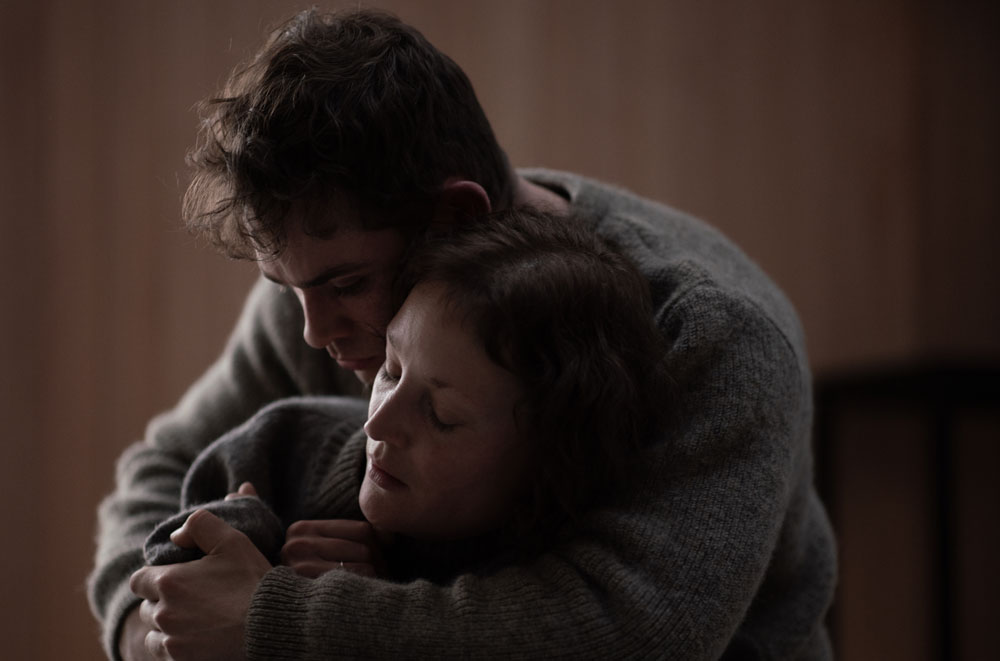

Jack (Dacre Montgomery) is an unwanted guest at the funeral of his mother Elizabeth in “Went Up the Hill,” not necessarily because he had a bad relationship with her, but can’t really say he had one at all as she distanced herself from nearly everyone in her life, practicing her art at a lakeside home where only her wife Jill (Krieps) wasn’t kept at a remove. Both find themselves on the outside looking in after Elizabeth took her own life, though that is the only connection they have when Elizabeth never mentioned she had a son and as opposed to other guests at the funeral who feel as if they’re respecting the deceased wishes by keeping Jack away, Jill can’t help but be curious about the last remaining blood relative of her lover, allowing him to stay in the cavernous house that Elizabeth has afforded that she no longer feels at home at.
After the memorial is over, Jack and Jill may be the only two left on the property, but that doesn’t mean they’re alone in Samuel Van Grinsven’s unsettling supernatural drama and when the filmmaker mischievously made one kind of ghost story with his debut feature “Sequin in a Blue Room” in which a sexually promiscuous teen would be a disappearing act to those he shared a bed with out of self-protection, he finds a novel way to embark on another actually involving spirits of the dead when Elizabeth doesn’t only linger as some abstract memory or even an apparition, but begins to manifest herself into the behavior of the two people with the strongest associations to her.
The notion that Elizabeth resides inside of them in different ways allows for the two to mourn together at the same time they recognize how there was another side of her they could never know and start to yearn to discover. While the occasion is naturally grim taking place in the dead of winter, Van Grinsven playfully oversees two chameleonic actors in Krieps and Montgomery chase answers both in conversation as well as in physical contact when they realize they can commune with the dead in conversation with one another, roving from one corner of the house to the other as Elizabeth’s soul bounces between them, too elusive to get a real handle on, yet also ever present and all encompassing.
Frankly, the gambit shouldn’t work, but Krieps and Montgomery bring Elizabeth to life as much as the specific characters they play with subtle shifts to suggest the other person in the room and Van Grinsven shows in just his second film a real command over the frame and the film’s unusual tone that honors how wily grief can be. In the year after it premiered at the Toronto Film Festival where Krieps introduced the film with a song she wrote specifically for it – a sign of the investment both actors put into the work when Montgomery wrote poetry inspired by his character and the two bonded over finding their characters’ specific scent with perfume – “Went Up the Hill” has haunted audiences around the world and finally arrives on U.S. shores this week and Van Grinsven graciously took the time to talk about how he extrapolated the story for his second feature from a single image, allowing his cast to take ownership over their characters and finding the film’s otherworldly central location.
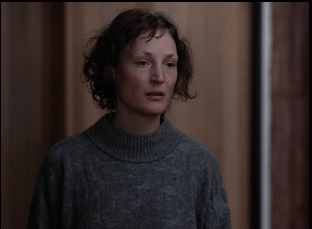 From what I understand, this all started with a single image. How did it grow from there?
Yeah, I always start with images. I’m visual and color is where story starts for me, and then I’m a queer filmmaker and I knew I wanted to play around with ideas of the maternal or the absence of a family figure from a queer perspective, the way in which we actively try to fill that void or that figure that we feel that we’ve lost or aspire to have back and the void in which that creates. That’s the wound, but I was interested in the idea that often people feel the wound so much they’re blind to people who come along in their lives who have filled that absence for them or are wanting to. That became quite important to me of two strangers becoming what the other needs them to be to fill a void and where the thematic heart of the film came from.
You make it sound so easy there, but what does it take to crack this character of Elizabeth, who is quite a presence in the film, but not a physical character exactly?
I’m making it sound easy because it’s been nine months. [laughs] It was challenging every step of the way, probably the greatest I’ve had so far from a screenwriting perspective with my co-writer because it’s elusive. It is a very visual thing and conveying that on paper was quite difficult. Also from a language perspective, specifically with dialogue, this I think will be the most challenging thing I’ve worked on because we created a character who is not a side character. [Elizabeth] is the third part of this three-hander who can only speak if asked a question and having five-page dialogue scenes that revolve around only being able to respond to a question is incredibly tough to write, so it was challenging on that front, but then also on a performance front, finding the cast who were daring and curious enough to play two roles, it was tough, but it was a challenge in a great way. Yeah, why make something easy?
You’re rewarded for it. And you’ve said Vicky and Dacre brought a lot to the characters. What was it like to get them involved?
It was brilliant. They come from very different backgrounds of performance and schools of acting, but they’re actually quite similar in a lot of ways and I learned so much from each of them. What they have in common is that they both throw themselves at everything completely. They’re right in the corner with you making the film and a big part of this film is that these two characters start as absolute strangers to each other and because they’re using each other’s bodies to talk to this third character [of Elizabeth], they actually remain strangers for a large portion of the film and what I liked about bringing Vicky and Dacre on specifically is that I think because on paper they feel like vastly different actors and from quite different backgrounds. They don’t bring any sort of audience expectation or preconceived idea of a relationship to the screen and therefore they get to feel and remain like strangers on screen. That was very exciting to me.
Once you get them in the room and you start seeing dynamics, is there anything that happens that changes your ideas of what this is takes it in a direction you didn’t expect?
Constantly, and Dacre and Vicky are the perfect two actors for that to happen. I always try and stay as open as I can to [the film] being completely different from what I expected. When it’s different what you expected, it’s often better. You have to be the anchor of the film [as a director], but I always want to be challenged and provoked and the two of them do that. When you’re working with two actors who were as connected to the material as they were, it just meant that we could strip things back a lot. For the presentation of this third character, there’s no VFX, no prosthetics or no costume that creates this ghost character. It is purely two actors very different in gender, accent, background, age, just creating a shared character.
And then there were scenes where I’d walk in to catch up with Vicky in the morning in her dressing room before we shot a scene and she’d turn around and be like, “I had an epiphany. There should be no dialogue in this scene,” and you just run with it because she’s as alive to it as I am and how much it’s changing day to day. She’s in complete control of her character, and that’s one of my favorite scenes in the film [now] where she throws a tantrum after walking inside the house. It was never in the screenplay, and her character [originally] explained more how she felt as opposed to showing us how she felt. There were multiple moments like that where Vicky was able to just take it to another level because she challenges you in the best way.
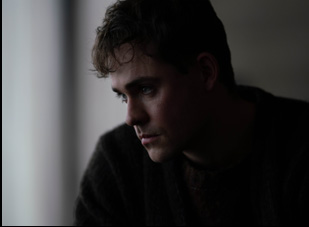 Dating back to “Sequin in a Blue Room,” you really have an eye for composition where you can simultaneously feel a character’s isolation but also that there is a weight in the negative space. What’s it like for you to go about blocking a scene?
It’s not easy. I work in a very specific way with camera and I love stillness of frame — locked off, no camera movement, very precise lighting. I can be quite strict about that side of things, and it’s a film about control, so I want them to feel constantly like the frame is controlled, but what I’m trying to do on set is still make it feel like a playground for the actors within that. So blocking your scene is constantly trying to find the push and pull of that, retaining the language and the style of the film but not completely box my actors in where they feel like they can’t move or explore or experiment. A lot of the time, I strip the set clean and I ask everyone to leave except for the actors and me and I just hear their instincts and get them to freely move around before the cameras there and we have the pressures of time. I know how I want to shoot the scene [before that], but I start reapplying those conventions to that and to try and create a balance. But it’s tough.
This house is a remarkable location and from what I understand, you actually wrote with something in mind, but not necessarily this specifically. Was there much of an adaptation?
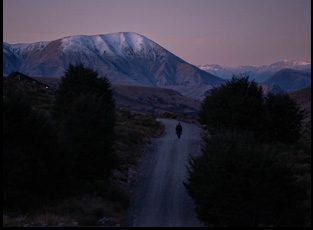
It took ages to find the house, which was surprising to me in a lot of ways because I’m from New Zealand and New Zealand has quite amazing architecture, especially home architecture because of the incredible landscape. There’s a quite a lot of beautiful modern homes that are nestled in and really embrace the landscape and we just could not find this house. Then it turned out we were looking in the wrong part of New Zealand. [This house] was actually an hour-and-a-half from where I was born, in a modern, almost brutalist architectural style that was on top of a hill overlooking a lake, completely isolated with nothing around it for miles. As soon as I heard all of those bits, I [thought], “Oh my God, that sounds amazing.”
But then when I walked in, it was beyond surreal because the actual geography of the house was so close to what we had written in the screenplay. The way in which there were two bedrooms next to each other, a hallway that weaved around to this large living room, and that there was a work and office space [too] and it all had the same view of this lake. It was extremely creepy. It had the color palette that I had always imagined. So we were incredibly lucky and it was also tough in the sense that [the experience mirrored] what the characters are going through by being contained to this extremely isolated, cold and dominating structure that we as cast and crew ended up going through. Architecture like that in a landscape like that, there’s no way it doesn’t end up infecting the process and having an impact on you.
 You breathe life into it, almost in a literal way with the score where respiration becomes a percussive element. What was it like to put music on this?
It was awesome. I got to work with Hanan Townshend, who I was familiar with because he was from New Zealand, but lives in Austin, Texas because he works with Terrence Malick, and it was an absolute joy. I always love working with music and score as early as possible. I start doing sketches with my composer well before pre-production because I love to share them with cast and crew as an extension of being able to explain tone and feeling to them and for us to all get on the same boat of what the film will feel like to an audience in the end. Coupled with that, Vicky Krieps writes a song for every character that she plays, and she played it for me on set, and then we put that in the film and getting to work with her and have her write an original song was just like one of the greatest moments as a director I’ve ever had. So this film, more than my previous film, had such a connection to music as a way of expanding the world.
What’s it been like to get this out into the world?
It’s been amazing. I’m in Melbourne right now, about to have my final festival screening tonight and it’s the last before we go to cinemas and I love experiencing it with different crowds because the way it plays in Luxembourg, Vicky Krieps’ home city, and it has a Luxembourg-ish scene in it in her language, that felt differently there and then sometimes we play for like a really young crowd that have discovered the film through Dacre’s connection to “Stranger Things” and that’s a really different energy. Sometimes we play in a small town in New Zealand and it’s really really cold outside and that has a different feeling. I love it. You get to see the film acting like a muscle and reacting to different things.
“Went Up the Hill” opens in select theaters across on August 15th. A full list of cities is here.